OpenCode is evolving AI-assisted development with flexible LLM selection, agent modes, tools, and planning workflows. Learn how its new approach could change AI coding.
AI coding tools are rapidly moving beyond simple autocomplete and code generation. Instead of only suggesting the next line of code, modern AI coding agents can understand an entire repository, analyse problems, modify files, execute commands, and help developers complete multi-step software projects.
One of the tools pushing this shift is OpenCode, an open-source AI coding agent designed primarily around terminal-based development. It is also available through desktop and IDE integrations.
What makes OpenCode particularly interesting is its flexible approach to LLMs, agents, tools, and modes. Developers are not locked into a single AI model. They can connect different providers, select models, create specialised agents, and control what those agents are allowed to do.
This is creating a new kind of AI coding workflow where the developer chooses not only what model to use but also how that model should behave.
What Is OpenCode?
OpenCode is an open-source AI coding agent that works directly with a developer’s project. Unlike a traditional chatbot, it can interact with the codebase and use development tools.
Depending on its permissions, OpenCode can read files, edit code, search through a repository, execute shell commands, use web resources, and work with other tools.
This makes OpenCode closer to an AI software-engineering agent than a conventional coding assistant.
A developer can start OpenCode inside a project and ask it to perform tasks such as:
- Analyse an existing codebase
- Find and fix bugs
- Build a new feature
- Refactor outdated code
- Create tests
- Explain unfamiliar code
- Review a pull request
- Research dependencies
- Execute development commands
The important difference is that the AI can work through multiple steps instead of simply returning a block of code.
The New LLM Workflow
The biggest advantage of OpenCode’s architecture is that the LLM and the coding agent are not the same thing.
OpenCode can work with different LLM providers, allowing developers to select models based on their requirements. Its model catalogue is built from provider integrations and configuration, and models can be switched during a session.
This means developers can potentially use:
A powerful reasoning model for architecture and difficult problems.
A fast model for simple coding tasks.
A cheaper model for routine modifications.
A local model when privacy or offline development matters.
This model flexibility is becoming increasingly important as the AI coding market expands.
Instead of asking, “Which AI coding tool should I use?”, developers can increasingly ask:
“Which model should handle this particular task?”
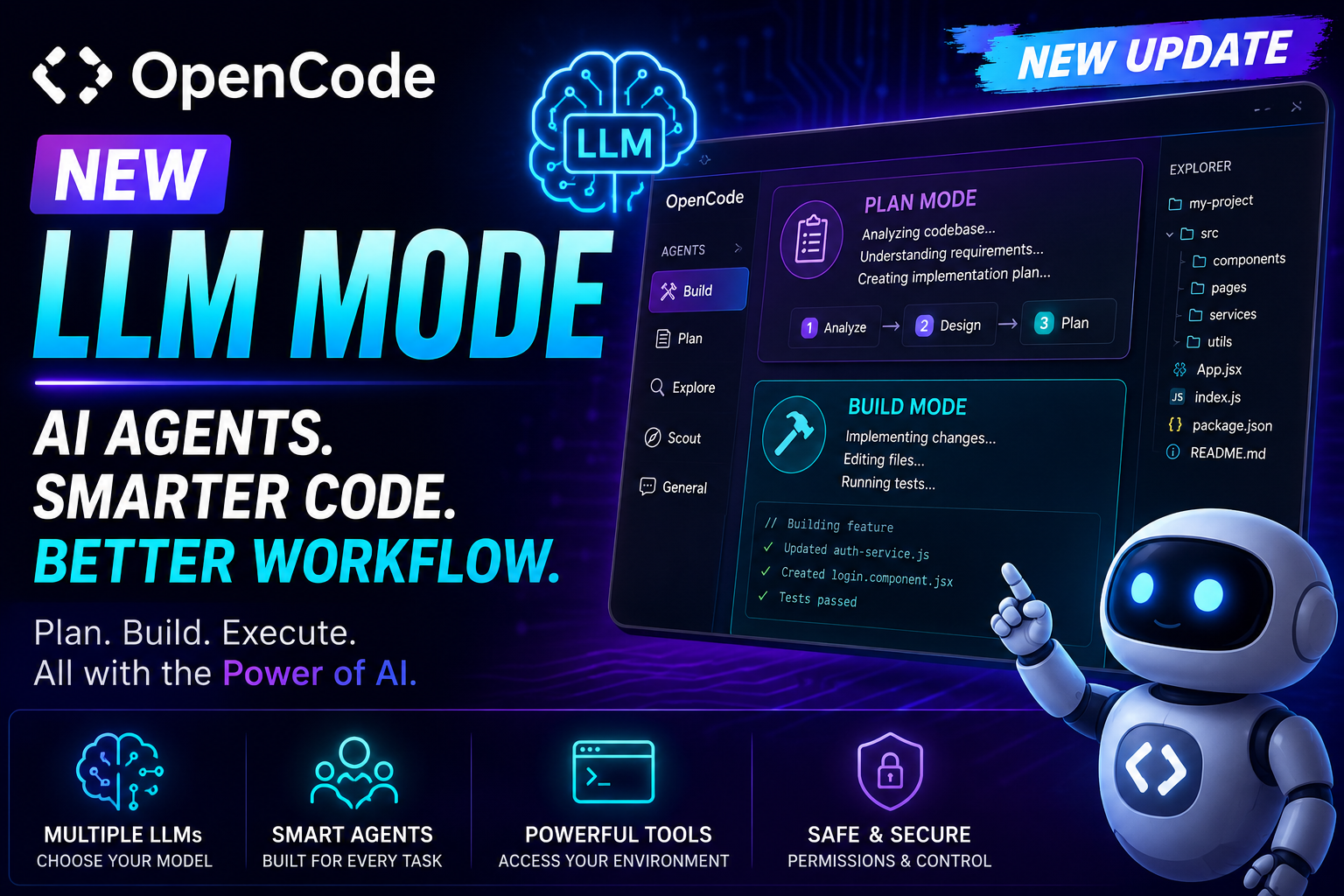
Build Mode vs Plan Mode
OpenCode’s agent architecture introduces an important distinction between planning and implementation.
The default build agent is designed for development work and has access to the tools required for modifying projects. The plan agent is more restricted and focuses on analysing code and preparing changes without immediately modifying the project.
This creates a workflow similar to having two software engineers.
Step 1: Plan
The AI examines the repository, understands the existing architecture, identifies the files that need modification, and proposes an approach.
Step 2: Build
Once the approach is understood, the developer can move into implementation and allow the AI to modify files and execute development commands.
This separation can reduce accidental changes and make AI-assisted development more controlled.
Why This Matters
Imagine that a developer says:
“Add authentication to my MERN application.”
A basic AI assistant might generate a login component and some backend code.
An agentic system can approach the task differently.
It can inspect the project structure, identify the frontend and backend, examine existing authentication-related code, determine where database models belong, plan the required changes, implement them, run commands, and potentially test the result.
That is a much larger jump than traditional code completion.
Multiple Agents for Different Jobs
OpenCode also supports specialised agents.
Its documentation currently describes primary agents such as Build and Plan, alongside subagents including General, Explore, and Scout.
Each can have a different role.
For example:
Explore Agent → Search and understand the codebase.
Plan Agent → Design the implementation.
Build Agent → Modify the project.
Scout Agent → Research external documentation and dependencies.
General Agent → Handle broader multi-step tasks.
This resembles a small AI development team working around the same project.
Model + Agent + Tools
The real power of the new workflow comes from combining three components:
1. LLM
The model provides reasoning and code-generation capabilities.
2. Agent
The agent determines the role and workflow of the model.
3. Tools
Tools allow the model to interact with the real development environment.
OpenCode provides built-in tools and also allows developers to extend its capabilities with custom tools and MCP servers.
Developers can also control tool permissions. For example, an AI could be allowed to read files but require approval before executing shell commands or editing important files.
That permission layer is particularly important for autonomous AI development.
Local LLMs Are Also Becoming Important
Another major advantage of OpenCode is its provider flexibility.
Developers can connect different LLM providers instead of being tied to one proprietary model.
This also opens the door to local and self-hosted models.
A developer with suitable hardware can potentially run an LLM locally and connect it to an agentic coding workflow. This can provide advantages such as greater control over data, reduced dependence on cloud services, and potentially lower long-term inference costs.
Community experiments in 2026 have demonstrated OpenCode being used with local models for extended coding sessions.
However, local models still need to balance reasoning quality, context length, speed, hardware requirements, and tool-use reliability.
OpenCode Is Moving Towards Model-Agnostic Development
One of the most interesting implications is that the future of AI coding may not revolve around one “best” model.
Instead, developers could build workflows where different models handle different jobs.
For example:
| Task | Possible AI Strategy |
|---|---|
| Architecture | High-reasoning model |
| Code exploration | Fast model |
| Routine edits | Low-cost model |
| Documentation | Fast general model |
| Security review | Specialised reasoning model |
| Private code | Local/self-hosted model |
| Complex debugging | High-end coding model |
OpenCode’s agent configuration supports assigning models to agents, making this kind of specialisation possible.
What This Means for Developers
The rise of agentic coding tools does not mean developers are becoming unnecessary.
Instead, the developer’s role is changing.
Developers increasingly need to become good at:
- Designing software architecture
- Writing precise specifications
- Reviewing AI-generated code
- Testing AI changes
- Managing permissions
- Choosing appropriate models
- Debugging agent failures
- Understanding security risks
The most valuable skill may become knowing how to manage AI software agents effectively.
The Challenges
Despite the progress, OpenCode and other AI coding agents are not magic.
AI-generated code can contain bugs, security vulnerabilities, incorrect assumptions, or unnecessary complexity.
Long-running agent sessions can also consume significant tokens, especially when powerful reasoning models are used.
There is another challenge: giving an AI access to tools means giving it the ability to make real changes.
That is why OpenCode’s permission system matters. Developers can configure tools to be allowed, denied, or require approval.
For production repositories, developers should still review changes, run tests, use version control, and avoid blindly accepting AI-generated modifications.
The Future of AI Coding
OpenCode represents a broader trend in software development: AI is moving from assistant to agent.
The next generation of coding tools will likely become increasingly capable of understanding large repositories, planning complex changes, coordinating multiple specialised agents, selecting appropriate models, and validating their own work.
Instead of opening an IDE and manually writing every component, developers may increasingly describe the desired outcome while AI agents handle much of the implementation process.
The developer remains responsible for the architecture, requirements, quality, and final decisions.