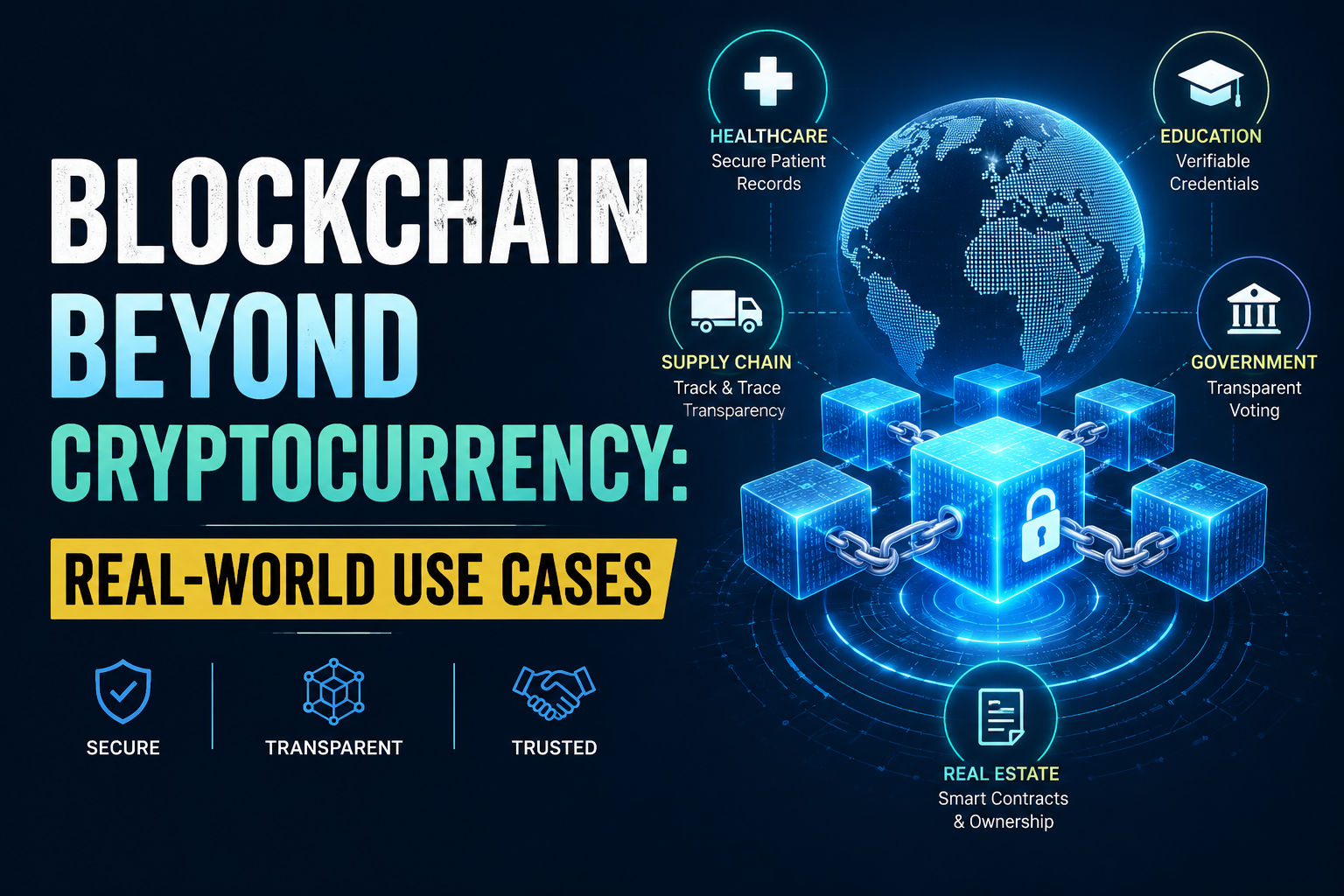
For most people, “blockchain” is just the technology behind Bitcoin or Ethereum—a way to trade digital coins and hope the price goes up. But that’s a narrow view of what this technology actually offers. At its core, blockchain is a way to record information so that no single party can alter it, and everyone with access can trust it’s accurate. That property turns out to be useful for a lot more than currency.
Here’s a look at how blockchain is being used well outside the world of crypto trading—including a few honest examples of where it hasn’t panned out.
What Makes Blockchain Useful, Structurally
Before diving into use cases, it helps to strip blockchain down to its actual value proposition:
- Immutability—once data is recorded, it’s extremely hard to change without everyone noticing.
- Decentralization—no single company or government controls the record.
- Transparency—anyone with permission can verify the data independently.
- Programmability—smart contracts let agreements execute automatically when conditions are met.
Any industry that struggles with trust, fraud, slow verification, or middlemen is a candidate for blockchain to add value.
1. Supply Chain Tracking
Supply chains are notoriously opaque. A product might pass through a dozen hands—manufacturer, shipper, distributor, retailer—before reaching a customer, and verifying its journey is often based on paperwork that can be forged or lost.
The best-known example is IBM’s Food Trust network, launched in 2017 with Walmart as a founding partner alongside Dole, Nestlé, Kroger, Tyson Foods, and others. The impact has been dramatic where it’s been rolled out: Walmart’s pilot cut the time needed to trace a package of mangoes back to its farm of origin from seven days down to about 2.2 seconds. That kind of speed matters enormously during a contamination scare, when every extra day on the shelf is a health risk.
On the shipping side, IBM partnered with Maersk on a similar system called TradeLens, aimed at digitizing the paper trail behind global container shipping. It’s also worth noting that not every pilot survives contact with reality—IBM and Maersk wound down TradeLens in 2023 after struggling to get competing carriers to join the network, and Walmart itself scaled back parts of its blockchain traceability push. It’s a useful reminder that the technology works, but getting an entire industry to cooperate on a shared ledger is often the harder problem.
Beyond food and shipping, blockchain-based traceability is also used for tracking the provenance of diamonds and precious metals, helping retailers verify “conflict-free” sourcing claims rather than just asserting them.
2. Healthcare Records
Medical records are scattered across hospitals, clinics, and insurance providers, often in incompatible systems. Estonia offers the clearest real-world example of blockchain solving this. Since 2016, the country has used a system called KSI Blockchain, developed with the cybersecurity firm Guardtime, to secure the integrity of national electronic health records.
Importantly, the blockchain itself doesn’t store the actual medical data—it stores cryptographic proof that the data hasn’t been tampered with. Every access to a patient’s record and every change made to it is logged on the blockchain, creating an audit trail that even system administrators can’t quietly alter. The same KSI infrastructure has since been extended to Estonia’s property registries, tax system, and business registry.
3. Voting Systems
Election security is a persistent concern—vote tampering, double-voting, and lack of transparency in ballot counting all undermine public trust. West Virginia became the first U.S. state to test blockchain-based mobile voting, using an app called Voatz, starting with a small pilot in the 2018 midterms for military members and citizens deployed overseas.
The results were mixed. Roughly 144 overseas voters, many in the military, used the app in the 2018 midterms, and the state called the pilot a success. But it drew real scrutiny from security researchers, and an MIT Technology Review report flagged the plan to expand the app for the 2020 election as a risky idea, given how hard it is to independently audit a closed-source mobile voting system. This is a good example of blockchain solving one narrow problem — tamper-evident vote records — without solving the much bigger problem of device and app security.
4. Real Estate and Property Titles
Buying property involves layers of paperwork, title searches, and intermediaries—all to answer one question: does the seller actually own this, and is it free of liens? Sweden’s land registry authority, Lantmäteriet, ran a multi-year pilot testing whether blockchain could speed up property transactions. The agency estimated the technology could eventually cut the time from signed purchase contract to registered title from around four months down to just a few days, saving Swedish taxpayers more than €100 million a year.
The Republic of Georgia went further and actually put the system into production. Working with the blockchain company Bitfury, Georgia’s national registry has hashed and recorded roughly 300,000 land titles on a public ledger, cutting the sale process down from days to minutes and reducing operational costs by as much as 90%.
5. Humanitarian Aid and Digital Identity
One of the most genuinely successful applications of blockchain outside of finance is the UN World Food Programme’s Building Blocks system. Launched in Jordan’s refugee camps in 2017, it pairs a blockchain-based virtual wallet with the UNHCR’s biometric iris-scan identity system, letting refugees buy groceries without cash, bank accounts, or physical ID cards.
The scale is significant: Building Blocks now serves more than a million refugees across Jordan and Bangladesh, has processed over $555 million in aid through 25 million transactions, and has saved millions of dollars in bank fees that would otherwise have gone to financial intermediaries. In 2022, the same underlying approach was adapted to deliver emergency funds to Ukrainian families displaced by the war, using the Stellar blockchain to move aid directly into mobile wallets within minutes.
This use case works well precisely because it targets a specific, painful problem: people who have fled their homes often have no bank account and no way to prove their identity through conventional means. A shared, tamper-proof ledger lets multiple aid agencies coordinate without duplicating payments or requiring a traditional banking relationship.
6. Intellectual Property and Royalties
Musicians, artists, and writers often lose track of how their work is used—and how royalties are (or aren’t) paid out. Blockchain-based platforms can timestamp original creations to help prove authorship and, through smart contracts, automatically split and distribute royalties whenever a work is sold, streamed, or licensed. This is part of what’s driving interest in NFTs beyond the speculative art market—the underlying idea of provable digital ownership has real utility for creators trying to track and monetize their work more directly, even if the hype cycle around NFT art has cooled considerably since 2021–2022.
7. Smart Contracts in Business Agreements
Beyond finance, smart contracts can automate agreements across industries: insurance payouts that trigger automatically when a flight is delayed, rental agreements that release a security deposit automatically at lease end, or supply agreements that release payment the moment a shipment is confirmed delivered. This removes a layer of manual verification and dispute resolution that traditionally requires lawyers, adjusters, or escrow agents.
The Honest Caveats
Blockchain isn’t a magic fix for every trust problem, and it’s worth being clear-eyed about the limits, especially given the examples above:
- It’s slow and resource-intensive compared to a traditional database, so it’s overkill for problems that don’t actually need decentralization.
- Garbage in, garbage out — blockchain guarantees that recorded data hasn’t been tampered with, but it doesn’t guarantee the data was accurate in the first place. If someone logs a fake shipment record, the blockchain will faithfully preserve that lie forever.
- Coordination is hard — TradeLens collapsed not because the technology failed, but because competing shipping carriers wouldn’t fully commit to a shared network. The technology only pays off when everyone in a supply chain, hospital network, or voting system agrees to use it.
- It doesn’t fix everything upstream or downstream of it — West Virginia’s voting pilot shows this well: a tamper-evident ledger doesn’t make the surrounding app, device, or human process automatically secure.
The Bigger Picture
Cryptocurrency was blockchain’s first mainstream use case, but it’s increasingly looking like a starting point rather than the destination. The more interesting story is happening in the background—supply chains, healthcare, land registries, humanitarian aid—anywhere that trust, verification, and paperwork have historically been slow, expensive, or exploitable.
The technology is still maturing, and not every pilot program will scale, as TradeLens and some of Walmart’s own initiatives show. But the pattern is clear: wherever verifying the truth is expensive, and wherever multiple parties genuinely need to trust a shared record without a single company controlling it, blockchain has something real to offer.
Further Reading
Walmart’s food traceability case study — Linux Foundation Decentralized Trust
Sweden’s blockchain land registry pilot — Computer Weekly
Georgia’s blockchain land registry — CoreLedger
Estonia’s KSI Blockchain for e-health records — e-Estonia
West Virginia’s blockchain voting pilot — StateScoop