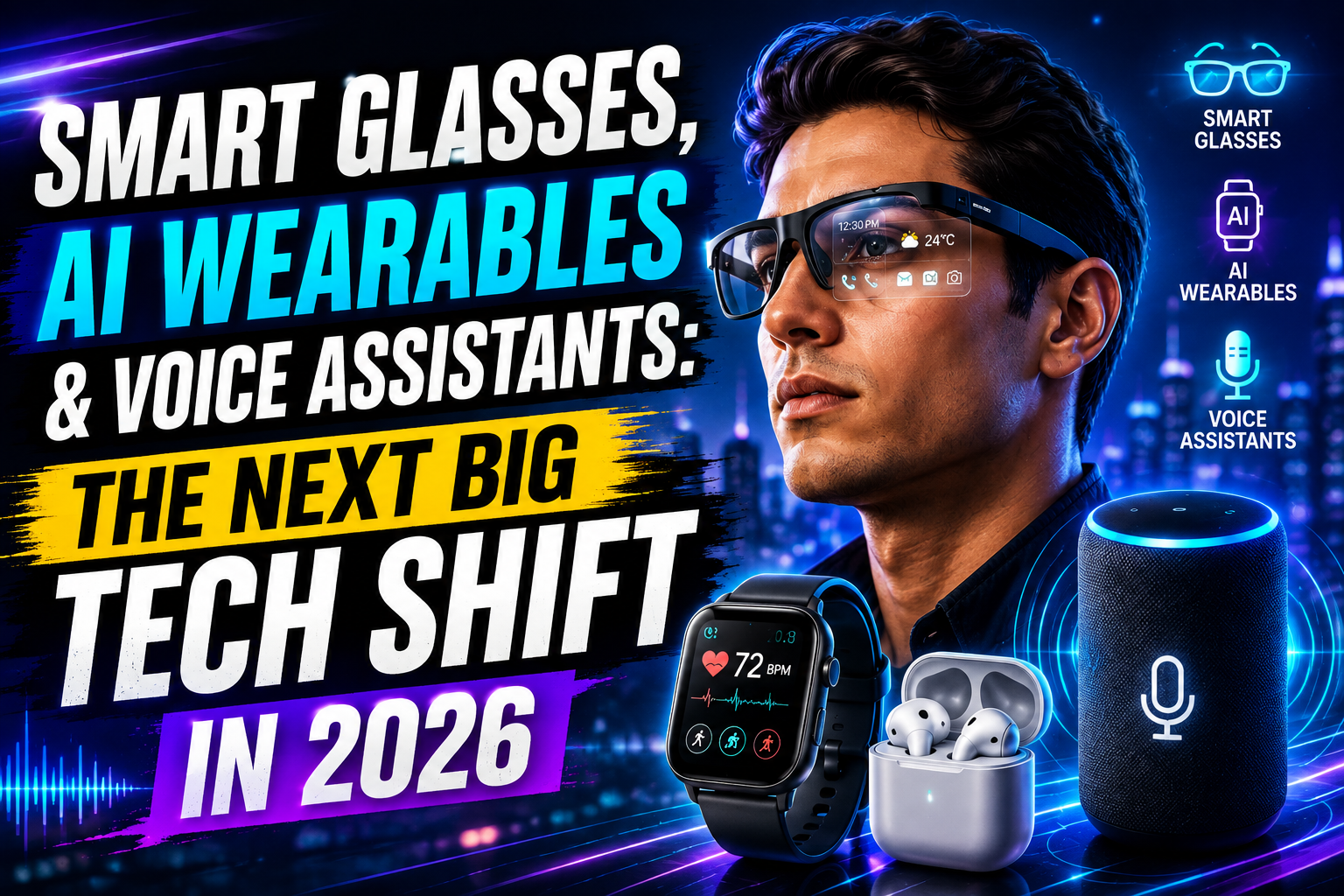
For years, “AI in your pocket” meant a chatbot app you opened when you needed it. That’s changing fast. In 2026, AI is moving off the screen and onto your body — into the glasses on your face, the band on your wrist, and the assistant that’s always listening for “Hey…” That shift is arguably the biggest consumer tech story of the year, even if it hasn’t made a single dramatic headline the way ChatGPT did in 2023.
Here’s what’s actually happening and why it matters.
Smart Glasses Are Having Their Breakout Year
Smart glasses spent nearly a decade as a punchline after Google Glass flopped. That era is over. Meta’s Ray-Ban glasses proved there was real consumer appetite for AI eyewear that doesn’t look ridiculous, and the rest of the industry is now racing to catch up.
Market researchers expect AI glasses shipments to jump sharply this year, roughly quadrupling in value as more players enter the field. A few things are driving that:
- Google is preparing its first AI-powered glasses, built on Android XR and its Gemini assistant, developed with partners including Warby Parker, Samsung, and Gentle Monster. The lineup reportedly includes an audio-only “screen-free” version and a display version with an in-lens screen for navigation, translation, and notifications.
- Apple has reportedly shelved a camera-equipped smartwatch to focus engineering resources on smart glasses, targeting a late-2026 release as it tries to avoid missing out on the category entirely.
- Snap and XReal are both pushing lighter-weight, more “everyday wearable” designs rather than bulky headsets.
The pitch across all of them is similar: instead of pulling out your phone to ask a question, get directions, or translate a sign, you just look and speak. The AI sees what you see and responds through built-in speakers or a tiny display.
The catch — and it’s a real one — is privacy. Glasses with always-on cameras and microphones raise obvious questions about consent for the people around the wearer, not just the wearer themselves. Expect this to be one of the defining tech-policy debates of the next couple of years as adoption grows.
Wearables Beyond Glasses: A Slower, Messier Story
Not every AI wearable has landed as smoothly. Standalone AI gadgets — pins, pendants, and similar “carry it separately” devices — have mostly struggled. Humane’s AI Pin became a cautionary tale after the company shut the product down; HP later acquired Humane primarily for its underlying technology rather than the device itself.
The lesson the industry seems to be learning: people don’t want a new object to carry. They want AI folded into things they already wear — glasses, watches, and earbuds — rather than one more gadget competing for pocket space. That’s part of why so much investment is now flowing into eyewear instead of standalone devices.
Voice Assistants Are Getting a Real Upgrade
Voice assistants have technically existed for over a decade, but most people stopped taking them seriously somewhere around “setting a timer for five minutes”. Generative AI is changing that. Assistants like Gemini, Siri, and Alexa’s newer AI-driven versions are being rebuilt to hold actual conversations, understand context across a whole interaction, and take multi-step actions instead of just answering single commands.
This matters because voice is the connective tissue for the wearable AI trend. Smart glasses without a screen depend entirely on a capable voice assistant to be useful — it has to understand vague, conversational requests (“What’s this building?” or “Text my sister I’m running late”) and actually get them right. The quality of the voice layer is quietly becoming the real differentiator between wearable AI that feels magical and wearable AI that feels gimmicky.
Why This Matters for Everyday Users
Put together, these three threads point towards the same shift: AI is moving from something you open to something that’s just on, running in the background of your daily life. A few practical implications worth watching:
- Less phone-pulling, more ambient assistance. Navigation, translation, and quick lookups are moving to glasses and earbuds.
- New privacy norms will need to catch up. Always-on cameras and mics in public spaces are a genuinely unresolved social and legal question.
- The “best” AI assistant may matter less than the best hardware it’s built into. Google, Apple, and Meta are competing as much on glasses design and comfort as on the underlying AI model.
- 2026–2027 is the real inflection point. Most of the major glasses launches — Google’s, Apple’s, and Snap’s — are landing in this window, so the next 18 months will likely decide which approach wins mainstream adoption.
The Bottom Line
AI in everyday apps isn’t just about smarter chatbots anymore — it’s about AI physically leaving the screen and joining you throughout the day. Smart glasses are the most visible part of that shift, wearables are still figuring out their place, and voice assistants are quietly becoming the most important interface in tech. Whether you’re excited or wary about it, this is the direction consumer AI is heading next.