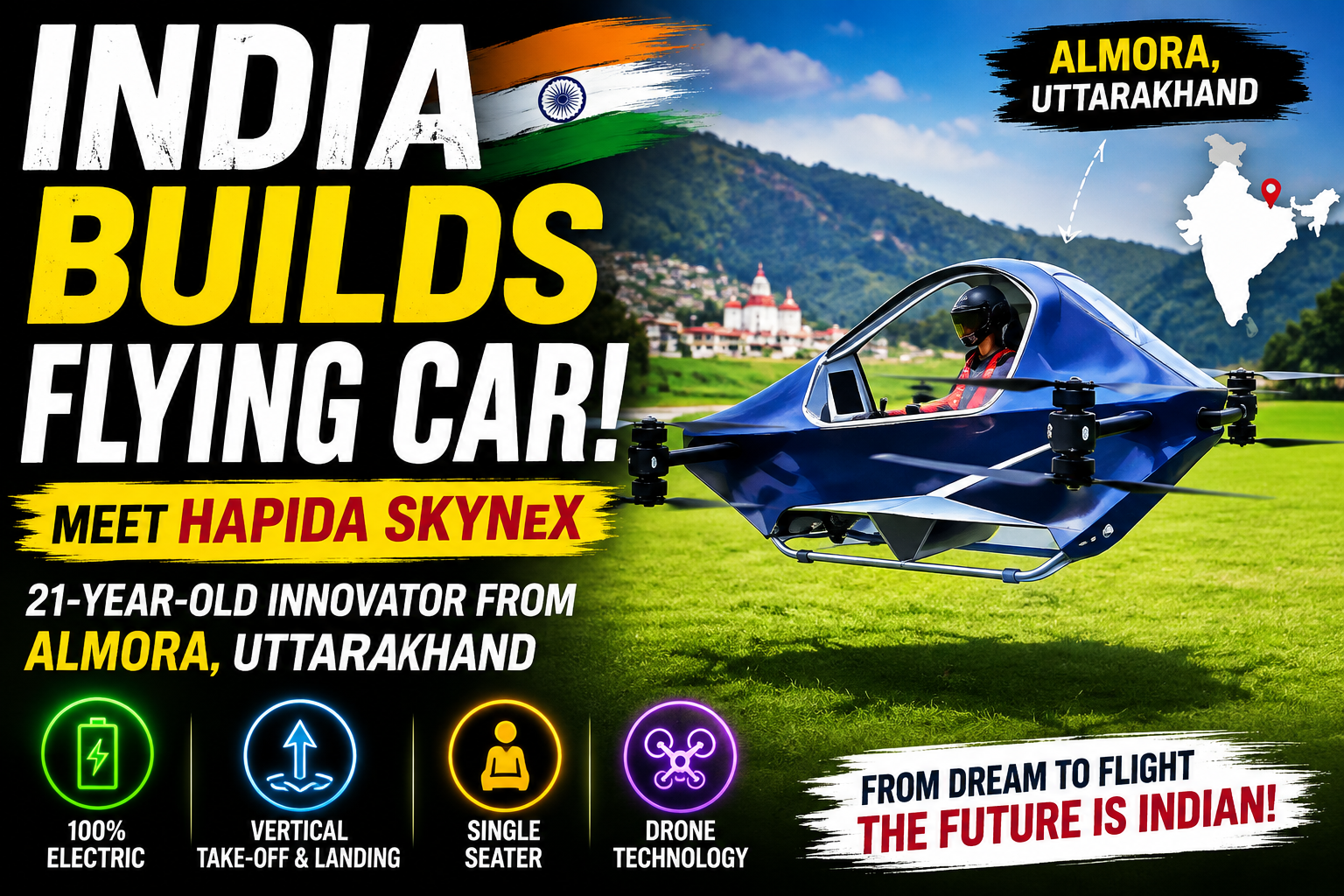
India’s flying-car dream may be getting closer to reality. An innovator from Almora, Uttarakhand, has developed and test-flown a single-seat electric flying vehicle called HAPIDA SKYNeX, bringing a futuristic concept from science fiction into the real world.
The project is attracting attention because it was developed by an individual innovator rather than a major automobile or aerospace company. The prototype demonstrates how drone technology, electric propulsion and vertical-flight systems could eventually transform personal transportation in India.

What Is HAPIDA SKYNeX?
HAPIDA SKYNeX is a single-seat electric flying vehicle developed by Uttarakhand-based innovator Ravi Tamta.
The vehicle uses technology derived from modern drone systems to achieve vertical flight. Instead of requiring a traditional runway, its design is intended to take off and land vertically, similar to the basic operating principle of an eVTOL aircraft.
The concept combines elements of:
- Electric propulsion
- Multirotor/drone technology
- Vertical take-off and landing
- Lightweight vehicle design
- Autonomous-flight technologies
The prototype is still far from being a commercially available flying car, but its successful demonstration highlights the growing interest in personal aerial mobility in India.
Why Is This Important for India?
India has some of the world’s most congested cities and challenging geographical environments.
Traffic congestion in cities such as Mumbai, Bengaluru, Delhi and Hyderabad costs commuters significant amounts of time every day.
At the same time, mountainous regions such as Uttarakhand present completely different transportation challenges.
Flying vehicles could eventually provide an alternative way to move people over:
- Traffic congestion
- Mountains
- Rivers
- Difficult terrain
- Remote areas
Instead of travelling around physical obstacles, aerial vehicles could potentially travel directly from one location to another.
However, this technology is still in its early stages.
How Does a Flying Car Work?
The concept behind HAPIDA SKYNeX is closer to an eVTOL aircraft than a traditional car with wings.
eVTOL stands for Electric Vertical Take-Off and Landing.
These aircraft use multiple electric motors and propellers to generate vertical lift. Once airborne, flight-control systems can maintain stability and control the aircraft.
A simplified flight process looks like this:
Battery → Electric Motors → Propellers → Vertical Lift → Flight Control
Multiple motors can also provide redundancy, which is an important consideration for future passenger-carrying aircraft.
From Drones to Flying Cars
One of the most important technologies behind projects like SKYNeX is the rapid development of drones.
Over the last decade, drones have become significantly more capable and affordable. Technologies originally developed for unmanned aerial vehicles are now being explored for larger passenger-carrying aircraft.
These technologies include:
- Flight controllers
- High-density batteries
- Electric motors
- Lightweight composites
- GPS navigation
- Sensors
- Computer vision
- Autonomous flight systems
The challenge is scaling these technologies safely enough to carry humans.
A drone carrying a camera is one thing. An aircraft carrying a passenger is an entirely different engineering and regulatory challenge.
India’s Growing Flying-Taxi Ecosystem
HAPIDA SKYNeX isn’t the only Indian project working towards electric aerial mobility.
Indian startups are also developing eVTOL aircraft and air-taxi concepts.
One notable company is The ePlane Company, based in Chennai. The startup has been developing electric aircraft designed for urban air mobility.
Another company, Sarla Aviation, is working on eVTOL aircraft for future air-taxi applications.
There are also projects exploring hybrid-electric aircraft and flying-car concepts.
This suggests that India’s aerial-mobility ecosystem is gradually moving beyond science-fiction concepts towards engineering prototypes.
Flying Cars vs Air Taxis
It is important to understand that a flying car and an air taxi are not exactly the same thing.
Flying Car
A flying car generally refers to a vehicle that can operate both on roads and in the air.
The idea is similar to:
Road → Take Off → Fly → Land → Road
This is extremely difficult because the vehicle needs to satisfy both automotive and aviation requirements.
Air Taxi
An air taxi is more like a small electric aircraft designed specifically for passenger transportation.
It may operate between designated landing locations rather than being driven on normal roads.
For this reason, air taxis may become commercially viable before true road-and-air flying cars.
The Biggest Challenge: Safety
The most important question isn’t whether we can make a vehicle fly.
We already can.
The real question is:
Can we make it safe enough to carry people over populated areas?
A passenger aircraft needs multiple layers of safety.
Engineers must consider:
- Motor failure
- Battery failure
- Communication loss
- Navigation problems
- Weather conditions
- Emergency landing
- Collision avoidance
- Software failures
- Pilot training
Battery technology presents another challenge.
Electric aircraft require large amounts of energy, but batteries are still much heavier than conventional aviation fuel for the same amount of stored energy.
Improving battery energy density will therefore be critical for making electric flying vehicles practical.
What About Regulation?
Flying cars cannot simply operate anywhere their owners want.
They will need to comply with India’s aviation regulations and safety standards.
Regulators will need to determine requirements for:
- Aircraft certification
- Pilot licensing
- Airworthiness
- Flight corridors
- Landing zones
- Passenger safety
- Air traffic management
- Battery and electrical safety
India will also need new infrastructure if urban air mobility becomes widespread.
Future cities could require dedicated vertical vertiports—special landing and take-off locations for eVTOL aircraft.
Could Flying Cars Become Common in India?
Probably not immediately.
The technology still has substantial engineering, economic and regulatory hurdles.
However, the long-term potential is significant.
Imagine a future where a passenger travels from one side of a congested city to another without spending an hour in traffic.
Or imagine emergency services using electric aircraft to reach remote mountain villages much faster than conventional vehicles.
Potential applications could include:
🚕 Urban Air Taxis
Short-distance passenger transportation over congested cities.
🚑 Emergency Services
Rapid transportation of medical teams, medicines and emergency equipment.
🏔️ Mountain Connectivity
Connecting remote communities in difficult-to-reach regions.
📦 Logistics
Moving high-value or time-sensitive packages between cities.
🌾 Agriculture
Monitoring farms and transporting equipment or supplies in difficult terrain.
India’s Opportunity
India has a unique opportunity to develop its own aerial-mobility industry.
The country already has strong capabilities in:
- Software development
- Drone technology
- Automotive engineering
- Space technology
- Artificial intelligence
- Electronics manufacturing
- Startup innovation
Combining these capabilities could help Indian companies develop competitive eVTOL technology.
Projects like HAPIDA SKYNeX are important not necessarily because they immediately deliver commercial flying cars, but because they demonstrate local experimentation and engineering capability.
The Road Ahead
HAPIDA SKYNeX is still a prototype, and it would be premature to call it a commercially ready flying car.
There is a long road between a successful prototype flight and a certified passenger vehicle.
But every major transportation technology starts with experimentation.
The automobile began as an experimental machine. Aviation itself went through decades of testing before becoming mainstream.
India’s flying-car journey could follow a similar path.
Conclusion
India’s flying-car era has not arrived yet—but the first steps are already happening.
The HAPIDA SKYNeX project demonstrates how Indian innovators are experimenting with electric propulsion, drone technology and vertical flight.
Meanwhile, startups working on eVTOL aircraft and air taxis are pushing India’s aerial-mobility ecosystem forward.
The biggest challenge will be transforming prototypes into vehicles that are safe, affordable, reliable and legally permitted to operate at scale.
If battery technology, autonomous flight, regulation and manufacturing continue to improve, India’s roads may eventually have competition from an entirely new transportation network above them.
For now, HAPIDA SKYNeX offers a fascinating glimpse of what that future could look like.
The future of transportation may not just be electric. It could also be airborne.
A big step toward innovative India