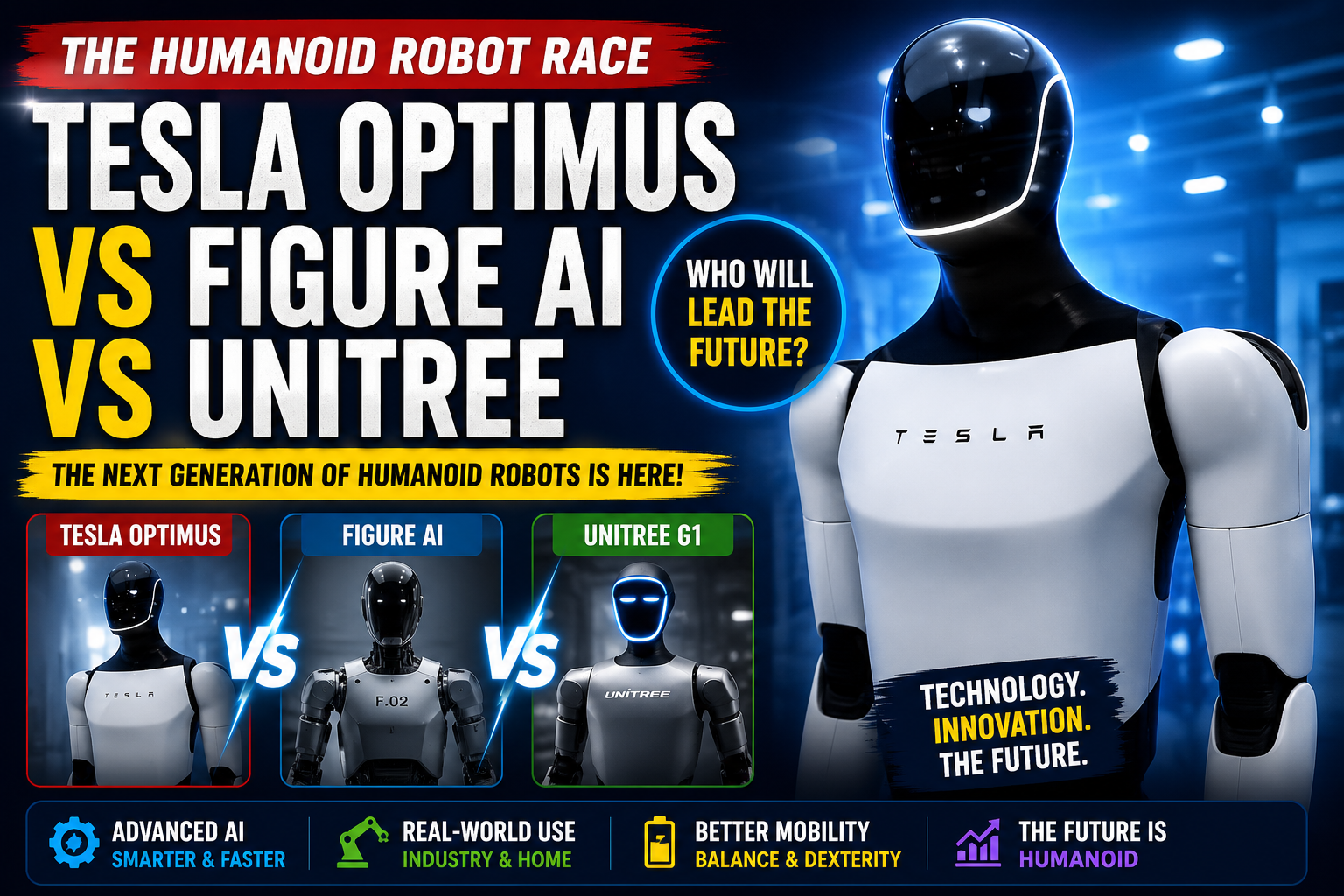
Humanoid robots have long been a dream of science fiction, but in 2026 they are becoming a reality. Companies around the world are investing billions of dollars to develop robots that can walk, lift objects, interact with humans, and even perform complex workplace tasks. Among the leading competitors are Tesla Optimus, Figure AI, and Unitree Robotics. Each company has a different vision, but all share the same goal: building intelligent humanoid robots that could transform industries and everyday life.
Tesla’s Optimus is perhaps the most well-known humanoid robot. Designed to work alongside humans, Optimus is powered by Tesla’s AI and computer vision technology, the same foundation used in its autonomous vehicles. Elon Musk believes Optimus could eventually become more valuable than Tesla’s car business. The robot is designed to perform repetitive, dangerous, and physically demanding tasks in factories, warehouses, and even homes. Tesla continues to improve its walking ability, hand dexterity, and object recognition, bringing the company closer to commercial deployment.
Another major player is Figure AI, a fast-growing robotics startup backed by major investors including Microsoft, NVIDIA, OpenAI, and Jeff Bezos. Figure AI has attracted global attention with its humanoid robot, Figure 02, which focuses on industrial automation. The company has already partnered with BMW to test robots in manufacturing environments. Figure AI combines advanced AI reasoning with high-precision movements, allowing its robots to understand instructions, manipulate objects, and collaborate safely with human workers.
China’s Unitree Robotics has also become one of the biggest names in the global robotics industry. Known initially for its affordable quadruped robots, Unitree has expanded into humanoid robotics with the Unitree G1. Unlike many competitors, Unitree aims to make humanoid robots more affordable and accessible. The G1 features agile movement, improved balance, and AI-powered perception, making it suitable for research, education, and future commercial applications. Competitive pricing could give Unitree an advantage as demand for humanoid robots grows worldwide.
Although all three companies are building humanoid robots, their strategies differ. Tesla focuses on large-scale manufacturing and AI integration; Figure AI targets enterprise and industrial customers with advanced reasoning capabilities, while Unitree emphasizes affordability and rapid commercialization. These different approaches highlight the diversity of the emerging humanoid robotics market.
Industry analysts believe humanoid robots could play a significant role in addressing global labor shortages, particularly in manufacturing, logistics, healthcare, and elderly care. Robots capable of handling repetitive tasks can improve workplace safety, increase productivity, and allow human workers to focus on more creative and strategic responsibilities. However, challenges remain, including reducing production costs, improving battery life, ensuring safe human-robot interaction, and addressing ethical concerns surrounding automation.
The competition among Tesla, Figure AI, and Unitree is accelerating innovation at an unprecedented pace. Advances in artificial intelligence, computer vision, sensors, and robotics hardware are making humanoid robots smarter, faster, and more capable every year. As these technologies mature, humanoid robots may become as common in workplaces as industrial machines are today.
The global humanoid robot race is no longer about creating impressive prototypes; it is about building practical robots that deliver real value. Whether Tesla’s AI ecosystem, Figure AI’s enterprise partnerships, or Unitree’s affordable robotics strategy ultimately succeeds, one thing is clear: the next decade will likely redefine how humans and intelligent machines work together.

2 thoughts on “The Humanoid Robot Race: Tesla, Figure AI, and Unitree Compete for the Future”