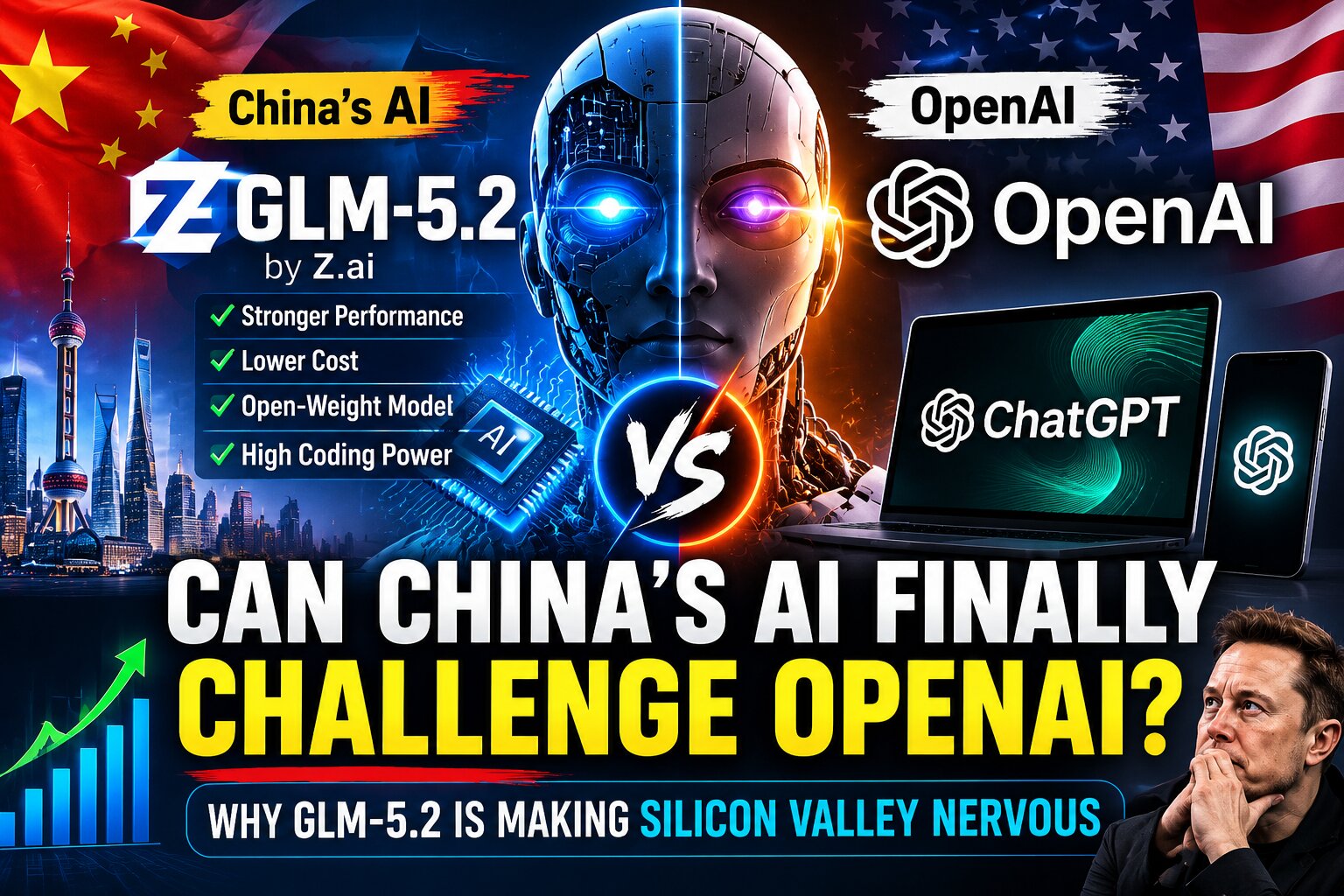
For the past few years, the global AI conversation has been dominated by companies like OpenAI, Google, Anthropic, and Microsoft. Their powerful AI models have set the benchmark for everything from coding and content creation to research and automation. But a new challenger has entered the race.
Chinese AI startup Z.ai has introduced GLM-5.2, an open-weight AI model that is quickly gaining attention from developers, researchers, and technology leaders around the world. What makes this model different isn’t just its performance. It’s the fact that it delivers capabilities close to some of the world’s leading AI models while costing significantly less to use.
Many experts are already calling this a “mini DeepSeek moment,” suggesting that China’s AI industry is once again closing the gap with the United States.
What Is GLM-5.2?
GLM-5.2 is the latest large language model developed by Beijing-based AI company Z.ai, formerly known as Zhipu AI.
The model has been designed to perform a wide range of tasks, including:
- Writing and debugging code
- Solving complex reasoning problems
- Creating content
- AI agent workflows
- Software development assistance
Unlike many proprietary AI systems, GLM-5.2 is available as an open-weight model, giving developers greater flexibility to deploy and customize it for their own applications. Its biggest advantage, however, is its combination of strong performance and low operating cost.
Why Is Silicon Valley Paying Attention?
The excitement around GLM-5.2 isn’t coming only from China.
Developers across the world have started testing the model because it performs surprisingly well in coding tasks and AI agent capabilities.
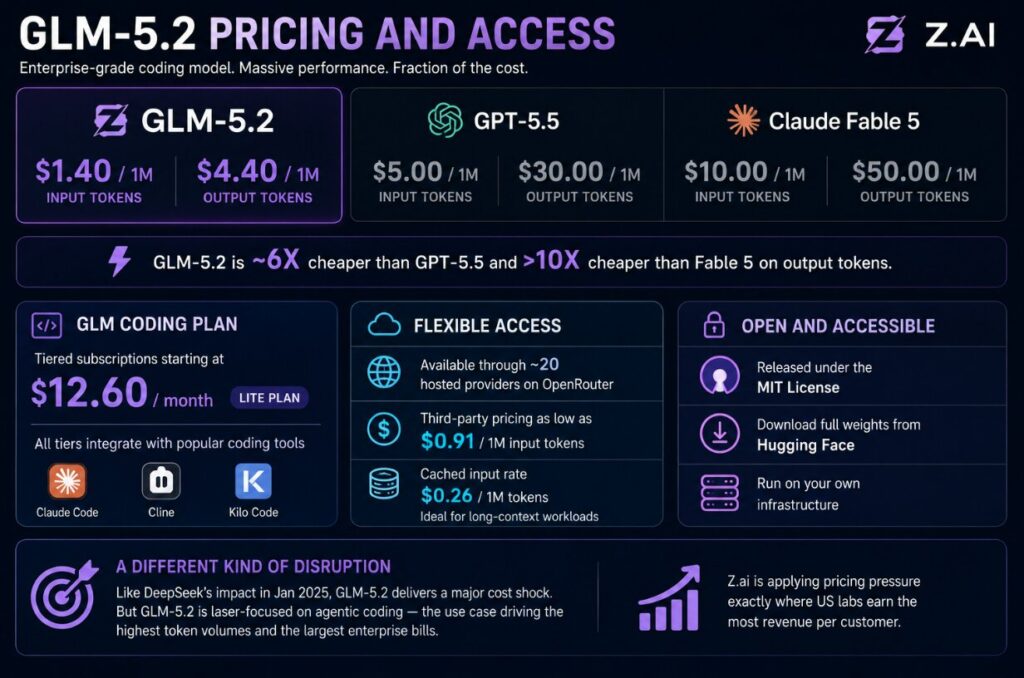
According to industry benchmarks, GLM-5.2 ranks among the leading AI models in software development and front-end code generation. While it may not outperform OpenAI’s latest flagship models in every category, it delivers impressive results at a fraction of the cost.
For startups and independent developers, this is a major advantage.
Instead of spending large amounts on premium AI APIs, companies now have another powerful option that can significantly reduce operating expenses.
The AI Race Is No Longer Just About Performance
For years, AI companies competed by building the smartest model.
Today, the competition has changed.
Businesses now care about three things:
- Performance
- Cost
- Deployment flexibility
An AI model that is slightly less capable but six times cheaper can become a very attractive choice for businesses building AI-powered products.
This is exactly where GLM-5.2 is making an impact.
It shows that the future of AI may not be determined only by intelligence but also by affordability and accessibility.
Can China Catch Up With OpenAI?
This question is becoming increasingly important.
China has invested heavily in artificial intelligence despite restrictions on advanced AI chips and increasing geopolitical tensions. Companies like DeepSeek previously surprised the technology industry by demonstrating that competitive AI models could be developed at much lower costs.
Now GLM-5.2 continues that momentum.
Although OpenAI, Anthropic, and Google still lead in frontier AI research, Chinese companies are narrowing the gap much faster than many experts expected. Rather than replacing OpenAI overnight, Chinese AI models are creating greater competition, encouraging faster innovation and giving developers more choices than ever before.
Challenges Still Remain
Despite its growing popularity, GLM-5.2 also faces important challenges.
Many businesses in the United States and Europe remain cautious about adopting Chinese AI models because of concerns related to data privacy, regulatory compliance, and security. Large enterprises often require strict governance policies before introducing new AI systems into their products.
As a result, widespread enterprise adoption may take time. For startups, researchers, and independent developers, however, these concerns are often less restrictive, making open-weight models increasingly attractive.
What Does This Mean for Developers?
For developers, this is excellent news.
More competition means:
- Lower AI costs
- Better model performance
- Faster innovation
- More open-source alternatives
- Greater flexibility for startups
Instead of depending on a single AI provider, businesses can now choose models that best fit their budget and technical requirements.
This growing competition is likely to accelerate AI adoption across industries.
| Feature | GLM-5.2 | OpenAI GPT Models |
|---|---|---|
| Developer Cost | Lower | Higher |
| Coding Performance | Excellent | Excellent |
| Open-Weight Availability | Yes | No |
| AI Agent Support | Strong | Strong |
| Best For | Startups, Developers, Open Deployment | Enterprise, General AI, Premium Features |
Final Thoughts
The global AI race is entering a new phase.
It is no longer a competition dominated by a handful of American companies. Chinese AI startups are proving they can build highly capable models that are both affordable and practical for real-world applications.
Whether GLM-5.2 eventually surpasses OpenAI is still uncertain. What is already clear, however, is that the AI industry has become far more competitive.
For developers, businesses, and consumers, that competition is ultimately good news because it drives innovation, lowers costs, and expands access to powerful AI technologies.
The question is no longer whether China can compete in AI. The real question is how quickly the rest of the world will adapt to this new era of global AI competition.
Related Articles
Samsung’s AI Memory Boom: How the AI Revolution Is Driving Record Profits


One thought on “Can China’s AI Finally Challenge OpenAI? Why GLM-5.2 Is Making Silicon Valley Nervous”