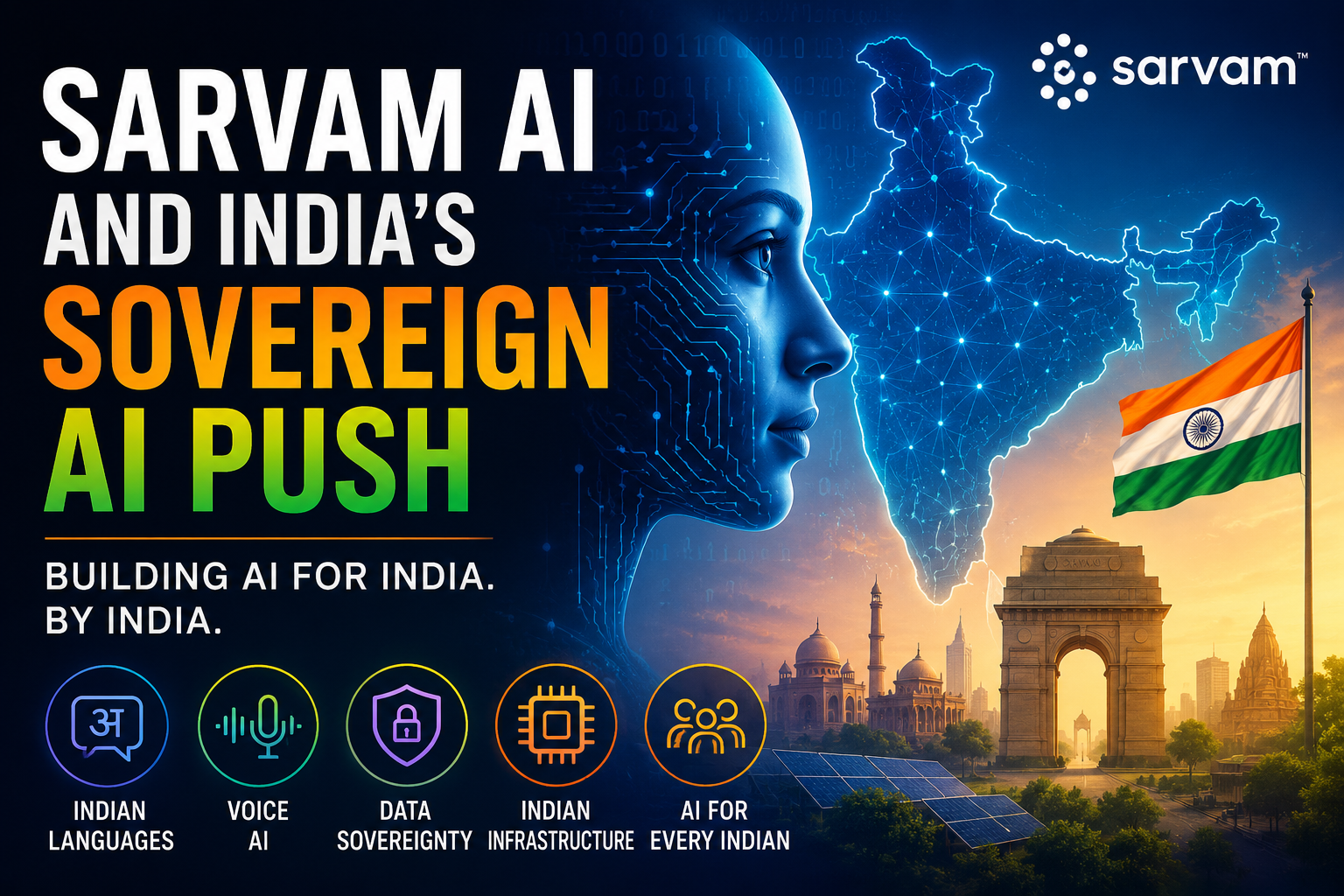
India is entering a new phase of artificial intelligence development. Instead of depending entirely on AI models developed by companies in the United States and China, India is increasingly focusing on building its own AI capabilities. At the centre of this movement is Sarvam AI, an Indian artificial intelligence startup working to develop AI models designed specifically for India.
From supporting Indian languages to developing AI systems for local businesses and government services, Sarvam AI represents a broader ambition: India wants greater control over the technology powering its digital future.
What Is Sarvam AI?
Sarvam AI is an Indian AI company focused on developing large language models (LLMs), AI applications and infrastructure for Indian users.
One of its key goals is solving a problem that global AI models often struggle with: India’s enormous linguistic and cultural diversity.
India has hundreds of languages and dialects, while a large portion of the population is more comfortable communicating in languages other than English. Sarvam AI is therefore focusing heavily on Indian-language AI, including languages such as Hindi, Tamil, Telugu, Bengali, Marathi and others.
This approach could make advanced AI more accessible to millions of Indians who may not be comfortable using English-based AI tools.
Why Does India Need Sovereign AI?
The idea of sovereign AI goes beyond simply creating another chatbot.
Sovereign AI means developing the technological capability to build, operate and control AI systems within a country’s own ecosystem.
Today, some of the world’s most powerful AI models are developed by companies such as OpenAI, Google, Anthropic and Meta. These models require enormous amounts of computing power, data and investment.
For India, relying completely on foreign AI infrastructure could create several challenges.
1. Data Control
AI systems process enormous amounts of information. Keeping important government, business and citizen data within trusted infrastructure can improve data governance and security.
2. Indian Languages
Most major AI models have historically performed best in English and a limited number of other widely represented languages.
India needs models that understand Indian languages, accents, cultural references and local contexts.
3. Strategic Independence
AI is increasingly becoming a strategic technology similar to semiconductors and cloud computing.
Building domestic AI capabilities can reduce India’s dependence on foreign technology companies.
4. Local Economic Growth
A strong domestic AI ecosystem can create opportunities for startups, researchers, engineers and semiconductor companies while generating new AI-powered businesses.
Sarvam AI’s Role in India’s AI Ecosystem
Sarvam AI is attempting to build an AI ecosystem specifically designed around Indian requirements.
Its work includes developing language models capable of understanding and generating Indian languages and creating AI applications for real-world use cases.
One particularly important area is voice-based AI.
Voice interfaces could be extremely valuable in India because many users are more comfortable speaking than typing, especially when interacting in regional languages.
Imagine being able to call an AI assistant and ask questions about:
- Government schemes
- Banking services
- Healthcare information
- Agriculture
- Education
- Business services
—all in your preferred Indian language.
This could significantly reduce the digital divide.
India’s Government Is Also Investing in AI
Sarvam AI’s growth is happening alongside India’s broader national AI strategy.
The Indian government has been investing in AI infrastructure, computing resources, datasets, research and startup support through initiatives such as the IndiaAI Mission.
The objective is not only to develop AI applications but also to create the infrastructure required to support India’s growing AI ecosystem.
Access to powerful GPUs and AI computing infrastructure is particularly important because training modern AI models can require enormous computational resources.
India’s strategy therefore involves several layers:
Compute + Data + Models + Talent + Startups + Applications
Together, these components can form the foundation of a sovereign AI ecosystem.
Why Indian-Language AI Could Be a Game Changer
India’s biggest advantage may also be one of its biggest AI challenges: linguistic diversity.
A person in Maharashtra might prefer Marathi, while another user in Tamil Nadu may primarily communicate in Tamil. Someone in rural India might prefer voice interaction rather than a traditional graphical interface.
AI that understands these differences could unlock completely new markets.
For example, an agricultural AI assistant could allow a farmer to ask:
“माझ्या पिकावर कोणता रोग आला आहे?”
Instead of requiring the farmer to translate the question into English, the AI could understand the request directly in Marathi and provide an appropriate response.
This is where Indian-focused AI companies could have an advantage over general-purpose global models.
Sarvam AI vs Global AI Giants
Sarvam AI is not necessarily trying to compete with global companies by simply building another general-purpose chatbot.
Its bigger opportunity is specialisation.
Companies such as OpenAI, Google and Anthropic are building globally capable AI systems. Sarvam AI can focus deeply on India’s unique requirements.
That includes:
- Indian languages
- Indian cultural context
- Voice-first interfaces
- Government applications
- Local businesses
- Indian enterprises
- Data sovereignty
- Cost-efficient AI deployment
This could create a different competitive model: global AI companies build for the world, while Indian AI companies build deeply for India.
Challenges Ahead
Despite the opportunity, India’s sovereign AI ambitions face significant challenges.
High Computing Costs
Training large AI models requires expensive GPUs and data centres. India will need significantly more computing infrastructure to compete at the frontier of AI.
Access to High-Quality Data
AI models need enormous amounts of high-quality training data. Collecting and properly preparing datasets for India’s many languages remains difficult.
Global Competition
Indian AI startups are competing in an extremely fast-moving industry where companies with billions of dollars in capital are developing increasingly powerful models.
Talent
India has a large software-engineering workforce, but frontier AI research requires highly specialised expertise in areas such as machine learning, semiconductor architecture and AI infrastructure.
The Bigger Picture
Sarvam AI is part of something larger than a single startup.
India is attempting to move from being primarily a consumer of global technology to becoming a builder of strategic technology.
This transition is already visible across multiple sectors:
- Semiconductors
- Space technology
- Quantum computing
- 5G and telecommunications
- Artificial intelligence
- Robotics
- Cloud infrastructure
AI could become one of the most important pieces of this transformation.
What Could India’s AI Future Look Like?
If India’s sovereign AI strategy succeeds, the country could develop a complete AI ecosystem—from semiconductor and computing infrastructure to models, applications and AI-powered services.
Indian AI models could eventually power everything from government services and banking to healthcare, education, agriculture and customer support.
The biggest impact may not come from creating an AI system that simply beats another model on a benchmark.
Instead, it could come from creating AI that understands how India communicates, works and lives.
Conclusion
Sarvam AI represents an important chapter in India’s journey towards AI sovereignty.
The company is part of a growing ecosystem attempting to solve uniquely Indian problems through artificial intelligence, particularly around language and accessibility.
India still has a long way to go. Building competitive AI models requires enormous computing power, capital, research talent and high-quality data.
But the direction is clear.
India does not want to remain only a user of AI created elsewhere. It wants to build AI for India—and eventually build AI from India for the world.
The success of companies like Sarvam AI could determine how quickly that vision becomes reality.