Artificial Intelligence is becoming smarter every day. From voice assistants and smart cameras to autonomous vehicles and wearable devices, AI is slowly becoming part of our daily lives. However, one major challenge still exists.
Most AI systems rely heavily on cloud servers. Every time a smart device captures data, it sends that information to distant data centers for processing and waits for a response. This process consumes bandwidth, introduces delays, and depends entirely on a stable internet connection.
This is where Edge AI is changing the game.
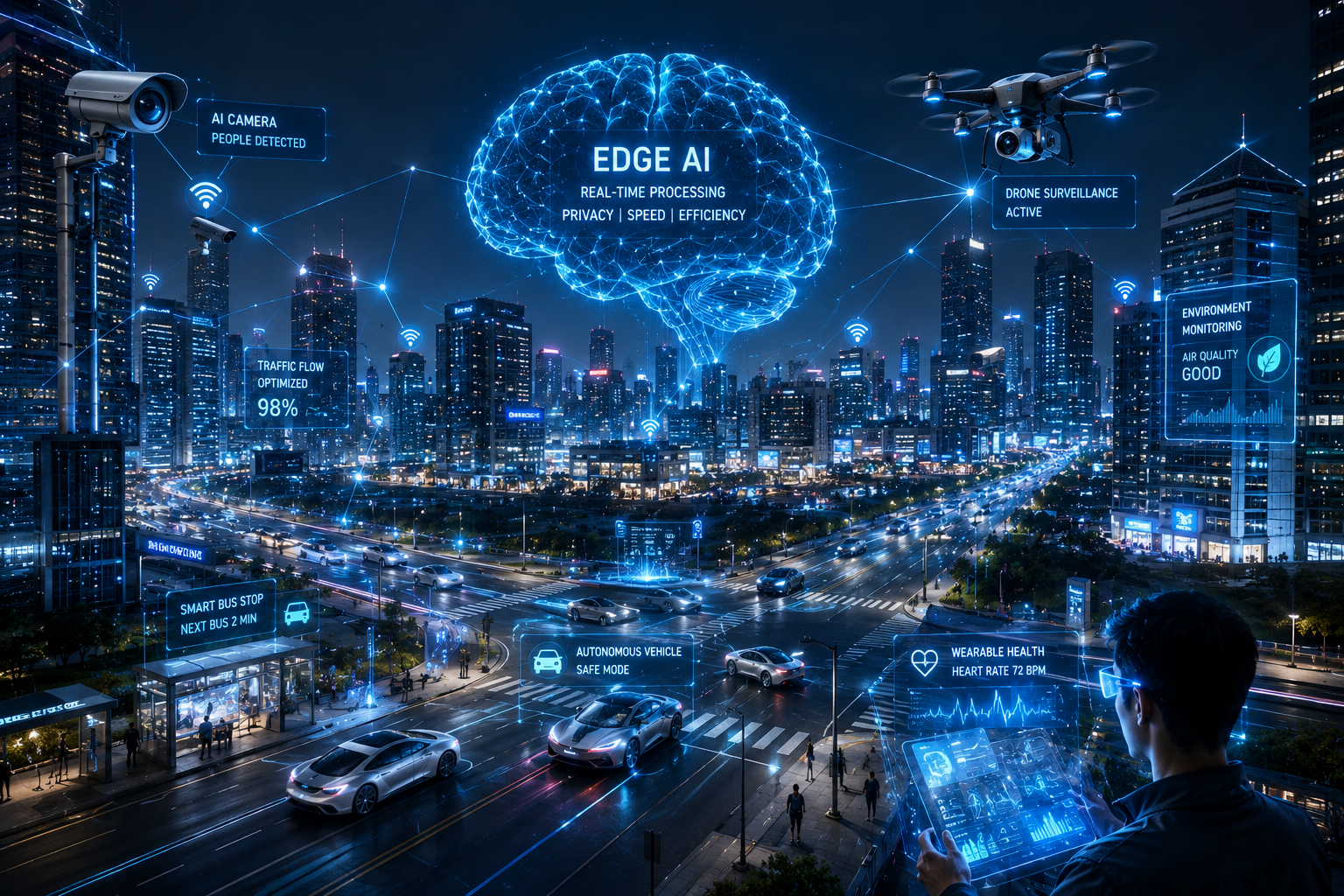
Edge AI is a technology that allows artificial intelligence to run directly on devices where data is generated. Instead of constantly sending information to the cloud, devices can process data locally and make decisions in real time.
Simply put, Edge AI brings intelligence closer to the source of data.
What Exactly Is Edge AI?
Edge AI refers to running machine learning and artificial intelligence models on devices such as:
- Smart cameras
- Smartphones
- Wearables
- IoT sensors
- Raspberry Pi devices
- Industrial gateways
- Drones and robots
These devices use optimized AI models to analyze information and make decisions locally.
For example, a smart security camera with Edge AI can detect a person entering a room and immediately send an alert without uploading every second of video footage to a cloud server.
This approach makes systems faster, smarter, and more efficient.
How Does Edge AI Work?
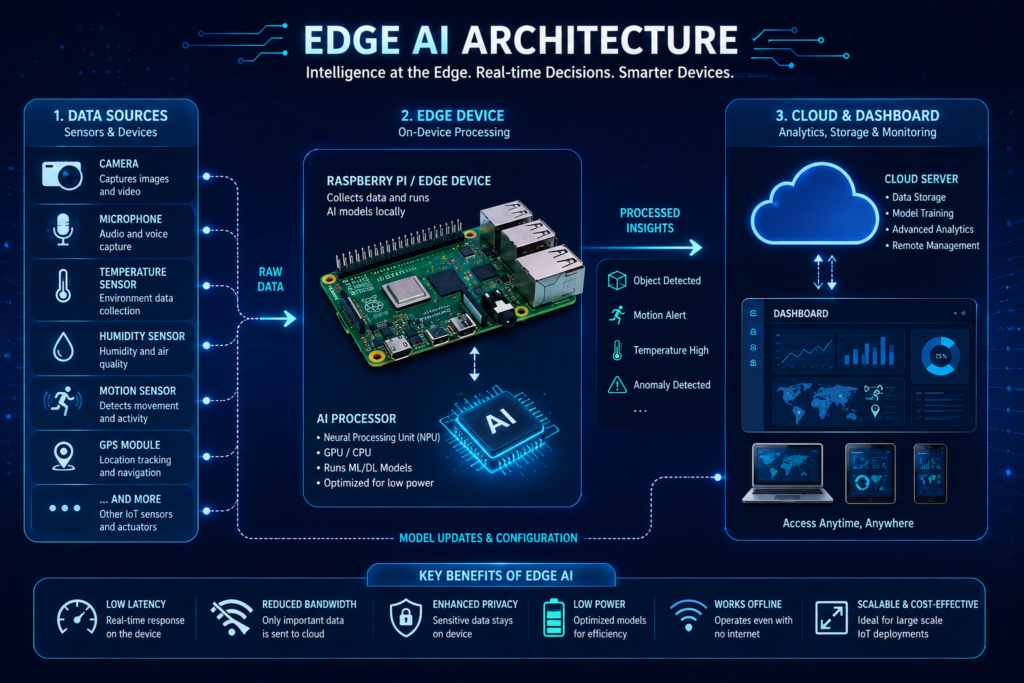
- A typical Edge AI system follows a simple process.
- First, sensors such as cameras, microphones, GPS modules, or temperature sensors collect data.
- Next, an embedded processor containing CPUs, GPUs, or specialized AI chips runs a lightweight AI model on the device itself.
- The AI analyzes the information and takes action immediately.
- Finally, only important events or summaries are sent to the cloud for storage and analytics.
- Imagine a wildlife monitoring camera installed inside a forest.
- Without Edge AI, the system would continuously upload video to the cloud, consuming huge amounts of bandwidth and power.
- With Edge AI, the camera analyzes footage locally and uploads only images that contain animal activity. The result is a faster and far more efficient system.
Why Is Edge AI Important for IoT and Smart Devices?
Real-Time Decision Making
Many applications cannot afford delays.
Autonomous vehicles, industrial robots, and security systems need to make decisions within milliseconds. Sending information to distant servers and waiting for responses could be dangerous. Edge AI eliminates this problem by processing information locally.
Better Privacy and Security
Modern devices collect enormous amounts of personal data, including videos, audio recordings, and location information.
By processing sensitive information directly on devices, Edge AI significantly reduces the amount of private data that needs to travel across networks.
This is particularly important in healthcare, surveillance, and smart city applications.
Lower Bandwidth Costs
IoT devices generate massive volumes of data.
For example, hundreds of CCTV cameras continuously streaming video can quickly overwhelm network resources.
Edge AI filters and processes information locally and transmits only meaningful events.
This dramatically reduces bandwidth requirements and operational costs.
Works Even Without Internet
One of the biggest advantages of Edge AI is reliability.
Cloud-based systems often fail when internet connectivity becomes unstable.
Edge AI systems can continue functioning even in remote areas with poor network coverage.
This capability makes Edge AI extremely valuable in agriculture, mining, wildlife monitoring, and industrial environments.
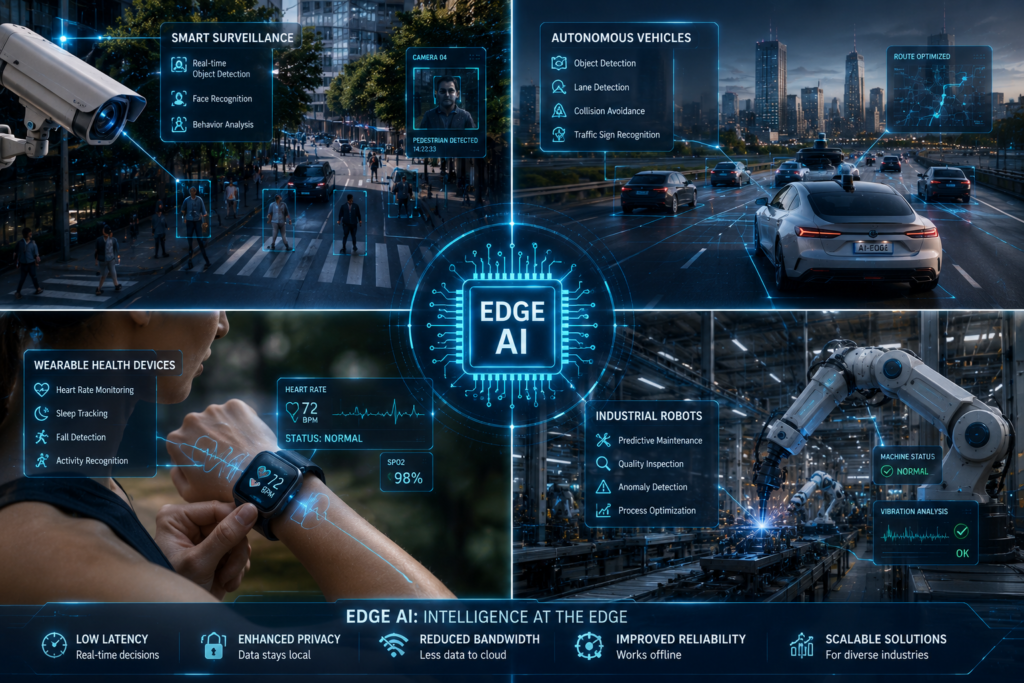
Real-World Applications of Edge AI
I. Smart Surveillance Systems
Modern security cameras can detect people, vehicles, and suspicious activities directly on the device.
II. Smart Homes
Voice assistants and smart appliances can understand commands locally, providing faster responses and improved privacy.
III. Healthcare Devices
Wearables can monitor heart rate, detect falls, and analyze health metrics without depending entirely on cloud servers.
IV. Industrial Automation
Factories use Edge AI for predictive maintenance and anomaly detection, reducing equipment failures and downtime.
V. Wildlife Monitoring
Camera traps equipped with Edge AI can identify animals, filter empty frames, and send alerts only when necessary.
The Future of Edge AI
The future of Artificial Intelligence is not entirely in the cloud.
Industry experts increasingly believe that the next generation of smart devices will rely on a hybrid approach where Edge AI handles real-time decisions while the cloud manages storage, training, and advanced analytics.
As AI chips become more powerful and energy efficient, billions of devices around the world will gain the ability to think and respond independently.
Edge AI is not simply another technology trend.
It represents a fundamental shift in how intelligent systems are built.
The future belongs to devices that are not only connected but also capable of understanding and acting on the world around them.