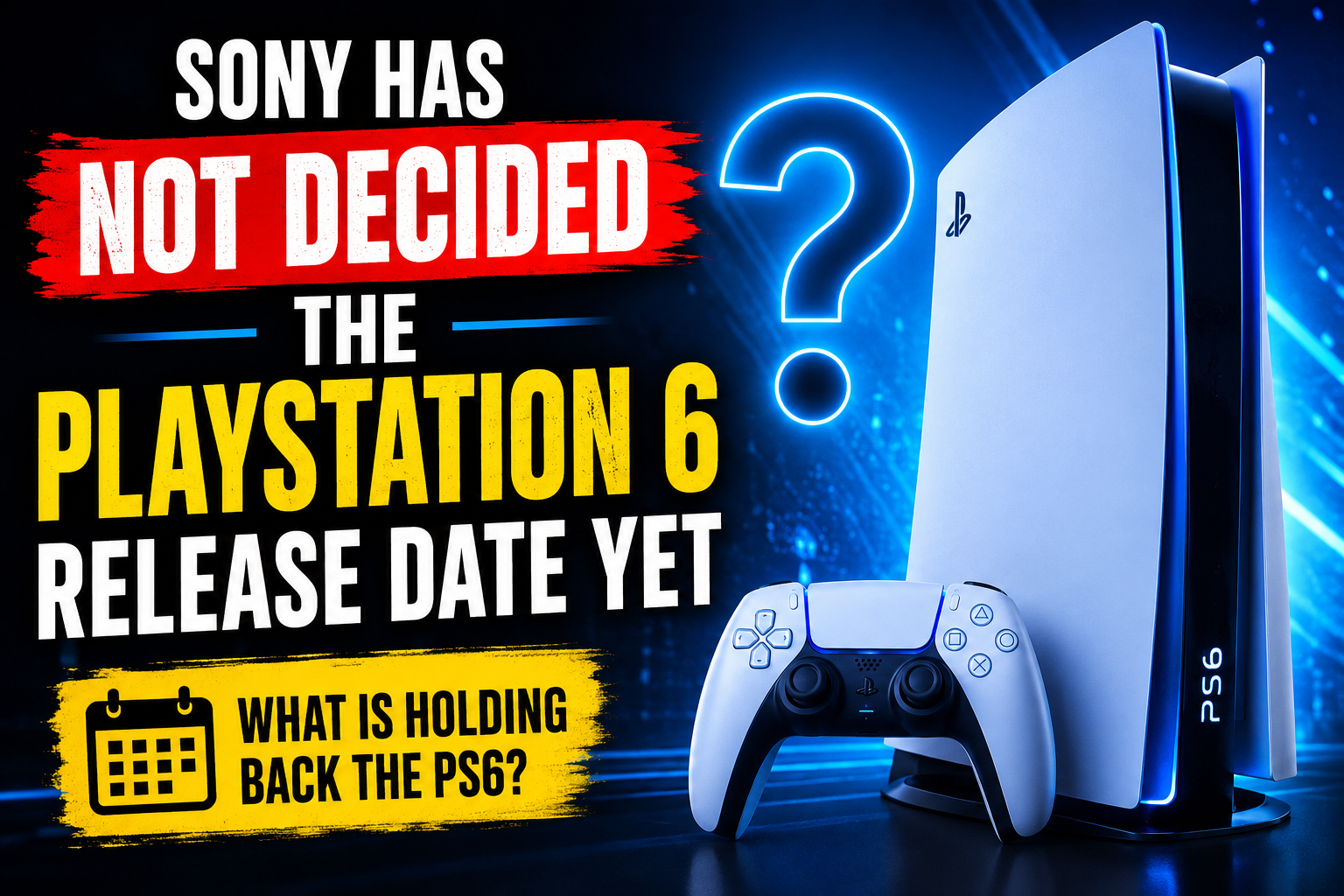
Sony has confirmed that it has not yet decided when the PlayStation 6 will launch, putting an unexpected question mark over the next generation of its hugely successful gaming console.
The update came from Sony CEO Hiroki Totoki in a recent interview with The Wall Street Journal. While the PS6 is widely expected to eventually replace the PlayStation 5, Sony has not committed to a specific launch date or even an official launch window.
For gamers who have been expecting the next PlayStation around the traditional seven-year console cycle, the announcement raises an important question: Why is Sony taking so long to make the decision?
Sony Is Keeping the PS6 Timeline Open
The PlayStation 5 launched in November 2020, meaning the console has now entered the later part of its generation.
Historically, PlayStation consoles have generally followed a roughly six-to-seven-year generation cycle. That has led to widespread expectations that the PS6 could arrive around 2027.
However, Sony has not confirmed that timeline.
According to recent reporting, Totoki said the company has not yet determined the PS6’s launch date. That means reports suggesting a specific PS6 launch year should currently be treated as speculation rather than an official Sony announcement.
Rising AI Demand Could Be a Major Problem
One of the biggest challenges facing Sony is the changing semiconductor market.
The rapid expansion of artificial intelligence has created enormous demand for memory, processors and other components used by data centres. This is putting pressure on the supply chain and increasing component costs across the technology industry.
That matters for a future PlayStation because a console needs to balance performance, component availability and price.
Sony could technically build a much more powerful machine, but if the cost of memory and other components becomes too high, the final retail price could become difficult for mainstream gamers to afford.
Recent reporting has specifically connected the uncertainty surrounding the PS6 with rising component costs and the broader pressure created by the AI boom.
The PS6 Could Become an Extremely Expensive Console
Price could become one of Sony’s biggest challenges with the next generation.
Some analysts have speculated that a PS6 could potentially become dramatically more expensive than previous PlayStation consoles if component costs continue rising. One analyst cited by GamesRadar warned that a console approaching the $1,000 level could significantly restrict its potential audience.
However, it is important to make one thing clear:
Sony has not announced a PS6 price.
Any $800, $900 or $1,000 figures currently circulating online are predictions or analyst estimates, not official pricing.
Sony therefore has to find a balance between building a genuinely next-generation machine and keeping the console affordable enough for a mass-market audience.
PS5 Still Has Plenty of Life Left
Another reason Sony may not be rushing the PS6 is the continued strength of the PS5 ecosystem.
Sony’s gaming business remains an important part of the company’s overall performance. In its latest quarterly results, Sony reported strong profits and raised its full-year operating-profit forecast, with its gaming and image-sensor businesses contributing significantly.
The PS5 also still has major games coming.
One of the biggest is Grand Theft Auto VI, scheduled for November 19, 2026. Analysts expect the game to provide a significant boost to PlayStation software sales and keep the PS5 relevant even as the hardware generation gets older.
This creates an interesting situation for Sony.
Why rush customers towards a new console when the existing platform still has major games capable of driving sales?
GTA VI Could Extend the PS5 Generation
The release of GTA VI could be particularly important.
Rockstar Games’ next Grand Theft Auto is expected to become one of the biggest entertainment releases of the decade. Since it is coming to PS5, Sony has another major reason to continue supporting the existing console.
Instead of launching a new PlayStation immediately before such a major release, Sony can potentially allow the PS5 ecosystem to benefit from the game’s enormous audience.
This could give Sony more time to wait for component prices and supply conditions to improve before committing to the next generation.
Sony Is Also Moving Away From Physical Games
The uncertainty around the PS6 comes at the same time as another major change in Sony’s PlayStation strategy.
Sony announced in July 2026 that physical disc production for new PlayStation games will end starting in January 2028. New games released after that point will be distributed digitally through the PlayStation Store and retailers. Games that were already released or scheduled for disc release before January 2028 are not affected by the change.
This could have a major impact on the PS6 generation.
If the PS6 launches around this period, Sony could potentially use the next generation to push PlayStation even further towards a digital-first ecosystem.
That would mean fewer physical game discs, greater dependence on digital purchases and an even stronger role for the PlayStation Store.
What About the PS6’s Technology?
Sony has not officially revealed the complete specifications of the PlayStation 6.
However, it is reasonable to expect the next generation to focus heavily on technologies that have already become important during the PS5 generation.
These could include:
- More powerful graphics processing
- Advanced ray tracing
- AI-powered image reconstruction
- Faster storage
- Improved energy efficiency
- Higher-quality 4K gaming
- Better support for high frame rates
- Deeper integration with digital services
- Potentially improved cloud gaming capabilities
Sony’s current PS5 Pro already provides an indication of where the company’s graphics technology is heading.
Its PSSR (PlayStation Spectral Super Resolution) technology uses machine-learning techniques to improve image quality while maintaining performance. Sony has also continued rolling out improvements to PSSR across supported games.
That makes AI an interesting area to watch when Sony eventually reveals the PS6.
Sony’s Gaming Strategy Is Changing
The PS6 delay or uncertainty is also connected to a broader transformation happening inside Sony.
CEO Hiroki Totoki has been shifting Sony’s focus away from traditional consumer electronics and towards entertainment, technology and intellectual property.
Sony’s businesses now extend across movies, music, anime, gaming and technology, with entertainment representing a much larger portion of the company’s business than it did in the past.
That means the PlayStation console is increasingly just one part of Sony’s larger entertainment strategy.
The company wants its franchises to reach audiences across multiple platforms and formats.
Games can become television shows. Movies can become games. Characters and intellectual property can exist across different entertainment products.
The PS6 will therefore be important, but it is unlikely to be the only thing determining Sony’s future in gaming.
So, When Will the PlayStation 6 Launch?
There is currently no official PS6 release date.
A 2027 launch has been widely discussed based on the historical PlayStation generation cycle, while some analysts and reports have speculated about a later launch.
But none of these dates should currently be presented as confirmed.
Sony’s latest comments make one thing clear: the company itself has not finalised the timing.
This means gamers should be cautious about social media posts claiming that Sony has officially announced a specific PS6 launch date.
What Gamers Should Expect Next
For now, Sony appears to have several reasons to take its time.
The company needs to monitor:
1. Component prices
AI infrastructure is increasing demand for key semiconductor components.
2. Console affordability
A dramatically more expensive PS6 could reduce its potential audience.
3. PS5 performance
The current console continues to generate revenue and has major releases ahead.
4. Game development cycles
Developers need time to prepare compelling next-generation games.
5. Digital transformation
Sony is already preparing for a future in which new PlayStation games are primarily digital.
6. Market conditions
Sony needs to determine when consumers will be ready to upgrade to another generation.
The Waiting Game Has Begun
The PlayStation 6 is clearly in Sony’s plans, but the company is not ready to tell gamers exactly when it will arrive.
That uncertainty could actually be beneficial.
Launching a new console too early could force Sony to sell expensive hardware at a price that consumers may reject. Waiting, meanwhile, could allow component supply and costs to stabilise while giving the PS5 more time to generate revenue.
The next PlayStation generation could therefore be defined by more than just better graphics.
It could represent a major transition towards AI-assisted gaming, digital-only distribution and a broader entertainment ecosystem.
For now, however, the biggest PS6 announcement is surprisingly simple:
Sony still hasn’t decided when you’re getting it.