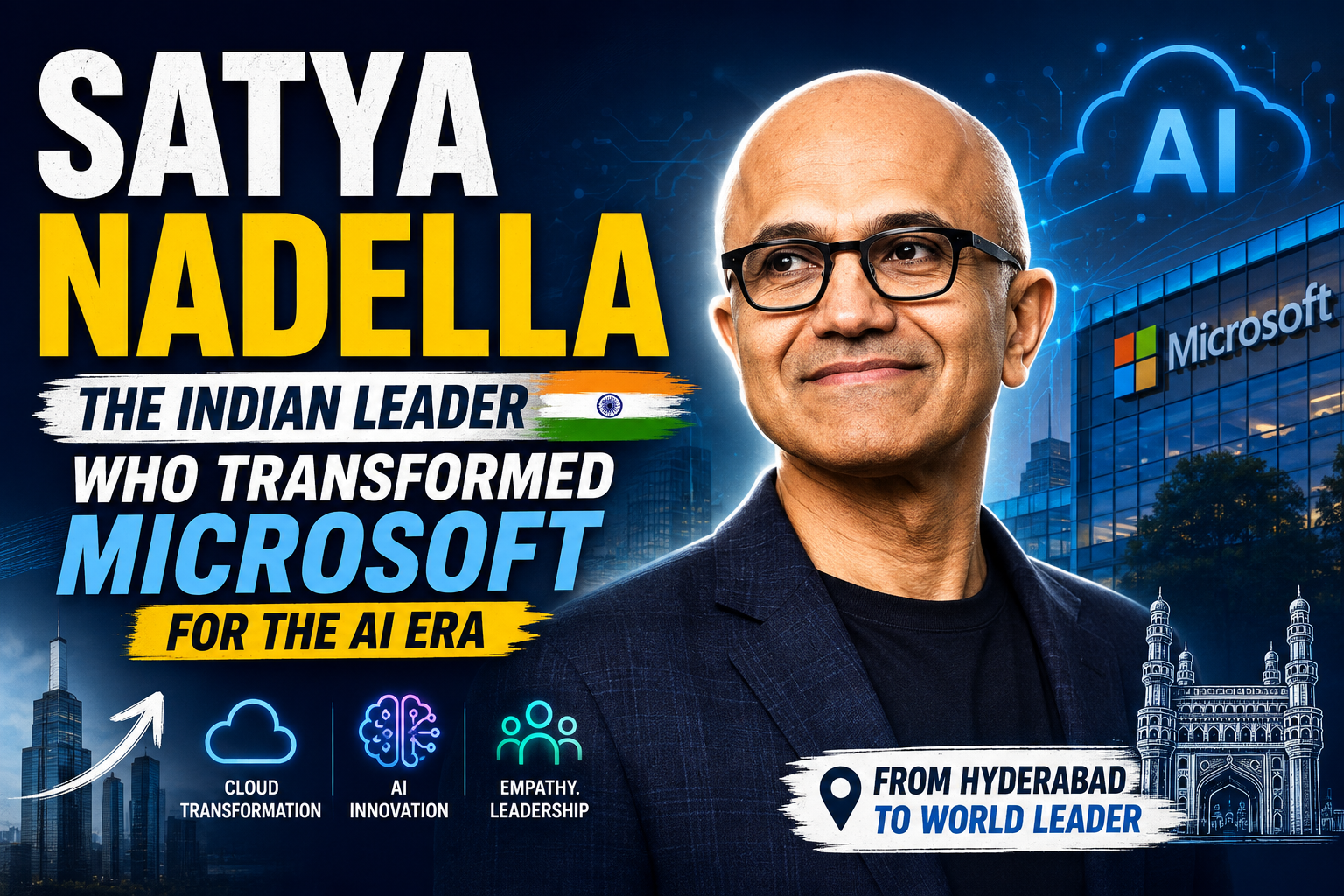
Satya Nadella is one of the most influential technology leaders of the modern era. Born in Hyderabad, India, Nadella rose through the technology industry to become the Chairman and Chief Executive Officer of Microsoft, one of the world’s largest technology companies. His journey from India to the leadership of a global technology giant is a story of education, persistence, empathy, and technological transformation.
From Hyderabad to Microsoft
Satya Narayana Nadella was born in Hyderabad and later moved to the United States to pursue higher education. He earned a bachelor’s degree in electrical engineering from Mangalore University, followed by a master’s degree in computer science from the University of Wisconsin–Milwaukee and an MBA from the University of Chicago.
Before Microsoft, Nadella worked at Sun Microsystems. He joined Microsoft in 1992 and went on to hold several leadership positions across the company’s enterprise and consumer businesses.
His long experience inside Microsoft gave him a deep understanding of the company’s technology, products, customers, and business challenges.
Becoming Microsoft’s CEO
In February 2014, Satya Nadella became Microsoft’s CEO, succeeding Steve Ballmer. He became the company’s third CEO and took charge at an important point in Microsoft’s history.
At the time, Microsoft was traditionally associated with Windows and PC software. Nadella helped shift the company’s focus towards cloud computing, developer platforms, subscriptions, artificial intelligence, and enterprise services.
One of the most important parts of his earlier career at Microsoft was his leadership of the Cloud and Enterprise group. Microsoft credits Nadella with helping transform its cloud infrastructure and services business before he became CEO.
The Cloud-First Transformation
One of Nadella’s biggest contributions to Microsoft has been the company’s aggressive move towards cloud computing.
Under his leadership, Azure became a central part of Microsoft’s technology strategy. Instead of depending primarily on traditional software sales, Microsoft increasingly built its business around cloud infrastructure, services, developer tools, and recurring subscriptions.
This transformation also changed Microsoft’s relationship with developers. Microsoft increasingly embraced technologies and platforms that were previously outside its traditional ecosystem, helping position the company as a major player across the broader technology industry.
A New Culture at Microsoft
Nadella’s influence was not limited to technology. He also emphasised changing Microsoft’s corporate culture.
His leadership philosophy is strongly associated with ideas such as empathy, continuous learning, collaboration, and a “growth mindset”. His book Hit Refresh describes his personal journey and his views on Microsoft’s transformation.
The cultural shift was significant because Microsoft had developed a reputation for intense internal competition during earlier periods of its history. Nadella pushed the company towards greater collaboration and learning.
His approach can be summarised by the idea that successful organisations should continuously learn rather than assume they already have all the answers.
Microsoft and the Rise of AI
The next major chapter of Nadella’s leadership has been artificial intelligence.
Microsoft has invested heavily in AI infrastructure, AI models, developer tools, and products such as Copilot. Nadella has increasingly positioned AI as a foundational technology that can change how people work with software.
In 2026, Microsoft’s leadership communications continue to highlight AI infrastructure and AI agents. Nadella has discussed developments involving Azure’s AI training capabilities and the expansion of Copilot and agent-based technologies.
This represents another major transformation for Microsoft: from a company centred around PC software to a cloud company and increasingly towards an AI-powered technology platform.
Nadella’s Vision for AI Agents
One of the emerging areas of Microsoft’s AI strategy is AI agents.
Traditional AI assistants generally respond to individual prompts. AI agents are designed to handle longer, multi-step tasks and interact with information, software, and workflows.
Microsoft has been developing technologies that allow organisations to create and deploy such agents. Nadella’s recent communications have emphasised long-running agents and Microsoft’s goal of helping organisations build AI capabilities around their own knowledge and workflows.
This could have a major impact on businesses because AI may increasingly move beyond answering questions and begin performing portions of real-world business processes.
More Than Just a Technology CEO
What makes Satya Nadella particularly interesting is that his leadership story is not only about technology.
His philosophy places significant emphasis on empathy. In Hit Refresh, Nadella describes empathy as an important part of how he approaches leadership and technology.
This perspective has helped shape the way he talks about Microsoft’s mission: technology should ultimately empower people and organisations rather than simply exist as an end in itself.
What Young Engineers Can Learn From Satya Nadella
Nadella’s career offers several lessons for students and young software engineers.
1. Keep Learning
Technology changes quickly. Nadella’s career moved from electrical engineering and computer science into cloud computing, enterprise software, and artificial intelligence.
The lesson is simple: your first skill set does not have to be your final skill set.
2. Understand Technology and Business
Nadella combines a technical background with business education and leadership experience. This combination helped him understand not only how technology works but also why customers and organisations adopt it.
3. Adapt to Technological Change
Microsoft’s transformation under Nadella demonstrates the importance of adapting before a technological shift becomes unavoidable.
Cloud computing was followed by AI, and Microsoft has continued investing in new platforms and technologies.
4. Leadership Is Not Only About Technical Knowledge
Nadella’s emphasis on empathy and organisational culture shows that leadership involves understanding people as much as understanding technology.
Satya Nadella’s Continuing Impact
As of 2026, Satya Nadella remains Microsoft’s Chairman and CEO. Microsoft’s official leadership profile continues to identify him in both roles.
His journey represents a remarkable transformation—not only of an individual who moved from Hyderabad to Silicon Valley and eventually led Microsoft, but also of Microsoft itself.
From cloud computing to AI infrastructure, Copilot, and AI agents, the company continues to evolve under Nadella’s leadership.