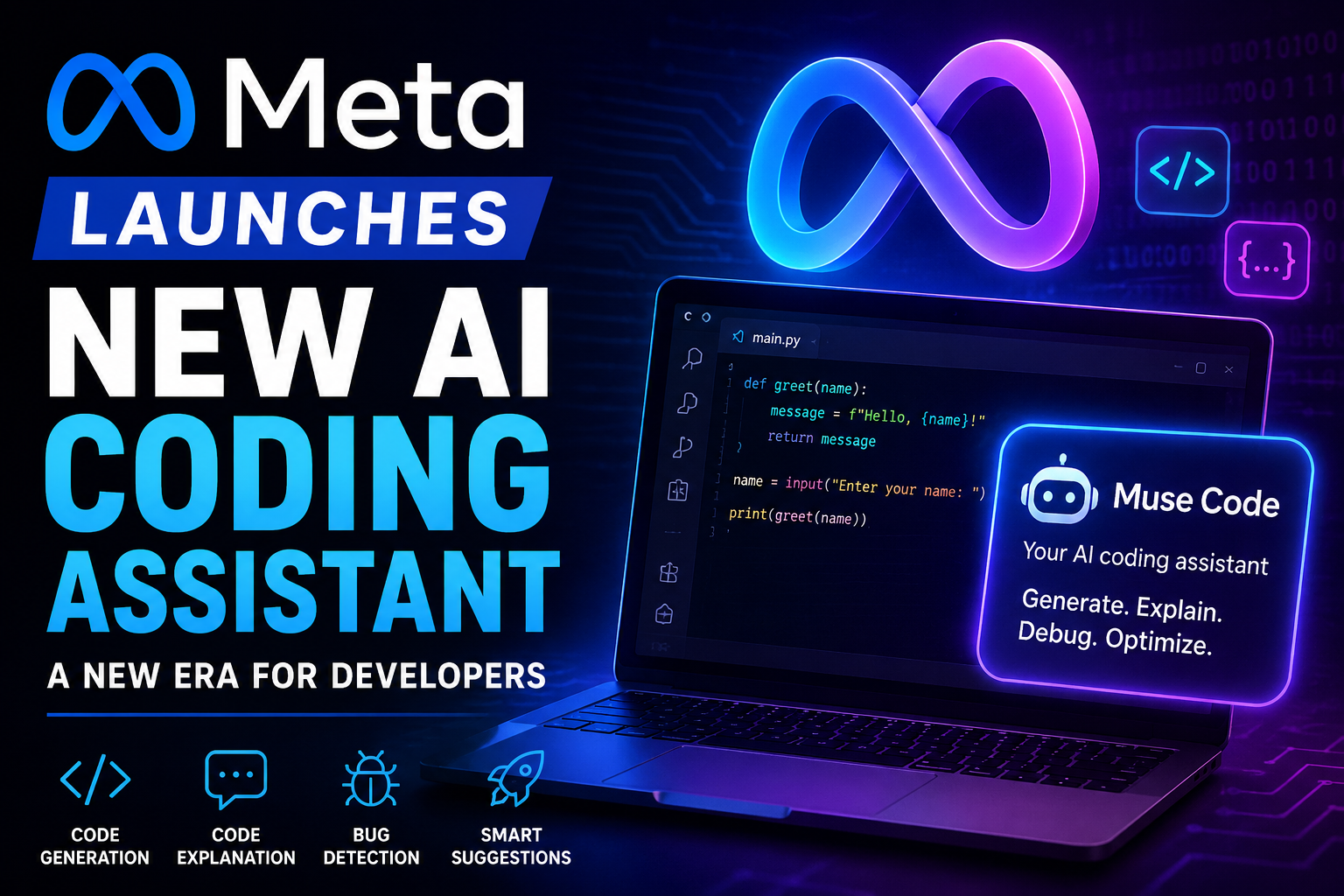
Meta has officially entered the AI coding assistant race with the launch of Muse Code, an advanced AI-powered programming assistant designed to help developers write, understand, debug, and optimize code more efficiently. As artificial intelligence continues to transform software development, Meta’s latest innovation aims to compete directly with GitHub Copilot, OpenAI’s ChatGPT, Anthropic’s Claude, and Google’s Gemini Code Assist.
The launch marks another major step in the rapidly growing AI developer tools market, where companies are racing to create the most intelligent coding companion for programmers.
What is Meta’s AI Coding Assistant?
Meta’s new AI coding assistant, Muse Code, is built to improve developer productivity by assisting with various programming tasks. Rather than simply generating snippets of code, the assistant is designed to understand entire projects, explain complex codebases, suggest improvements, detect bugs, and automate repetitive programming work.
According to Meta, the tool is powered by its latest large language models optimized specifically for software engineering tasks. The assistant supports multiple programming languages and integrates directly into popular development environments.
Its goal is simple: allow developers to spend less time writing repetitive code and more time solving real problems.
Key Features
Meta’s AI coding assistant includes several features aimed at both beginner and professional developers.
1. Intelligent Code Generation
Developers can describe what they want in plain English, and the AI generates functional code almost instantly.
For example:
“Create a REST API using Express.js with JWT authentication.”
The assistant produces complete boilerplate code that developers can customize further.
2. Code Explanation
Understanding someone else’s code—or even your own after a few months—can be difficult.
Muse Code can explain functions, classes, algorithms, and architecture in simple language, making it easier for teams to maintain large projects.
3. Bug Detection
The AI scans code for:
- Syntax errors
- Logic mistakes
- Performance issues
- Security vulnerabilities
- Memory leaks
It also recommends fixes before developers deploy applications.
4. Refactoring Suggestions
Instead of only fixing problems, the assistant recommends cleaner, faster, and more maintainable code.
This helps improve software quality without requiring developers to manually review every file.
5. Multi-Language Support
Meta says the assistant supports many popular programming languages, including:
- Python
- JavaScript
- TypeScript
- Java
- C++
- Go
- Rust
- PHP
Support for additional languages is expected in future updates.
Integration with Development Tools
One of the biggest advantages is integration with existing developer workflows.
Muse Code can work inside popular IDEs such as:
- Visual Studio Code
- JetBrains IDEs
- Cloud-based development environments
- Git repositories
This means developers don’t need to leave their editor to ask questions or generate code.
How Does It Compare with GitHub Copilot?
The AI coding assistant market has become highly competitive.
| Feature | Meta Muse Code | GitHub Copilot |
|---|---|---|
| Code Generation | ✅ | ✅ |
| Bug Detection | ✅ | ✅ |
| Code Explanation | ✅ | ✅ |
| Project Understanding | Advanced | Advanced |
| Multi-language Support | Yes | Yes |
| AI Chat | Yes | Yes |
Meta is focusing heavily on understanding entire codebases rather than only generating small snippets, an area where AI assistants are rapidly evolving.
Benefits for Developers
Faster Development
Routine coding tasks become significantly quicker.
Better Learning
Students can use AI explanations to understand programming concepts more easily.
Higher Code Quality
Automatic bug detection and optimisation improve software reliability.
Increased Productivity
Developers can spend more time designing systems instead of writing repetitive boilerplate.
Challenges and Concerns
Despite the excitement, AI coding assistants still face several limitations.
AI Can Make Mistakes
Generated code should always be reviewed before production deployment.
Security Risks
Developers must verify that generated code follows secure coding practices.
Licensing Questions
The software industry continues to debate how AI models are trained on publicly available code.
Privacy
Organisations working with confidential source code may require strict privacy controls before adopting AI assistants.
The Growing AI Coding Assistant Market
Meta joins a rapidly expanding market that already includes:
- GitHub Copilot
- OpenAI ChatGPT
- Anthropic Claude
- Google Gemini Code Assist
- Amazon CodeWhisperer
- JetBrains AI Assistant
As competition increases, developers are likely to benefit from faster innovation, better features, and improved pricing.
Industry analysts expect AI-assisted programming to become a standard part of software development over the next few years.
What This Means for the Future
AI is changing the role of software developers rather than replacing them.
Instead of writing every line manually, programmers increasingly act as architects, reviewers, and problem-solvers while AI handles repetitive coding tasks.
Meta’s entry into this space further confirms that AI-powered development tools are becoming an essential part of the modern software engineering workflow.
As these assistants become more capable, they could dramatically reduce development time, improve software quality, and make programming more accessible to beginners.