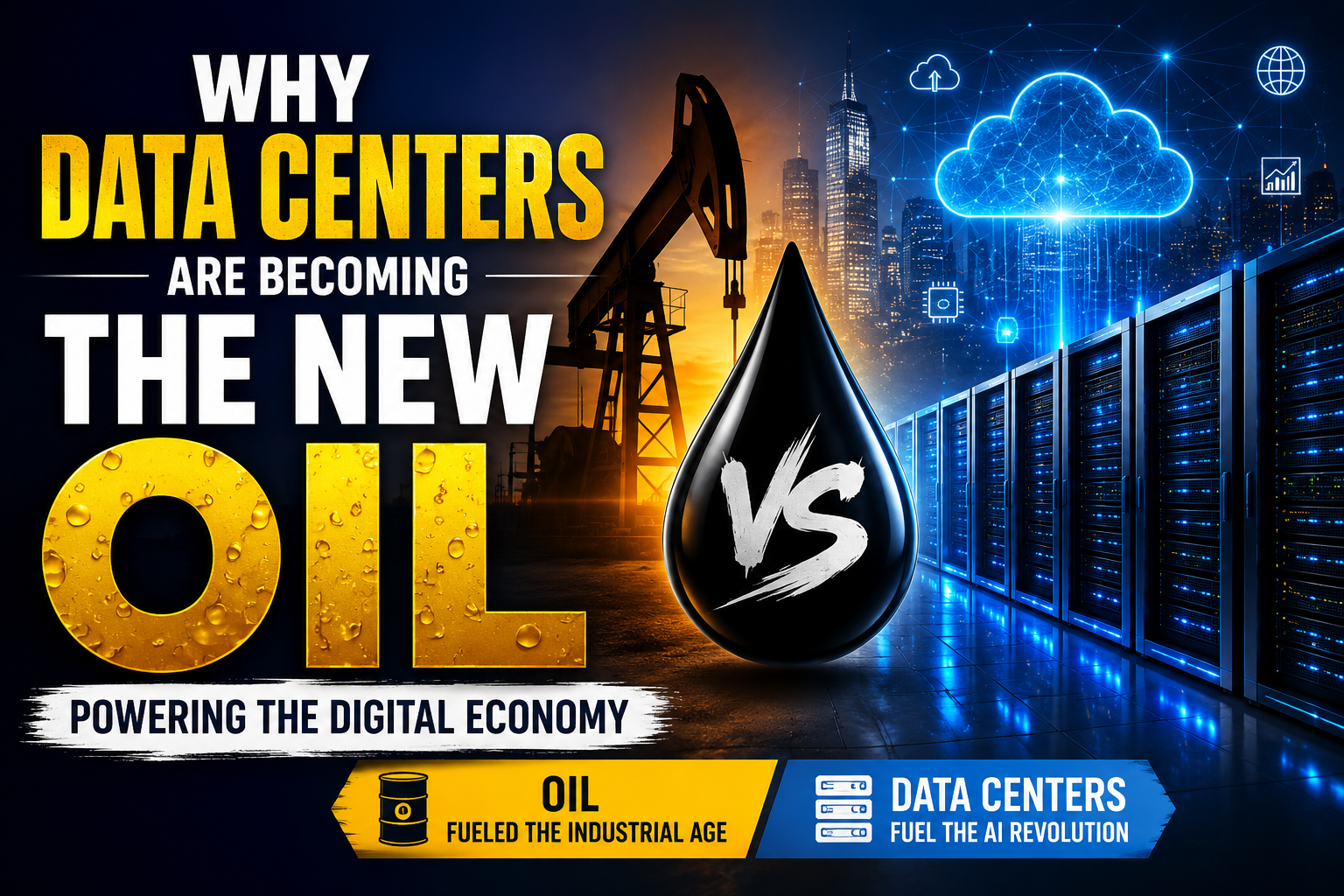
Discover why data centres are becoming the new oil of the digital economy. Learn how AI, cloud computing, and massive data growth are driving global investments in modern data centres.
The phrase “Data is the new oil” has been popular for years. But in 2026, another phrase is rapidly gaining attention:
“Data centres are the new oil.”
Just as oil fuelled the Industrial Revolution, data centres are powering the artificial intelligence revolution. Every ChatGPT conversation, YouTube video, online payment, cloud application, and AI-generated image depends on powerful servers running inside massive data centres.
As countries compete to become AI leaders, the race is no longer just about building better software. It’s about building the infrastructure that powers it.
In this article, we’ll explore why data centres are becoming one of the world’s most strategic assets and why governments and technology companies are investing billions in them.
What Is a Data Centre?
A data centre is a secure facility filled with thousands of high-performance computers (servers), networking equipment, and storage systems.
These facilities process, store, and distribute digital information around the clock.
Every time you:
- Search on Google
- Watch Netflix
- Use ChatGPT
- Store files in Google Drive
- Make a UPI payment
- Shop on Amazon
Your request is processed by servers located inside data centres.
Without data centres, the internet simply would not function.
Why are data centres compared to oil?
During the 20th century, countries with oil reserves became economic superpowers because industries, transportation, and manufacturing depended on energy.
Today, the digital economy depends on computing power instead of oil.
Modern AI systems require enormous computational resources, making data centres the backbone of innovation.
Just like oil refineries transform crude oil into fuel, data centres transform raw digital data into valuable services, insights, and AI intelligence.
This comparison has become stronger because:
- AI requires massive computing power.
- Cloud services rely on distributed server infrastructure.
- Businesses are becoming increasingly data-driven.
- Digital services now influence every industry.
AI Is Fueling an Unprecedented Boom
Artificial intelligence has dramatically increased demand for computing infrastructure.
Training modern AI models requires the following:
- Thousands of GPUs
- High-speed networking
- Petabytes of storage
- Continuous electricity
- Advanced cooling technologies
Companies developing AI assistants, autonomous systems, robotics, and scientific research all require massive data centre capacity.
As AI adoption accelerates, existing facilities are reaching their limits, driving the construction of larger and more advanced data centres worldwide.
Tech giants are spending billions.
Major technology companies are investing at record levels.
Some of the biggest investors include:
- Microsoft
- Amazon Web Services (AWS)
- Meta
- OpenAI partners
- Oracle
- NVIDIA
These companies are building hyperscale campuses capable of housing hundreds of thousands of servers.
The competition is no longer just about creating the best AI model—it’s about owning enough computing infrastructure to support future demand.
Data Centers Have Become Strategic Infrastructure
Governments now view data centres as national strategic assets.
Countries are competing to attract investments because data centres:
- Create high-skilled jobs
- Support local cloud services
- Improve cybersecurity
- Strengthen digital sovereignty
- Enable AI innovation
- Attract technology companies
Many nations are introducing incentives such as tax benefits, land allocation, and renewable energy support to encourage new projects.
India’s Opportunity
India is rapidly emerging as one of the fastest-growing data centre markets.
Several factors are driving growth:
- Rapid internet adoption
- Expansion of digital payments
- Government digital initiatives
- AI startup ecosystem
- Growing cloud adoption
- Data localization requirements
Cities such as Mumbai, Hyderabad, Chennai, Bengaluru, Noida, and Pune are becoming major data centre hubs.
As AI demand increases, India could become a global destination for digital infrastructure investment.
The Hidden Challenge: Electricity
Building a data centre isn’t just about installing servers.
These facilities require enormous amounts of electricity.
Large AI data centres can consume as much power as a small city.
To address this challenge, companies are investing in:
- Solar energy
- Wind power
- Battery storage
- Nuclear energy partnerships
- Advanced cooling systems
- Energy-efficient AI hardware
Sustainable infrastructure is becoming a competitive advantage.
Water Consumption Is Another Concern
Cooling thousands of servers generates significant heat.
Many facilities use millions of litres of water every day to maintain safe operating temperatures.
This has raised environmental concerns, especially in regions facing water shortages.
The industry is responding with:
- Liquid cooling
- Air cooling innovations
- Water recycling systems
- Immersion cooling technologies
Future data centres will need to balance performance with environmental responsibility.
AI Is Changing Data Center Design
Traditional data centres were designed primarily for storage and standard cloud applications.
AI workloads require entirely different infrastructure.
Modern AI facilities include the following:
- High-density GPU clusters
- AI networking fabrics
- Faster storage systems
- Liquid cooling
- Intelligent power management
- AI-based monitoring systems
These next-generation facilities are becoming specialised AI factories.
Why Investors Are Paying Attention
Investment firms increasingly see data centres as long-term infrastructure assets.
Demand continues to rise because:
- AI adoption is accelerating.
- Businesses are moving to the cloud.
- Edge computing is expanding.
- Video streaming continues to grow.
- Internet-connected devices are increasing.
Unlike many technology trends, demand for digital infrastructure is expected to remain strong for years.
The Future of Data Centers
Experts believe future facilities will become:
- Greener
- More automated
- AI-managed
- More energy efficient
- Faster
- Closer to users through edge computing
We may also see floating data centres, underwater facilities, and data centres powered entirely by renewable energy.
The next decade will likely redefine how computing infrastructure is built.
Final Thoughts
Oil powered the industrial age.
Data powers the digital age.
But data alone has little value without the infrastructure to process it. That infrastructure is the modern data centre.
As artificial intelligence, cloud computing, autonomous systems, and connected devices continue to grow, data centres are becoming one of the world’s most valuable strategic assets.
The countries and companies that build the most efficient, sustainable, and powerful data centres will help shape the future of the global digital economy.
In many ways, the world’s newest race isn’t for oil fields—it’s for data centres.