India’s startup ecosystem is entering a new phase.
For years, the Indian startup story was largely about venture capital, billion-dollar valuations and rapid user growth. But in 2026, an increasing number of technology companies are taking the next major step: going public.
The IPO market is becoming an important exit route for founders and investors—and a new way for ordinary Indian investors to participate in the country’s technology economy.
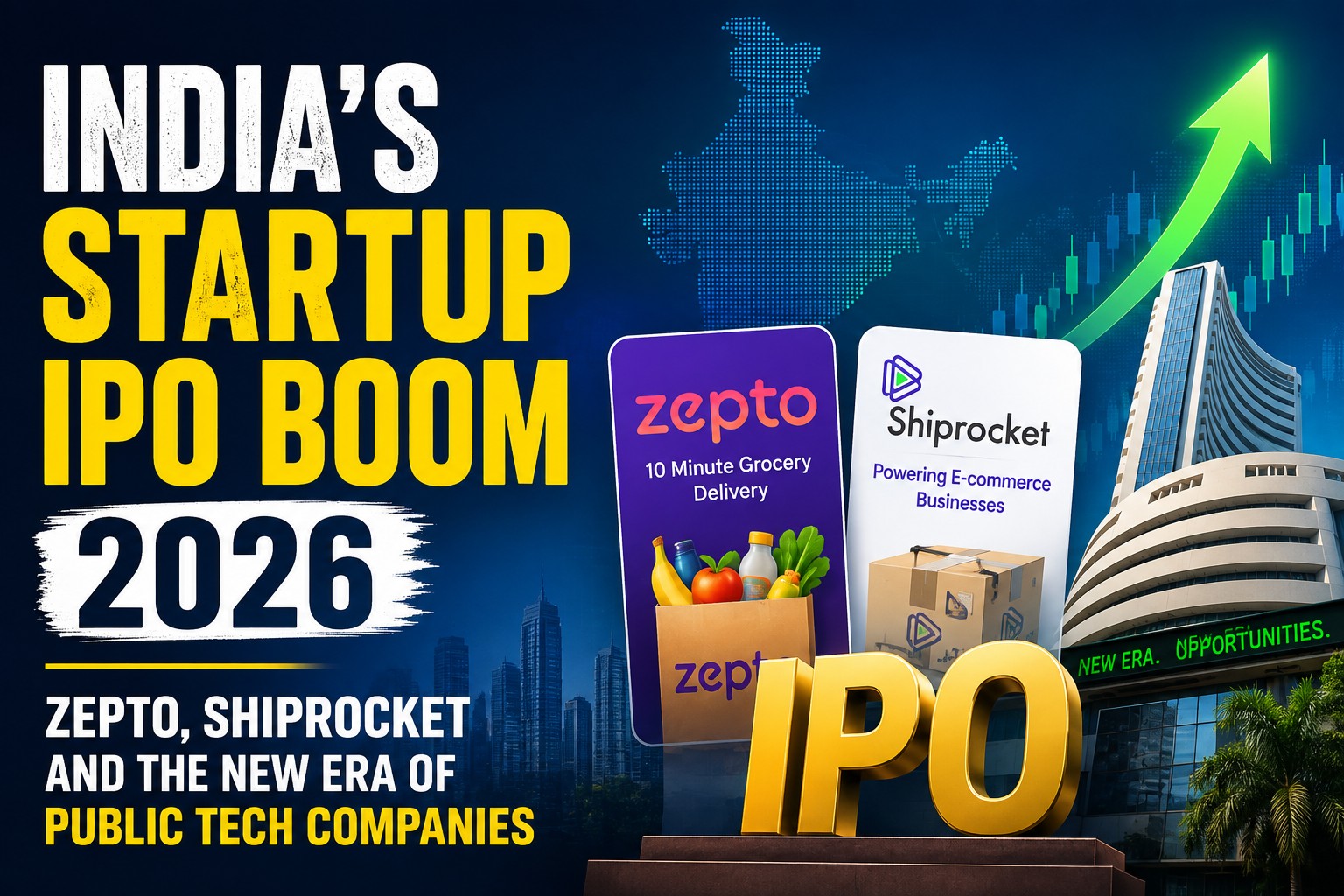
Two names currently attracting significant attention are Zepto and Shiprocket.
While their businesses are very different, their IPO journeys represent something bigger: India’s transition from a private-startup economy toward a public technology-company ecosystem.
🚀 India’s Startup IPO Story Is Getting Bigger
India’s new-age technology companies have increasingly moved toward public markets.
The momentum follows a strong startup IPO cycle in recent years, with companies from fintech, food delivery, e-commerce and consumer technology demonstrating that Indian public-market investors are willing to evaluate businesses that were once considered too young or too unconventional.
In 2026, the pipeline remains active, with Zepto and Shiprocket among the most closely watched names. Inc42’s current startup IPO tracker describes continued momentum for new-age technology companies entering the public markets.
This represents an important change in the Indian startup ecosystem.
Earlier, the typical journey looked like:
Startup → Venture Capital → More Funding → Unicorn → Acquisition/Next Funding Round
Now, another path is becoming increasingly common:
Startup → Venture Capital → Scale → IPO → Public Company
🛒 Zepto: Quick Commerce Goes Public
Few Indian startups represent the country’s new digital economy as strongly as Zepto.
Founded in 2020, the quick-commerce company built its business around delivering groceries and everyday products rapidly through a network of dark stores.
Its potential IPO is particularly significant because it would give public-market investors direct exposure to India’s rapidly evolving quick-commerce industry.
Zepto received SEBI approval for its IPO in May 2026. Reports at the time indicated that the issue could be in the range of ₹8,000–9,000 crore, although the final structure and size can change before launch.
An updated filing reported a proposed ₹8,010 crore fresh issue, along with an offer-for-sale component involving existing shareholders.
Why is Zepto’s IPO important?
Because it tests whether public investors are willing to value a company primarily on growth, market expansion and future profitability potential, rather than simply current profits.
Quick commerce is an extremely competitive industry.
Companies are spending heavily on:
- Dark-store expansion
- Delivery infrastructure
- Customer acquisition
- Discounts
- Technology
- Inventory
- Logistics
That makes profitability and unit economics particularly important for investors.
📦 Shiprocket: The Technology Behind E-Commerce
While Zepto is focused on consumer-facing quick commerce, Shiprocket operates behind the scenes of India’s e-commerce ecosystem.
The company provides technology and logistics solutions that help online merchants manage shipping, fulfillment, returns and other aspects of e-commerce operations.
And today, August 12, 2026, Shiprocket’s IPO has opened for public subscription, with the issue scheduled to remain open until August 14. The offering comprises a ₹885 crore fresh issue and a ₹732 crore offer for sale.
Before the IPO opened, Shiprocket also raised approximately ₹727 crore from anchor investors, with participation from major institutional investors including Goldman Sachs, HDFC Mutual Fund and SBI Mutual Fund.
This institutional participation is noteworthy because it demonstrates that large investors are willing to put significant capital behind India’s technology-enabled logistics sector.
💰 Why Are Startups Choosing IPOs?
There are several reasons.
1. Access to Large-Scale Capital
An IPO can provide companies with substantial capital to expand their operations.
For a technology company, that money can be used for:
- Technology infrastructure
- New products
- Acquisitions
- Market expansion
- Hiring
- Debt repayment
- Research and development
For example, Shiprocket’s fresh IPO proceeds are intended for areas including technology infrastructure, expansion and debt repayment.
2. Early Investors Get an Exit
Most startups raise money from venture capital and institutional investors.
Eventually, those investors need a way to realize returns.
An IPO provides a liquid public market where some existing shareholders can sell their holdings.
This creates a healthier cycle:
VC investment → Startup growth → IPO → Investor exit → Capital recycled into new startups
That can potentially strengthen the entire startup ecosystem.
📈 3. Public Market Visibility
Being publicly listed changes how a company is perceived.
A listed technology company has to regularly disclose financial information and business developments to investors.
This can improve:
- Transparency
- Corporate governance
- Financial discipline
- Public visibility
- Institutional coverage
The company is no longer accountable only to private investors.
It becomes accountable to public shareholders.
🇮🇳 Why 2026 Could Be a Turning Point
The most important aspect of the startup IPO boom isn’t simply the number of companies going public.
It is the change in investor mindset.
Indian investors are increasingly familiar with technology businesses.
They understand concepts such as:
- SaaS
- Fintech
- Quick commerce
- E-commerce
- Digital payments
- Platform businesses
- Network effects
- Customer acquisition costs
- Contribution margins
A decade ago, many of these business models were unfamiliar to traditional public-market investors.
Today, they are becoming part of mainstream investing discussions.
⚠️ But IPO Doesn’t Automatically Mean Success
This is where investors need to be careful.
A startup becoming a public company doesn’t suddenly make its business profitable.
A company can have:
High revenue + rapid growth + strong brand
and still produce significant losses.
This is particularly relevant for companies operating in highly competitive industries.
For example, Shiprocket is entering the public market while still being in an investment-heavy phase and without having posted a net profit, according to recent reporting.
That means investors need to look beyond the excitement surrounding the IPO.
🔍 What Should Investors Watch?
Instead of asking only:
“Will the IPO give listing gains?”
Investors should ask much more important questions.
Revenue Growth
Is the company consistently increasing revenue?
Profitability
Can the company eventually generate sustainable profits?
Cash Burn
How much money does the company consume to maintain growth?
Unit Economics
Does each customer, order or transaction eventually generate attractive economics?
Competition
Can competitors easily replicate the business?
Valuation
Is the IPO price reasonable compared with the company’s growth and financial performance?
Use of IPO Funds
Will the money raised create long-term business value?
These questions are far more important for long-term investors than short-term IPO hype.
🏢 From Startup to Public Company
Going public fundamentally changes the culture of a technology company.
A startup can sometimes prioritize:
Growth → Market Share → User Acquisition
A public company must increasingly balance:
Growth + Profitability + Governance + Shareholder Returns
This can be challenging.
Founders have to deal with quarterly expectations, institutional investors, analysts, regulatory requirements and public scrutiny.
The transition from startup to public company is therefore not simply a financial event.
It is an organizational transformation.
🤖 The Next Generation Could Be AI Startups
The startup IPO boom could eventually move beyond fintech, e-commerce and logistics.
India’s next generation of public technology companies could emerge from:
- Artificial intelligence
- SaaS
- Cybersecurity
- Semiconductor technology
- Robotics
- Defence technology
- Climate technology
- Healthtech
- Enterprise software
India’s growing AI and deep-tech ecosystem could produce companies capable of reaching public markets later this decade.
That would represent another major evolution:
From consumer internet startups → to deep-tech and AI companies.
🌏 India Is Building Its Own Public Tech Ecosystem
One of the biggest long-term consequences of the startup IPO boom is the creation of a stronger Indian public-market technology ecosystem.
Consider the evolution:
2010s:
Indian startups focused heavily on fundraising and user growth.
Early 2020s:
India produced multiple unicorns and large technology platforms.
Mid-2020s:
New-age companies increasingly began entering public markets.
Late 2020s:
AI, SaaS, semiconductor and deep-tech startups could become the next generation of listed technology companies.
This creates a potential cycle where successful public companies generate wealth, experienced founders start new businesses and investors recycle capital into emerging startups.
🔮 What Does the Future Look Like?
Zepto and Shiprocket are important not simply because they are large startups.
They represent two different sides of India’s technology economy.
Zepto represents the consumer-facing digital economy—quick commerce, logistics, dark stores and changing consumer behaviour.
Shiprocket represents the infrastructure behind digital commerce—technology, shipping, fulfilment and merchant enablement.
If these companies successfully transition into strong public businesses, they could encourage more Indian startups to consider the IPO route.
But public markets will ultimately decide which companies deserve premium valuations.
🇮🇳 The New Era of Indian Tech Companies
India’s startup ecosystem is entering an interesting stage.
The question is no longer simply:
“Can an Indian startup become a unicorn?”
The next question is:
“Can an Indian unicorn become a great public company?”
That distinction matters.
A successful startup needs to prove that it can grow.
A successful public company needs to prove that it can grow sustainably, manage capital efficiently, build durable competitive advantages and create long-term shareholder value.
Zepto and Shiprocket are now part of that experiment.
And if the IPO wave continues, the coming years could produce a new generation of Indian technology companies that are not only billion-dollar startups but also globally competitive public companies built in India. 🇮🇳🚀