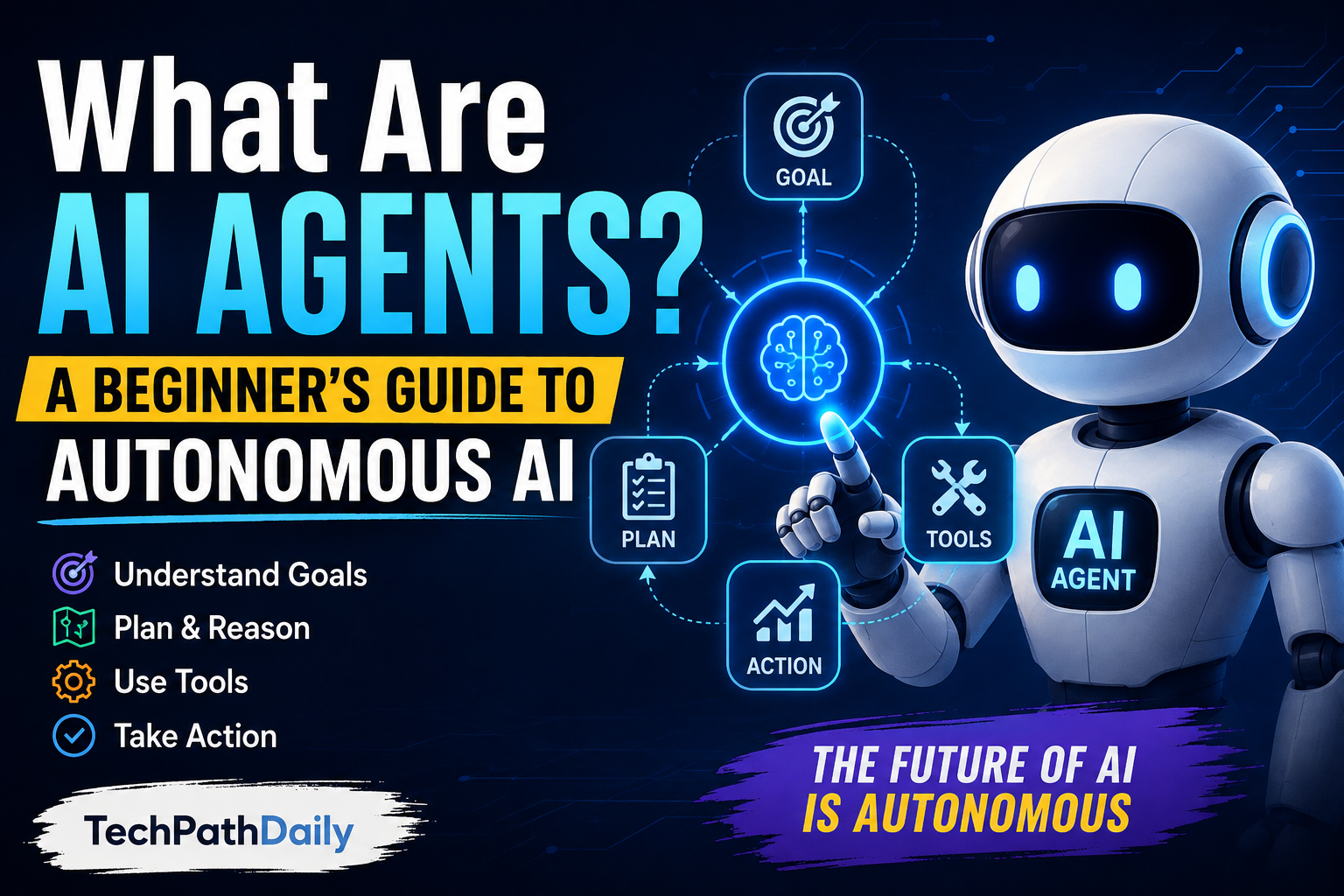
Artificial intelligence is moving beyond simple question-and-answer chatbots. The next major shift is AI agents—systems that can understand a goal, plan multiple steps, use external tools, and take actions with limited human intervention.
For example, a traditional chatbot might tell you how to book a flight. An AI agent could potentially search available flights, compare options, interact with a booking system, and complete the process according to rules and permissions.
This shift from generating answers to taking actions is one reason AI agents and agentic AI have become important areas of AI development.
In this guide, we’ll explain what AI agents are, how AI agents work, their architecture, types, real-world applications, benefits, limitations, and what the future of autonomous AI could look like.
What Are AI Agents?
An AI agent is a software system that uses artificial intelligence to pursue a goal by reasoning about a task, deciding what actions to take, using available tools, and adapting based on the results.
Modern AI agents are often powered by large language models (LLMs). The model acts as the reasoning engine while tools, data sources, memory, and orchestration mechanisms allow the system to interact with the outside world.
Google Cloud describes AI agents as systems capable of reasoning, planning, memory, and taking actions on behalf of users.
A simple way to understand the difference is:
Traditional chatbot:
User → Question → AI → Answer
AI agent:
User → Goal → AI plans → Uses tools → Observes results → Adjusts → Completes task
This ability to act toward a goal rather than simply generate a response is what makes AI agents different from conventional chatbots.
AI Agent vs Chatbot: What’s the Difference?
A chatbot generally waits for a user message and produces a response.
An AI agent can go further by breaking a goal into multiple steps and using tools to accomplish those steps.
| Feature | Traditional Chatbot | AI Agent |
|---|---|---|
| Answers questions | Yes | Yes |
| Generates text | Yes | Yes |
| Plans multiple steps | Limited | Yes |
| Uses external tools | Limited | Yes |
| Takes actions | Usually limited | Yes |
| Maintains state/memory | Sometimes | Often |
| Autonomous decision-making | Low | Higher |
| Goal-oriented execution | Limited | Yes |
Anthropic makes an important distinction between workflows and agents: workflows follow predefined paths, while agents dynamically decide how to use tools and accomplish a task.
This distinction is important because not every AI application needs to be an autonomous agent.
How Do AI Agents Work?
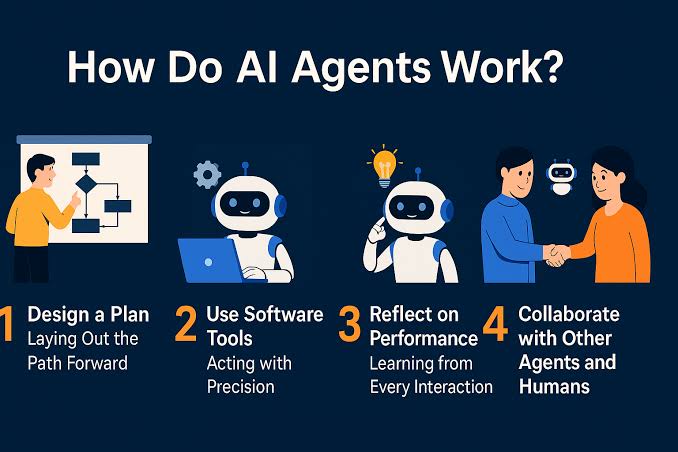
At a high level, an AI agent operates through a continuous cycle:
Understand → Plan → Act → Observe → Adjust
Let’s break this down.
1. The User Gives a Goal
Everything starts with a goal.
For example:
“Find three affordable hotels in Mumbai for this weekend and compare them.”
The AI agent doesn’t necessarily answer immediately.
It first needs to determine what actions are required.
2. The AI Agent Understands the Request
The underlying AI model interprets the user’s instructions.
It identifies important information such as:
- Destination
- Dates
- Budget
- Number of people
- Required preferences
- Desired output
The agent then converts the natural-language request into a task it can work on.
3. The Agent Creates a Plan
The agent may break the task into smaller steps.
For example:
- Search hotels.
- Collect prices.
- Check availability.
- Compare ratings.
- Filter according to budget.
- Present the best options.
This is where AI agents differ significantly from basic prompt-response systems.
The system can determine what needs to happen next.
4. The Agent Uses Tools
An AI model by itself cannot necessarily perform every real-world action.
That’s why agents are connected to tools.
Examples include:
- APIs
- Web search
- Databases
- Calculators
- Code execution
- Email systems
- CRM software
- Payment systems
- Internal company applications
IBM explains that AI agents can use external tools and data sources to execute tasks with minimal human intervention.
For example:
AI Model
   ↓
Decides what needs to happen
   ↓
Selects a tool
   ↓
Calls API
   ↓
Receives result
   ↓
Analyzes result
   ↓
Chooses next action
5. The Agent Observes the Result
After using a tool, the agent receives information.
For example:
Search API → 25 hotels found
The agent can then analyze those results.
It might decide:
“Only five hotels match the user’s budget.”
It can then continue processing those five results.
6. The Agent Adjusts Its Plan
Suppose the first search doesn’t produce suitable results.
A capable agent can modify its approach.
For example:
Search hotels
      ↓
No suitable results
      ↓
Expand search area
      ↓
Search again
      ↓
Compare results
This dynamic decision-making loop is one of the defining characteristics of agentic systems.
Anthropic describes agents as systems where the LLM dynamically directs its own process and tool usage rather than simply following a fixed workflow.
7. The Agent Completes the Task
Once the objective has been achieved, the agent provides the result or performs the requested action.
For example:
“I found three hotels under your budget. Here are their prices, ratings, distance from the city center, and booking options.”
The agent has effectively transformed a high-level instruction into a series of actions.
AI Agent Architecture
A modern AI agent can contain several important components.
Google Cloud identifies major building blocks such as models, grounding, tools, data architecture, orchestration, and runtime.
A simplified architecture looks like this:
             USER
               ↓
          Goal / Request
               ↓
        ┌───────────────┐
        │   AI Agent    │
        └───────────────┘
               ↓
       ┌───────────────┐
       │   LLM / Model  │
       └───────────────┘
          ↓    ↓    ↓
       Memory Tools Data
          ↓    ↓    ↓
       ┌─────────────────┐
       │   Environment   │
       │ APIs / Database │
       │ Web / Software  │
       └─────────────────┘
               ↓
            Result
Let’s understand the major components.
1. AI Model
The AI model acts as the reasoning engine.
Modern agents commonly use LLMs to understand instructions, reason about tasks, generate plans, and decide which tools to use.
2. Tools
Tools give the agent the ability to interact with external systems.
For example:
Tool: Weather API
Tool: Search API
Tool: Database
Tool: Calculator
Tool: Email API
Without tools, an agent may be limited to generating information.
With tools, it can potentially perform actions.
3. Memory
Memory allows an agent to retain relevant information.
There are different approaches to memory, including:
- Conversation history
- User preferences
- Long-term stored information
- Task state
- External databases
For example, an AI travel agent could remember that a user prefers budget hotels and vegetarian restaurants.
4. Knowledge and Grounding
Agents may need access to external knowledge rather than relying only on what the model learned during training.
This can involve:
- Company documents
- Databases
- Knowledge bases
- Search engines
- RAG systems
Grounding can help agents work with current or domain-specific information. Google Cloud includes grounding and knowledge retrieval among the core concepts of AI agent systems.
5. Orchestration
Orchestration controls how different components work together.
For a complex task, an agent may need to:
Receive task
    ↓
Create plan
    ↓
Call Tool A
    ↓
Analyze result
    ↓
Call Tool B
    ↓
Update plan
    ↓
Generate final result
In more advanced systems, multiple agents may collaborate on different parts of the same problem.
Types of AI Agents
AI agents can be categorized in different ways depending on their architecture and behavior.
For modern LLM applications, some useful categories include:
1. Simple AI Agents
These agents perform relatively straightforward tasks.
Examples:
- Customer support
- FAQ assistance
- Information retrieval
- Basic automation
2. Tool-Using Agents
These agents can select and use external tools.
For example:
User asks for currency conversion → Agent calls exchange-rate API → Returns result.
Tool use significantly expands what an AI system can accomplish.
3. Planning Agents
Planning agents break complex objectives into multiple steps.
For example:
“Research the electric vehicle market and prepare a report.”
The agent might:
- Search for information.
- Collect data.
- Compare companies.
- Analyze trends.
- Generate a report.
4. Multi-Agent Systems
Instead of using one AI agent, a system can use multiple specialized agents.
For example:
             Manager Agent
             /     |      \
            /      |       \
       Research   Data    Writing
        Agent     Agent    Agent
One agent might perform research, another analyze data, and another generate the final report.
IBM describes multi-agent systems as systems where multiple specialized agents collaborate on more complex tasks.
Real-World Examples of AI Agents
AI agents aren’t limited to theoretical research. Companies are increasingly exploring them for practical workflows.
1. AI Coding Agents
AI coding agents can help developers with tasks such as:
- Writing code
- Debugging
- Refactoring
- Running tests
- Understanding repositories
- Making code changes
This represents a significant change from autocomplete tools because the AI can work across multiple steps.
2. Customer Support Agents
An AI support agent could:
- Receive a customer complaint.
- Identify the issue.
- Search company documentation.
- Retrieve customer information.
- Suggest a solution.
- Create a support ticket.
- Escalate the case when necessary.
3. Research Agents
Research agents can potentially:
- Search multiple sources
- Extract information
- Compare findings
- Summarize results
- Generate reports
This can reduce the amount of repetitive research work.
4. Sales Agents
Sales agents can help with:
- Lead qualification
- Customer research
- CRM updates
- Email drafting
- Follow-up scheduling
5. IT and DevOps Agents
AI agents can potentially monitor systems, analyze logs, investigate incidents, and recommend or execute remediation actions when appropriate.
However, production systems need strong permissions, monitoring, testing, and human oversight.
AI Agents vs Generative AI
Generative AI and AI agents are related, but they are not the same thing.
Generative AI primarily focuses on creating content such as:
- Text
- Images
- Audio
- Video
- Code
AI agents use AI models as part of a larger system that can reason, use tools, and execute tasks.
A simple way to remember this:
Generative AI creates. AI agents create, decide, and act.
IBM describes agents as a natural progression beyond generative AI because agents can use generated outputs to interact with tools and other systems.
AI Agents vs Automation
Traditional automation generally follows predefined rules.
For example:
IF customer submits form
       ↓
Send confirmation email
An AI agent can potentially handle a less predictable workflow:
Customer message
       ↓
Understand intent
       ↓
Determine problem
       ↓
Search knowledge base
       ↓
Check customer account
       ↓
Choose appropriate action
       ↓
Respond or escalate
The key difference is flexibility.
Traditional automation is often deterministic.
AI agents can make model-driven decisions within the boundaries defined by developers.
For predictable tasks, however, traditional automation can still be the better choice.
Anthropic specifically recommends using the simplest architecture that solves the problem rather than adding agentic complexity unnecessarily.
Benefits of AI Agents
AI agents can provide several advantages.
1. Automation of Complex Tasks
Instead of automating only one step, agents can coordinate multiple steps.
2. Reduced Manual Work
Agents can handle repetitive research, support, administrative, and software tasks.
3. Faster Decision-Making
Agents can analyze information and take actions much faster than manual workflows in appropriate use cases.
4. Better Scalability
One agent-based system can potentially handle large numbers of similar tasks.
5. Natural-Language Interaction
Users can describe goals using normal language rather than learning complex software interfaces.
Limitations and Risks of AI Agents
AI agents are powerful, but they aren’t magic.
Their autonomy also introduces new risks.
1. Incorrect Decisions
An agent can misunderstand a user’s goal or make an incorrect decision.
2. Hallucinations
If an agent relies on inaccurate information, it may produce an incorrect result or take an inappropriate action.
3. Security Risks
Giving an AI access to tools, databases, emails, or other systems increases the potential impact of mistakes and attacks.
Prompt injection is one example of a security risk that becomes especially important when agents can take actions. Anthropic notes that autonomous agents can have greater exposure to unintended actions and prompt-injection attacks.
4. Cost
Agents may make multiple model calls and tool calls for a single task.
That can increase:
- API usage
- Infrastructure costs
- Latency
5. Lack of Predictability
An autonomous system may take a different path to solve the same problem.
This makes testing and evaluation more complicated.
Anthropic notes that agents can be harder to evaluate because they operate across multiple steps, modify state, call tools, and adapt during tasks.
How to Build an AI Agent
Developers don’t need to build everything from scratch.
A typical AI agent application may contain:
Frontend
   ↓
Backend
   ↓
LLM
   ↓
Agent Logic
   ↓
Tools / APIs
   ↓
Database / Knowledge Base
Common technologies involved can include:
- Python or JavaScript
- LLM APIs
- Vector databases
- REST APIs
- Function calling
- RAG
- Agent frameworks
- Cloud infrastructure
Google Cloud, for example, provides an Agent Development Kit and resources for building and deploying AI agents.
Anthropic also recommends simple, composable architectures instead of automatically adding complex frameworks when building agentic systems.
Are AI Agents the Future of AI?
AI agents could become one of the most important directions in AI because they move AI from answering questions to completing tasks.
Instead of opening five applications and manually performing ten steps, users could increasingly describe the outcome they want and allow AI systems to coordinate parts of the process.
However, widespread adoption will depend on more than model intelligence.
The industry also needs:
- Better reliability
- Strong security
- Better evaluation
- Permission controls
- Human oversight
- Lower costs
- Improved interoperability
- Better monitoring
Google Cloud’s 2026 guidance on production-ready agents emphasizes that moving agents from impressive prototypes into production requires infrastructure for areas such as state management, security, governance, orchestration, and scaling.
Final Thoughts
AI agents represent an important evolution in artificial intelligence.
Traditional AI applications often respond to specific inputs. Generative AI expanded what machines can create. AI agents take another step by allowing AI systems to reason about goals, use tools, interact with external systems, and execute multi-step tasks.
But autonomous AI doesn’t mean completely independent AI.
The most useful systems will likely combine AI autonomy with human control, strong security, reliable tools, and carefully designed workflows.
For beginners, the easiest way to remember the concept is:
A chatbot gives you an answer. An AI agent works toward a goal.
As AI moves from simple conversations toward action-oriented systems, understanding AI agents will become increasingly important for developers, businesses, and anyone interested in the future of technology.
Frequently Asked Questions About AI Agents
What is an AI agent in simple terms?
An AI agent is a software system that can understand a goal, decide what steps are needed, use tools, and perform tasks with limited human intervention.
Is ChatGPT an AI agent?
A conversational AI model by itself is not necessarily an autonomous agent. An agentic application can use an AI model together with tools, memory, planning, and execution capabilities to complete multi-step tasks.
What is agentic AI?
Agentic AI refers broadly to AI systems designed to pursue goals and take actions with some degree of autonomy.
What is the difference between AI agents and chatbots?
Chatbots primarily respond to user prompts. AI agents can go further by planning tasks, using external tools, observing results, and taking actions.
Can AI agents replace humans?
AI agents can automate certain tasks, but they don’t eliminate the need for humans. Human oversight remains important, especially when agents can access sensitive data or perform consequential actions.
What technologies are used to build AI agents?
AI agents commonly use LLMs, APIs, databases, tool/function calling, RAG, memory systems, orchestration logic, and cloud infrastructure.
Further Reading
For readers who want to explore AI agents in more depth:
- Google Cloud — Core Concepts of AI Agents: A useful technical overview of models, tools, grounding, memory, orchestration, and runtime.
- Anthropic — Building Effective Agents: Practical guidance on agent architectures, workflows, tool use, and when to use agents.
- IBM — How to Build an AI Agent: A beginner-friendly explanation of how LLM-powered agents interact with external tools and data.
Related reads: https://techpathdaily.com/ai-is-becoming-a-global-weapon/