Artificial intelligence has moved far beyond chatbots and image generators. In 2026, AI is increasingly being used to write code, analyse documents, create marketing content, answer customer questions, process data, assist researchers, and automate repetitive business tasks.
That has created one of the biggest questions in the modern workplace:
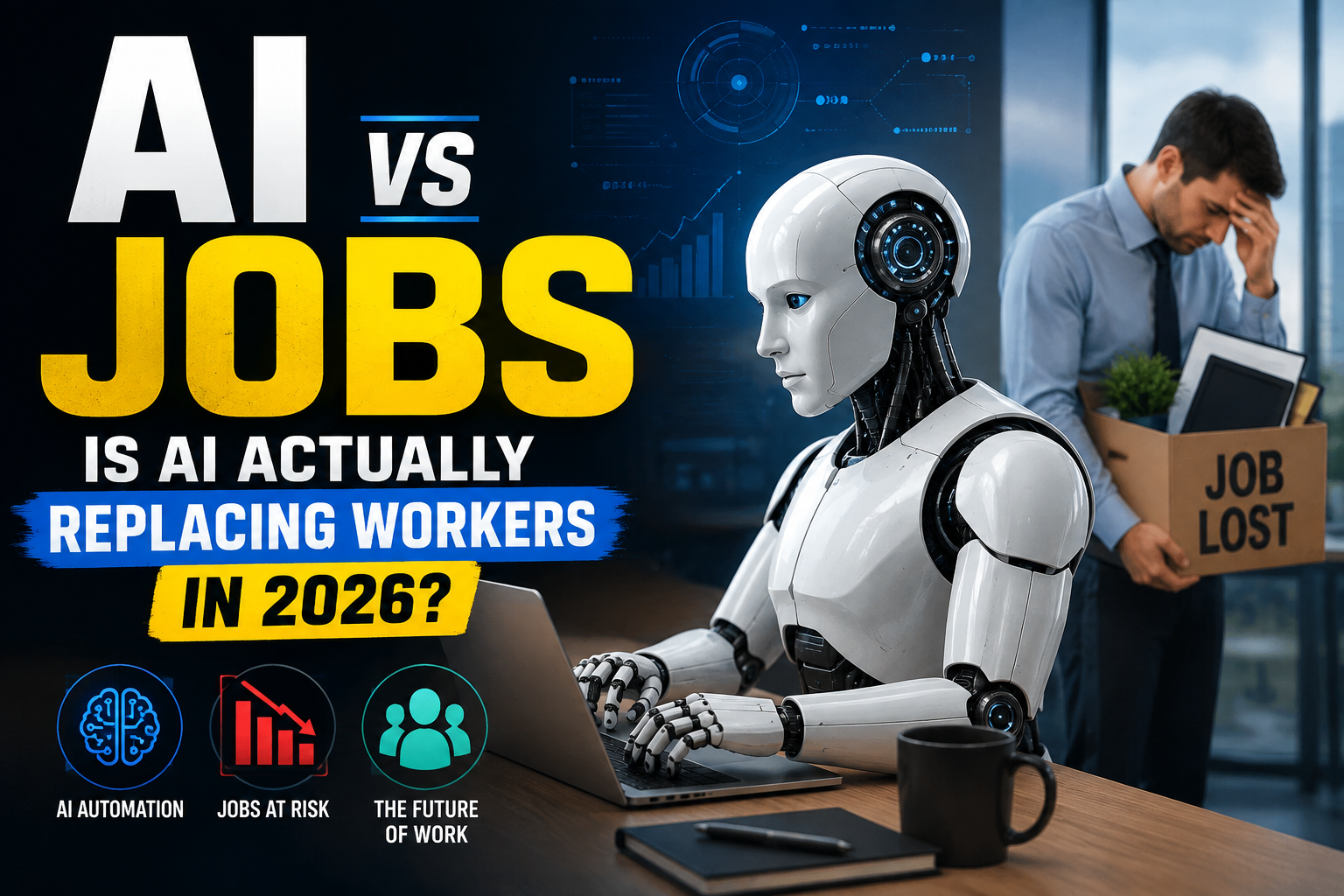
Is AI actually replacing human workers in 2026?
The short answer is yes—but not in the simple way many people expected.
AI is replacing some tasks, changing job descriptions, reducing demand for certain roles, and creating new opportunities at the same time. The bigger transformation may not be a world where humans suddenly lose their jobs to machines. Instead, we may be moving toward a workplace where one AI-assisted worker can accomplish what previously required several people.
That distinction could have a major impact on hiring, salaries, careers, and especially entry-level workers.

AI Is Replacing Tasks Before It Replaces Jobs
One of the biggest mistakes in the AI-and-jobs debate is treating a job as one single task.
Most jobs consist of dozens or hundreds of different activities.
For example, a software developer may:
- Write code
- Debug applications
- Read documentation
- Design systems
- Review pull requests
- Communicate with clients
- Attend meetings
- Make architectural decisions
- Test software
- Maintain production systems
AI can already perform some of these activities surprisingly well.
But that does not necessarily mean the entire software developer job disappears.
This is why researchers increasingly distinguish between task automation and job automation.
The International Labour Organization’s research on generative AI emphasizes that occupations contain different tasks with different levels of exposure to AI.
In other words:
AI can automate part of a job without eliminating the entire job.
This is likely to be one of the defining characteristics of the 2026 labor market.
What Is Actually Happening to Jobs in 2026?
The answer is more complicated than “AI is taking everyone’s jobs.”
Recent evidence points toward several simultaneous trends.
1. Some jobs are shrinking
Companies are increasingly using AI to automate repetitive digital work.
Jobs involving highly predictable and repetitive tasks can be particularly vulnerable.
Examples include:
- Basic data entry
- Simple content production
- Routine customer support
- Basic translation
- Repetitive administrative work
- Simple document processing
- Some entry-level coding tasks
This does not mean every worker in these occupations will disappear.
Instead, companies may need fewer people to produce the same amount of work.
2. Some jobs are being transformed
This may actually be the biggest impact of AI.
Consider software development.
A developer who previously spent several hours writing boilerplate code can now use AI coding tools to generate an initial implementation within minutes.
The developer’s role therefore changes.
Instead of spending most of the day typing code, the developer may spend more time:
- Reviewing AI-generated code
- Testing it
- Designing architecture
- Understanding requirements
- Fixing complex problems
- Managing security
- Making engineering decisions
The job doesn’t necessarily disappear.
The skill requirements change.
Boston Consulting Group argues that task automation should not automatically be interpreted as job elimination and estimates that a large share of U.S. jobs could be reshaped by AI over the next few years.
The Biggest Concern: Entry-Level Jobs
Perhaps the most important part of the AI jobs discussion is not experienced professionals.
It is young workers trying to get their first job.
Recent research and reporting indicate that AI’s effects are becoming particularly visible in some entry-level occupations where companies can automate routine work.
This creates a potential problem.
Traditionally, companies hire junior employees to perform relatively simple tasks.
A junior software developer might start by:
fixing bugs → writing small features → reviewing code → building larger systems → becoming a senior engineer.
But what happens if AI can perform many of those beginner-level tasks?
Companies could potentially decide they need:
Fewer junior workers + more experienced workers using AI.
That creates what economists sometimes call a pipeline problem.
If companies stop hiring enough juniors today, where will tomorrow’s senior engineers come from?
This is one of the most important unanswered questions surrounding AI and employment.
AI Doesn’t Only Destroy Jobs
There is another side to the story.
Every major technological revolution has eliminated certain forms of work while creating new ones.
The printing press reduced demand for some forms of manual copying.
Industrial machinery transformed manufacturing.
Computers eliminated many repetitive office tasks while creating entire technology industries.
AI could follow a similar pattern.
New roles are already emerging around:
- AI engineering
- AI infrastructure
- AI safety
- AI governance
- AI security
- Data engineering
- AI product management
- AI operations
- AI evaluation
- Human-AI interaction
The World Economic Forum’s Future of Jobs Report 2025 projects significant labor-market disruption through 2030, while also forecasting substantial creation of new roles.
The important point is that job creation and job destruction can happen simultaneously.
Which Jobs Are Most Exposed to AI?
There is no universal list of jobs that AI will “kill.”
However, jobs containing a large percentage of predictable digital tasks are generally more exposed to automation.
Higher exposure
- Data entry
- Basic administrative work
- Routine customer support
- Basic content writing
- Simple translation
- Repetitive document processing
- Some entry-level programming
- Basic research and summarization
Medium exposure
- Software development
- Marketing
- Accounting
- Financial analysis
- Journalism
- Graphic design
- Education
- Human resources
Lower automation potential
Jobs that require substantial physical activity, interpersonal interaction, judgment, responsibility, or unpredictable environments may be harder to automate completely.
Examples include:
- Nurses
- Care workers
- Skilled technicians
- Electricians
- Plumbers
- Construction workers
- Therapists
- Teachers
- Emergency responders
That does not mean AI won’t affect these professions.
It means AI may become a tool inside these jobs rather than a complete replacement for the worker.
The “AI + Human” Model Could Become the New Normal
Instead of thinking:
Human vs AI
we may need to think:
Human + AI vs Human without AI
This distinction could become extremely important.
Imagine two software developers.
Developer A
Works manually.
- Searches documentation manually
- Writes repetitive code manually
- Performs repetitive testing manually
- Creates documentation manually
Developer B
Uses AI effectively.
- Generates initial code with AI
- Uses AI for debugging
- Automates documentation
- Uses AI to analyze logs
- Uses AI for testing
- Reviews and improves AI output
If Developer B can produce significantly more high-quality work, companies may increasingly prefer workers who know how to use AI effectively.
This creates a new competitive advantage:
Knowing how to work with AI may become as important as knowing how to perform the underlying job.
AI Could Change What Companies Look for When Hiring
Employers may increasingly care about skills that AI cannot easily replace.
These include:
Problem-solving
Can you understand a complex problem and determine what actually needs to be built?
Critical thinking
Can you recognize when an AI-generated answer is wrong?
Communication
Can you explain technical ideas clearly to customers, managers and teammates?
Domain knowledge
Can you understand the business problem rather than simply generate output?
Decision-making
Can you make responsible decisions when there is no obvious answer?
AI literacy
Can you use AI tools effectively without blindly trusting them?
This is particularly important because AI-generated output can still contain errors, security vulnerabilities, hallucinations, or incorrect assumptions.
What About Software Developers?
Software development is one of the professions receiving enormous attention because AI coding tools have improved rapidly.
AI can now assist developers with:
- Code generation
- Debugging
- Refactoring
- Documentation
- Testing
- Code explanation
- Database queries
- API development
- Boilerplate generation
That sounds threatening to developers.
But there is an important distinction.
Writing code is only one part of software engineering.
Building reliable software also requires:
- Understanding requirements
- System architecture
- Security
- Scalability
- Testing
- Deployment
- Monitoring
- Business understanding
- Team collaboration
This means the role of a developer could evolve from:
“person who writes code”
toward:
“engineer who designs, validates and manages software systems—with AI doing more of the implementation.”
Recent reporting also suggests that the software engineering market is becoming more favorable toward experienced engineers while entry-level opportunities face greater pressure.
AI Is Also Creating a Productivity Race
There is another possibility that receives less attention.
AI may not necessarily cause companies to reduce their workforce.
Instead, companies may use AI to produce more with the same number of employees.
For example:
A company with 100 employees might previously have produced 100 units of output.
After adopting AI, those same employees might produce 150 or 200 units.
The company doesn’t necessarily need to fire 50 people.
Instead, it can potentially:
- Launch more products
- Serve more customers
- Enter new markets
- Reduce prices
- Increase revenue
This could create additional demand for workers.
The outcome depends heavily on what companies decide to do with the productivity gains.
What Happens If AI Becomes Much Better?
This is where the discussion becomes uncertain.
Today’s AI is already capable of performing many knowledge-work tasks.
But future systems could become substantially more capable.
If AI eventually performs a much larger percentage of professional tasks reliably, the economic impact could be significantly greater.
At that point, governments and companies may have to address difficult questions:
- How should workers be retrained?
- Should AI-generated productivity be taxed?
- Should companies share productivity gains with workers?
- How should education change?
- Should some jobs remain human-only?
- How do young people gain experience if entry-level work disappears?
These aren’t purely technological questions.
They are economic and social questions.
So, Is AI Actually Replacing Workers in 2026?
Yes—but the reality is more nuanced than the headlines suggest.
AI is already:
- Automating certain tasks
- Reducing demand for some repetitive roles
- Changing job descriptions
- Increasing productivity
- Reshaping hiring requirements
- Creating new categories of work
- Putting pressure on some entry-level positions
But there is still no evidence that AI has simply eliminated the majority of human employment.
The more realistic scenario is:
AI will replace some tasks, transform many jobs, create new jobs, and change what it means to be productive at work.
The International Labour Organization’s research similarly focuses on occupational exposure to generative AI rather than assuming that exposure automatically means complete job replacement.
What Should Workers Do?
The worst strategy is to ignore AI.
The second-worst strategy is to assume that learning one AI tool will guarantee job security.
Instead, workers should build a combination of:
Domain expertise + technical skills + AI literacy + human skills
For example, a software developer shouldn’t simply learn how to ask an AI to generate code.
They should understand:
Programming → Software Engineering → AI-assisted Development
Similarly:
Marketing → Analytics → AI-assisted Marketing
Finance → Financial Analysis → AI-assisted Finance
The goal isn’t to compete with AI at everything.
The goal is to become someone who can use AI to become significantly more capable.
The Future May Not Be “AI Takes Your Job”
The more realistic question may be:
“What parts of your job will AI change?”
Some workers will lose roles.
Some jobs will disappear.
Some new careers will emerge.
And millions of existing jobs will probably change without disappearing completely.
The biggest winners may not necessarily be people who know the most about AI.
They may be people who combine strong professional knowledge with the ability to use AI effectively.
For workers entering the job market in 2026, that means learning AI should not replace learning the fundamentals.
It should multiply them.
Final Thoughts
The AI revolution is still in its early stages.
It is too early to declare that AI will cause mass unemployment—or that it will have no serious effect on workers.
Both extremes oversimplify a complicated transition.
The evidence available today points toward a more complicated future: AI is reshaping work faster than many organizations and workers are prepared for.
For employees, the message is simple:
Don’t compete with AI where AI is better. Learn how to work with it.
For companies, the challenge is equally important:
Automation can increase productivity, but building a sustainable workforce still requires investing in people.
And for students and fresh graduates, the lesson may be the most important of all:
Don’t ask, “Will AI take my job?”
Ask:
“How can I become the person who knows how to use AI better than the person who doesn’t?”
Further Reading
For authoritative research on the future of work, readers can explore the International Labour Organization’s research on Generative AI and Jobs and the World Economic Forum’s Future of Jobs Report .
Both provide useful data and analysis for understanding how AI and other technologies are changing employment.