India’s e-commerce and quick-commerce revolution has created a massive demand for something consumers rarely think about: last-mile logistics.
Behind every order placed on an e-commerce app is a complex network of warehouses, delivery partners, technology platforms, routeing systems and logistics operations. One Indian startup that has built its business around solving this challenge is Shadowfax.
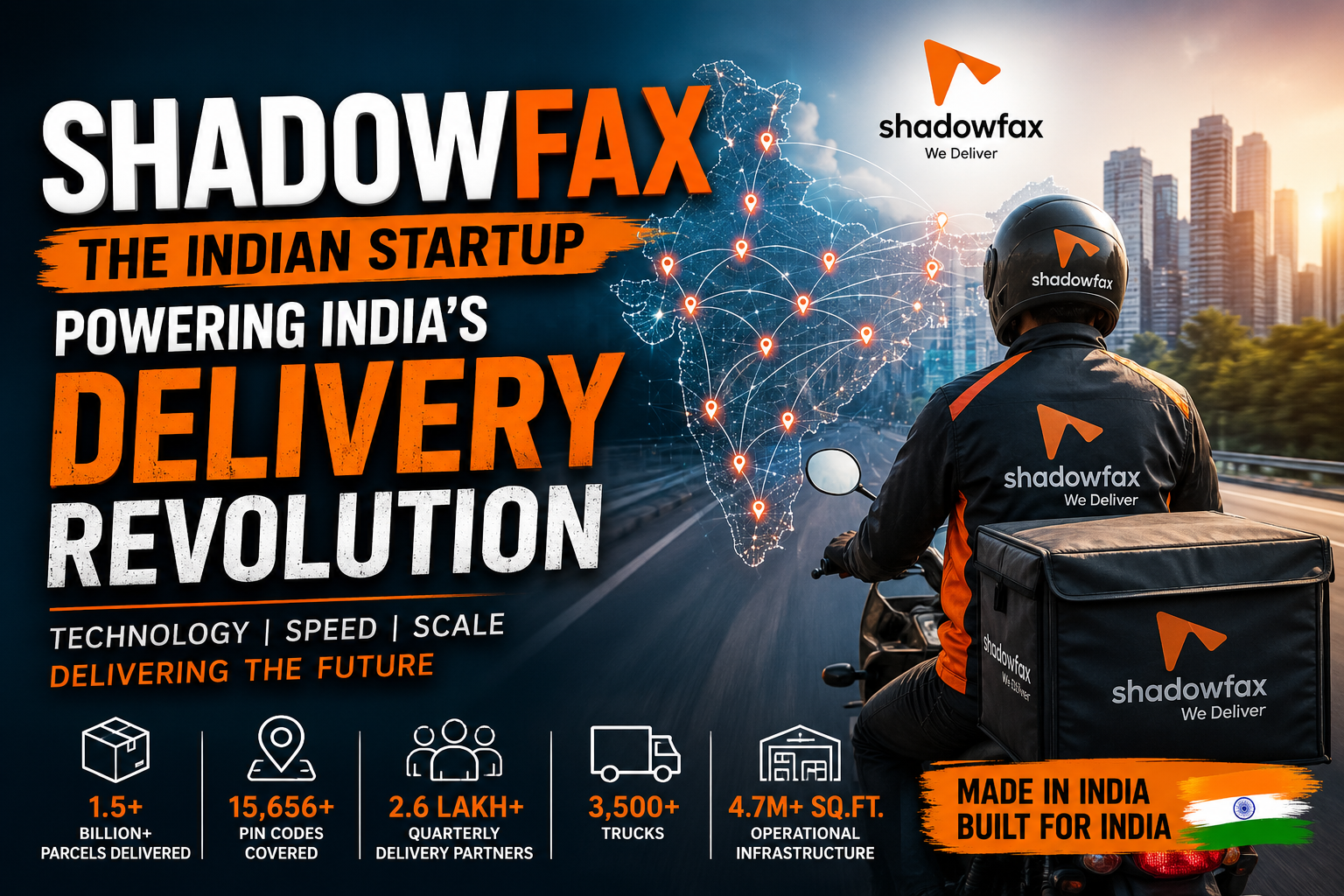
Founded in 2015, Shadowfax started as a last-mile food delivery company and has evolved into a technology-driven logistics platform serving e-commerce, D2C, retail and quick-commerce businesses across India. The company says it now operates across more than 15,656 PIN codes, works with over 2.6 lakh quarterly delivery partners, and has delivered more than 1.5 billion shipments.
What Is Shadowfax?
Shadowfax is an Indian logistics technology company focused on helping businesses deliver products to customers quickly and efficiently.
Unlike traditional courier companies that primarily focus on moving packages from one location to another, Shadowfax combines logistics infrastructure with software, automation, APIs and artificial intelligence.
Its services include:
- Express parcel delivery
- Same-day delivery
- Next-day delivery
- Hyperlocal delivery
- Quick-commerce logistics
- Reverse logistics
- Warehousing and fulfilment
- D2C and e-commerce shipping
- SME shipping through Shadowfax 360
The company works with brands including Nykaa, Myntra, AJIO, Meesho, Mokobara and Dot & Key, according to its website.
From Food Delivery to a Logistics Powerhouse
Shadowfax’s journey began in 2015, when it operated as a last-mile food delivery service.
According to the company’s account of its history, it was already handling more than 10,000 orders per day within its first year. Over time, the company expanded beyond food delivery and moved deeper into e-commerce and logistics.
This shift was important because India’s online commerce market was rapidly changing.
E-commerce companies needed logistics partners capable of handling millions of shipments, while customers increasingly expected:
- Faster deliveries
- Real-time tracking
- Easy returns
- Reliable delivery estimates
- Same-day and next-day shipping
Shadowfax positioned itself around these requirements.
The Technology Behind Shadowfax
Technology is one of the most important parts of Shadowfax’s business model.
The company uses APIs, automation, artificial intelligence and data-driven systems to manage different parts of the logistics process. Its technology platform is designed to provide visibility from the first mile to the last mile.
One example is Shadowfax Maps, an AI-powered mapping system that helps identify address errors, improve geocoding and optimise delivery routes.
The company also has Shadowfax Shield, an AI-based system designed to identify suspicious orders, fraudulent returns and unusual shipment patterns.
These technologies are important because logistics companies operate on extremely thin margins. Even small improvements in routeing, delivery success rates or fraud detection can have a significant impact when millions of packages are processed.
Shadowfax 360: Targeting India’s D2C and SME Businesses
One of Shadowfax’s newer initiatives is Shadowfax 360 (SF360).
The platform is designed for e-commerce businesses, D2C brands, SMEs and online sellers that need to manage shipping through a single digital platform.
Shadowfax says SF360 allows businesses to manage shipping, fulfilment, parcel delivery and COD-related operations from one dashboard.
This is an interesting strategic move because India’s e-commerce ecosystem is no longer dominated only by large marketplaces.
Thousands of small businesses are selling through:
- Shopify stores
- Their own websites
- Online marketplaces
- D2C platforms
These businesses also need reliable logistics infrastructure.
By targeting this segment, Shadowfax is attempting to expand beyond large enterprise customers.
Shadowfax and Quick Commerce
Quick commerce has become another major opportunity for logistics companies.
Customers increasingly expect groceries, medicines and everyday products to arrive within minutes or hours rather than days.
Shadowfax provides hyperlocal and quick-commerce delivery capabilities, including 30-minute delivery services. Its network and technology allow businesses to provide same-day and rapid delivery options.
The growth of quick commerce could therefore become an important part of Shadowfax’s future.
However, quick commerce also presents a major challenge: speed is expensive.
Maintaining large delivery networks, local fulfilment infrastructure and high delivery-partner availability requires significant operational efficiency.
A Massive Delivery Network
Shadowfax’s scale is one of its biggest advantages.
The company currently reports:
1.5 billion+ parcels delivered
15,656+ PIN codes covered
2.6 lakh+ quarterly delivery partners
3,500+ trucks
4.7 million+ sq. ft. of operational infrastructure
2,500+ cities served
This network creates an important competitive advantage.
The more locations a logistics company covers, the more attractive it can become to businesses that want a single logistics partner across India.
Shadowfax’s IPO Journey
Shadowfax reached another major milestone in January 2026 when it went public.
Its IPO was priced in a range of ₹118–₹124 per share and was subscribed nearly three times. However, the company’s shares declined around 9% from the ₹124 issue price to ₹112.60 on its debut, according to TechCrunch.
The IPO marked an important transition for Shadowfax—from a venture-backed startup into a publicly listed logistics technology company.
Going public also means greater scrutiny from investors. Future growth will increasingly be judged not only by shipment volumes but also by profitability, margins, customer concentration and the company’s ability to maintain growth.
Flipkart’s Connection With Shadowfax
Flipkart has been an important investor in Shadowfax.
In July 2026, reports indicated that Flipkart was considering selling part of its remaining stake in Shadowfax through a transaction valued at approximately ₹700–₹750 crore.
Such transactions are not necessarily a negative signal about the underlying business. Early investors often monetise their holdings after a company reaches the public markets.
For Shadowfax, the bigger question is how successfully it can continue expanding while improving profitability.
What Makes Shadowfax Different?
Shadowfax’s competitive advantage comes from combining several elements:
1. Large delivery network
Its extensive network allows it to serve businesses across thousands of Indian locations.
2. Technology-driven operations
AI-powered mapping, fraud detection, APIs and automation help improve logistics efficiency.
3. Multiple logistics segments
Shadowfax isn’t dependent on just one type of delivery. It operates across e-commerce, D2C, quick commerce, hyperlocal delivery and other logistics segments.
4. Strong enterprise relationships
Working with major consumer and e-commerce brands provides significant shipment volumes.
5. Focus on emerging businesses.
Products such as Shadowfax 360 allow the company to target SMEs and D2C brands alongside large enterprises.
The Challenges Ahead
Despite its scale, Shadowfax operates in a highly competitive industry.
The company faces competition from established logistics businesses, e-commerce-owned logistics networks and other technology-enabled delivery platforms.
The biggest challenges include:
- Maintaining profitability while expanding
- Managing delivery-partner costs
- Reducing failed deliveries and returns
- Customer concentration
- Increasing automation
- Handling intense competition
- Maintaining service quality at a massive scale
The public markets will also put greater pressure on the company to demonstrate sustainable financial performance.
The Future of Shadowfax
The future of Shadowfax is closely connected to the future of Indian commerce.
As more Indians shop online, more brands launch D2C businesses and quick commerce expands beyond major metropolitan areas, demand for logistics infrastructure will continue to grow.
Shadowfax is positioning itself not simply as a courier company but as technology infrastructure for India’s commerce ecosystem.
Its combination of AI, APIs, delivery networks, warehousing and digital shipping platforms could allow it to participate in several layers of India’s rapidly evolving commerce economy.
The company’s own description captures this transformation: logistics is no longer simply about moving parcels—it is becoming infrastructure that powers commerce.
Conclusion
Shadowfax is a good example of how an Indian startup can evolve with a changing market.
What began as a last-mile food delivery business in 2015 has transformed into a large-scale logistics technology platform operating across thousands of Indian locations.
Its next chapter will be particularly interesting.
With its IPO completed, expansion into SMEs and D2C businesses through Shadowfax 360, investments in AI-powered logistics and growing demand from quick commerce, Shadowfax has the opportunity to become one of India’s important logistics technology companies.
The real test now is whether it can combine scale, speed and technology with sustainable profitability.
For India’s fast-growing digital economy, companies like Shadowfax may ultimately become as important as the e-commerce platforms themselves—because every online purchase needs one thing before it reaches the customer: a reliable way to get there.