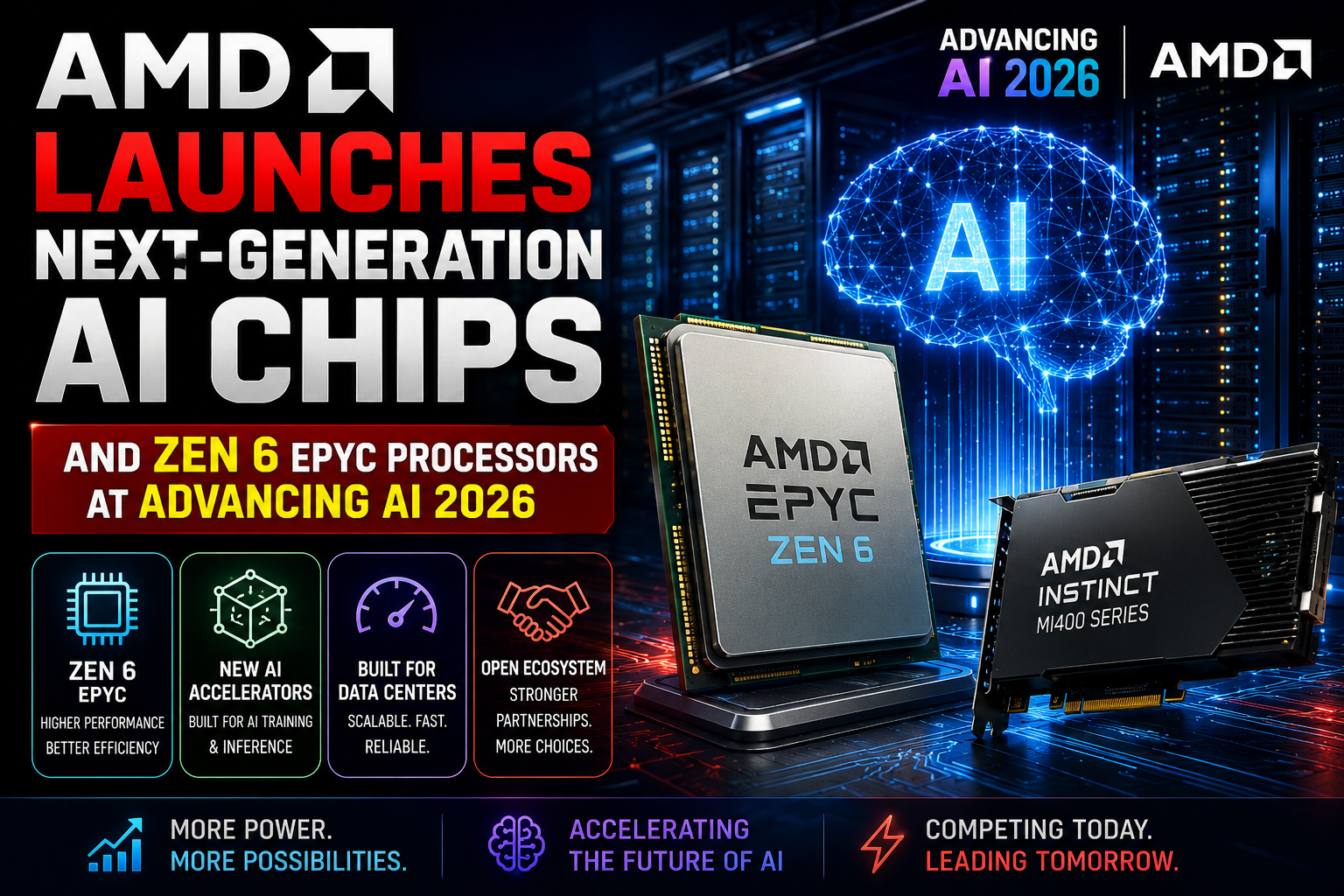
The race to power the future of Artificial Intelligence is becoming more competitive, and AMD has taken another major step forward. At its Advancing AI 2026 event, the company introduced its latest AI hardware innovations, including next-generation Zen 6 EPYC processors, new AMD Instinct AI accelerators, and upgraded AI infrastructure designed for modern data centers. The event highlighted AMD’s vision of delivering an open AI ecosystem capable of competing with Nvidia in the rapidly growing AI market.
AMD’s Focus on AI Infrastructure
As AI models become larger and more complex, companies need faster processors, powerful GPUs, and high-speed networking to train and run these models efficiently. AMD showcased a complete AI platform that combines CPUs, GPUs, networking, and software, allowing businesses to build and scale AI applications more effectively. According to AMD, this end-to-end approach is intended to simplify AI deployment for enterprises, cloud providers, and developers.
Zen 6 EPYC Processors
One of the biggest announcements was the introduction of AMD’s Zen 6 EPYC server processors. These processors are designed for data centers and AI workloads that require high performance, energy efficiency, and scalability.The new processors are expected to deliver improvements in computing power, memory bandwidth, and overall efficiency compared with previous generations. These enhancements can help organizations process massive AI datasets faster while reducing operating costs.
New AI Accelerators
AMD also introduced its latest Instinct AI accelerators, which are built to handle demanding AI training and inference tasks. These accelerators are designed for applications such as generative AI, large language models (LLMs), scientific computing, and enterprise AI.By combining powerful AI accelerators with its EPYC processors, AMD aims to provide a complete solution for organizations building next-generation AI infrastructure.
Competing with Nvidia
Nvidia currently dominates the AI hardware market, with its GPUs widely used by major AI companies and cloud providers. However, AMD is steadily expanding its AI portfolio through new hardware, software, and partnerships.At Advancing AI 2026, AMD emphasized an open ecosystem that gives customers greater flexibility in choosing hardware and software for AI workloads. The company also highlighted collaborations with industry partners to accelerate AI adoption across cloud computing and enterprise environments.
Why This Matters
The demand for AI computing continues to grow as businesses adopt AI for customer service, healthcare, finance, cybersecurity, software development, and research. Faster AI chips can reduce training time, improve inference speed, and lower operational costs.For developers, enterprises, and cloud providers, AMD’s latest announcements offer more options in a market that has largely been led by a single major supplier. Increased competition could also encourage faster innovation and provide customers with greater flexibility when building AI systems.
Final Thoughts
AMD’s announcements at Advancing AI 2026 demonstrate the company’s strong commitment to becoming a major player in the AI hardware industry. With the launch of Zen 6 EPYC processors, next-generation Instinct AI accelerators, and a broader AI infrastructure strategy, AMD is positioning itself to meet the growing demand for high-performance AI computing.As artificial intelligence continues to reshape industries worldwide, competition among chipmakers is expected to accelerate. For businesses, developers, and AI enthusiasts, this means faster innovation, improved performance, and more choices for building the next generation of AI applications.