DeepSeek Harness: The Open-Source AI Agent Framework That Could Change How Coding Agents Are Built
Published: August 2026 | Updated: August 2026
The AI race is moving beyond bigger and smarter language models. The next battleground is how those models actually work in the real world — how they use tools, edit files, execute code, remember context, interact with software, and complete multi-step tasks.
That’s where DeepSeek Harness (DSH) enters the picture: a new open-source AI agent framework designed to give language models the infrastructure they need to act, not just answer.
Table of Contents
- What Is DeepSeek Harness?
- Why Does AI Need a Harness?
- DeepSeek’s “Everything Is a Plugin” Architecture
- DeepSeek Harness vs. Traditional AI Agents
- DeepSeek Harness Runtime Modes Explained
- Traceable Agent Runs: Solving the Observability Problem
- Why Developers Are Paying Attention to DeepSeek Harness
- Why Open Source Could Be DeepSeek Harness’s Biggest Advantage
- Risks and Security Considerations
- Local-First Design: What It Means for Data Privacy
- How to Try DeepSeek Harness
- What DeepSeek Harness Means for the Future of AI
- FAQ: DeepSeek Harness
DeepSeek has released DeepSeek Harness as an open-source developer preview, introducing a different approach to building AI agents: “Everything is a plugin.” Instead of one large, tightly integrated system, DeepSeek has designed a modular runtime where models, tools, skills, sessions, sandboxes, storage, scheduling, agent loops, and even the user interface can be swapped or recombined.
The idea behind DeepSeek Harness can be summarised in one formula:
Agent = Model + Harness
The model provides intelligence. The harness gives that intelligence the ability to operate in an environment.
What Is DeepSeek Harness?
DeepSeek Harness is an open-source execution runtime for AI agents, with an initial focus on coding agents and agent development.
Unlike a traditional chatbot that primarily responds with text, an AI coding agent needs to perform actions. A capable coding agent may need to:
- Read and modify source code
- Run terminal commands
- Search files
- Call external tools
- Maintain sessions
- Execute multi-step workflows
- Delegate tasks to sub-agents
- Operate inside controlled environments
DeepSeek Harness provides the infrastructure required for these actions.
DeepSeek says DSH is currently in developer preview, meaning the project is evolving quickly and compatibility-breaking changes can still occur. It’s released under the MIT license, making it free to use, modify, and extend.
Why Does AI Need a Harness?
Think of a large language model (LLM) as the brain of an AI agent.
A powerful model can understand a programming problem and generate code. But on its own, it doesn’t automatically have access to your terminal, filesystem, browser, databases, or development environment.
The harness is the layer that connects the model to the real world.
For example, imagine asking an AI:
“Fix the authentication bug in my Spring Boot application.”
A simple chatbot might explain what could be wrong.
An AI coding agent powered by a harness can potentially:
- Inspect the project
- Search authentication-related files
- Read configuration
- Identify the bug
- Modify the code
- Run tests
- Inspect the results
- Fix additional errors
- Report what changed
That shift — from generating answers to executing workflows — is one of the most important developments in modern AI agent design.
DeepSeek’s “Everything Is a Plugin” Architecture
The most distinctive part of DeepSeek Harness is its plugin-based architecture.
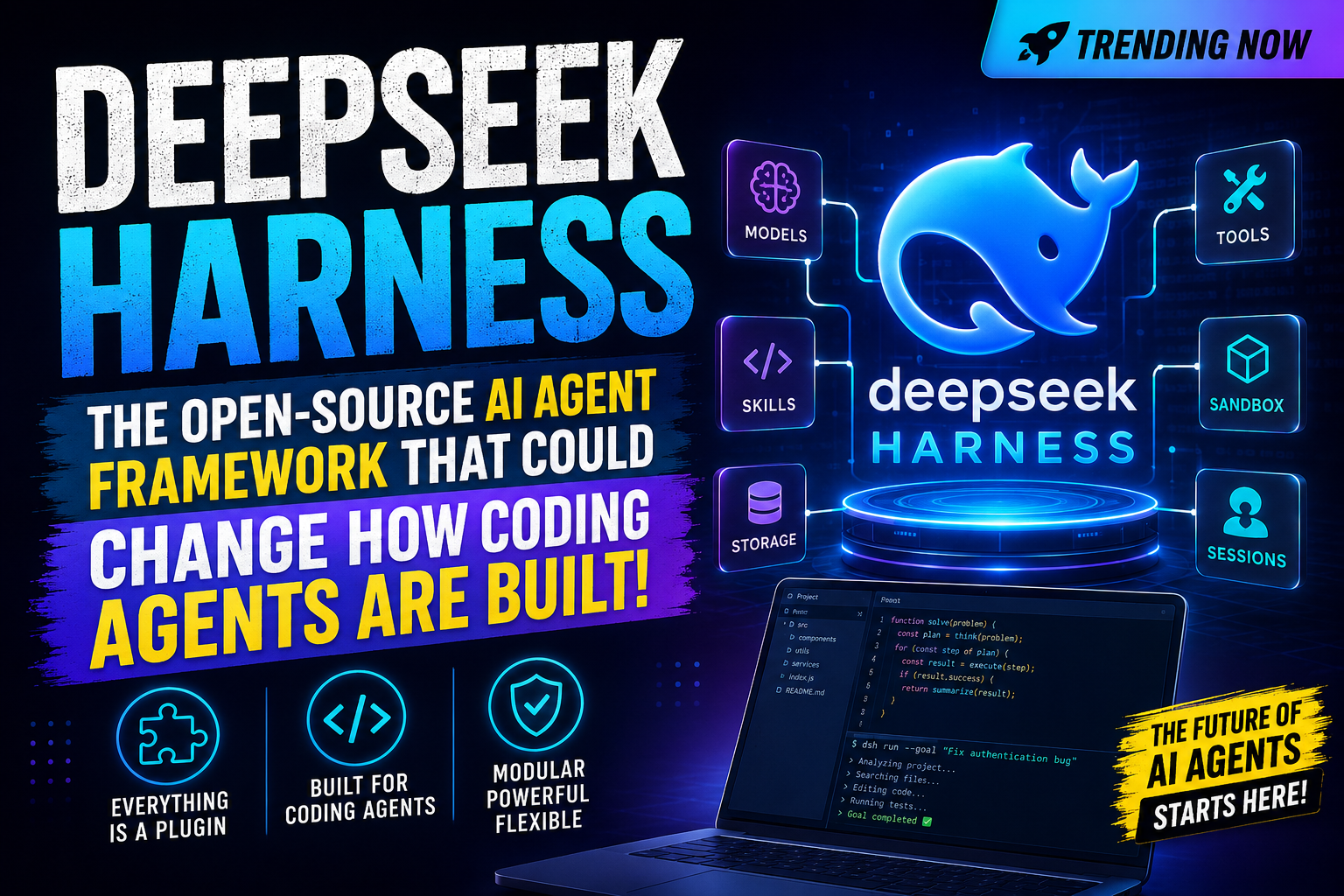
DeepSeek built DSH around Cordis, a plugin-oriented kernel. Rather than embedding every capability directly into the core runtime, capabilities are delivered as plugins, including:
- Models
- Tools
- Skills
- Sessions
- Sandboxes
- Storage
- Agent loops
- Scheduling
- User interface
This means developers can replace one component without rebuilding the entire agent. For example, a developer could switch model providers while keeping the rest of the agent infrastructure intact.
That modularity matters because the AI ecosystem changes fast — today’s best model may not be tomorrow’s best model.
DeepSeek Harness vs. Traditional AI Agents
Traditional AI applications often follow a simple pattern:
Model → Tools → Custom Application
The developer builds all the surrounding infrastructure manually, from scratch, for every project.
DeepSeek Harness pushes toward a more modular formula:
Model + Plugins + Runtime + Tools + Environment = Agent
This distinction matters because an agent’s behavior isn’t determined by the model alone. The tools it can access, how context is managed, how tasks are orchestrated, how sessions are stored, and how execution is controlled all shape the final outcome — which is exactly why the concept of a “harness” is becoming central to AI agent development.
DeepSeek Harness Runtime Modes Explained
DeepSeek Harness ships with several runtime modes built for different use cases.
Standard Mode
Standard Mode delivers the full coding-agent experience: file editing, shell access, search, skills, planning, goals, sub-agents, and workflows. This is the mode closest to what developers expect from modern AI coding agents.
Code Mode
Code Mode lets models orchestrate multiple tool calls through generated code. Instead of calling tools individually for every action, an agent can combine operations into a single multi-step program — making complex workflows more efficient and easier to coordinate.
Minimal Mode
Minimal Mode intentionally strips the environment down to a shell and file editor. This is useful for benchmarking AI models, since reducing available capabilities makes it easier to isolate how much of an agent’s performance comes from the model versus the surrounding infrastructure.
Creator Mode
Creator Mode targets developers building custom agent configurations. It allows inspection of the runtime, experimentation with plugins, and creation of customized agent presets — potentially one of the most interesting parts of the DeepSeek Harness ecosystem, since developers aren’t limited to a single predefined agent.
Traceable Agent Runs: Solving the Observability Problem
One of DeepSeek Harness’s standout features is trajectory tracking.
DeepSeek says information seen by the model can be recorded in an append-only session log, including system prompts, reasoning, tool calls, results, sub-agent scheduling, and context injection. Developers can then inspect, resume, fork, search, and replay these records.
This addresses a major challenge in autonomous AI systems: observability. When an AI agent makes a mistake, developers need answers to questions like:
- What did the model see?
- Which tool did it call?
- What result did it receive?
- Why did the workflow continue?
- Where did the agent go wrong?
A traceable execution history makes debugging and evaluating AI agents far easier.
Why Developers Are Paying Attention to DeepSeek Harness
DeepSeek Harness arrives as AI coding agents become a central part of modern software development. Developers are increasingly experimenting with Claude Code-style agents, Codex-based workflows, autonomous coding systems, and custom AI development environments.
DeepSeek isn’t just competing at the model layer anymore — it’s moving into the agent infrastructure layer, a strategically significant shift.
Instead of saying “Here is another AI model,” DeepSeek is effectively saying:
“Here is infrastructure for building agents around models.”
Because DSH is open source, developers can inspect, modify, extend, and build on top of it freely.
Why Open Source Could Be DeepSeek Harness’s Biggest Advantage
DeepSeek Harness is released under the MIT license, one of the most permissive open-source licenses available, making it attractive for developers and organizations that want to experiment without licensing friction.
The project is already attracting significant developer attention on GitHub, where the repository has accumulated tens of thousands of stars shortly after launch.
Open source also opens the door to a broader plugin ecosystem. Imagine installing specialised plugins for:
- GitHub workflows
- Database operations
- Browser automation
- Cloud deployment
- Testing
- DevOps
- Documentation
- Security analysis
- Data processing
Instead of building an AI agent from scratch, developers could assemble one from reusable, community-built components. That’s the bigger vision behind DeepSeek’s “everything is a plugin” philosophy.
Risks and Security Considerations
DeepSeek Harness is still a developer preview and shouldn’t be treated as a finished, production-ready platform. DeepSeek itself warns that the project is evolving rapidly and that compatibility-breaking changes may occur.
Security is a particularly important consideration. An AI agent that can read files, execute commands, and interact with external tools carries considerably more risk than a standard chatbot.
A recent research assessment investigated indirect prompt-injection risks in DeepSeek Harness across thousands of controlled executions. The study reported successful attack rates under some tested conditions — underscoring the importance of placing strong security controls between untrusted content and sensitive agent actions.
This doesn’t mean DeepSeek Harness is inherently unsafe. It highlights a broader challenge facing all autonomous AI agents:
The more capabilities an agent receives, the more carefully those capabilities must be controlled.
Local-First Design: What It Means for Data Privacy
DeepSeek describes Harness as a local-first agent development and coding environment.
According to its data-processing statement, user inputs, model outputs, session context, tool-call records, file paths, and runtime logs are stored locally by default once the software is installed and running.
However, developers should keep in mind that external models, web tools, MCP services, and plugins can carry their own separate data-processing practices. In other words, “local-first” doesn’t automatically guarantee that every piece of data stays on the local machine.
How to Try DeepSeek Harness
Getting started with DeepSeek Harness is straightforward via its npm-based quick start.
After installing Node.js, launch the Web UI with:
bash
npx @deepseek-ai/dsh webThe project can also be installed from source through its GitHub repository.
Official resources:
What DeepSeek Harness Means for the Future of AI
The most important takeaway from DeepSeek Harness isn’t necessarily the software itself — it’s the idea behind it.
For years, AI progress was measured by asking: How powerful is the model?
Increasingly, the industry is asking: What can the model actually do?
A model may have impressive reasoning capabilities, but its real-world usefulness depends heavily on the environment surrounding it — the tools, memory, execution system, permissions, workflows, and feedback mechanisms. That environment is what a harness provides.
This shift could open a new phase of AI development where improving an agent doesn’t always require training a larger model. Sometimes, the biggest improvement comes from building a better harness.
FAQ: DeepSeek Harness
What is DeepSeek Harness used for? DeepSeek Harness is used to build and run AI coding agents that can read and edit files, execute terminal commands, call external tools, and complete multi-step development workflows autonomously.
Is DeepSeek Harness free to use? Yes. DeepSeek Harness is open source and released under the MIT license, meaning it’s free to use, modify, and distribute.
Is DeepSeek Harness production-ready? Not yet. DeepSeek Harness is currently in developer preview, so breaking changes can occur and it isn’t recommended for critical production deployments without additional security review.
How is DeepSeek Harness different from a chatbot? A chatbot generates text responses. DeepSeek Harness gives an AI model the infrastructure to take real actions — editing code, running commands, and orchestrating multi-step tasks.
What is Cordis in DeepSeek Harness? Cordis is the plugin-oriented kernel that powers DeepSeek Harness, allowing models, tools, sessions, storage, and other components to be swapped or extended independently.
Does DeepSeek Harness store my data locally? By default, yes — DeepSeek describes Harness as local-first, storing inputs, outputs, and logs locally. However, any external models, tools, or plugins used within Harness may have their own separate data practices.