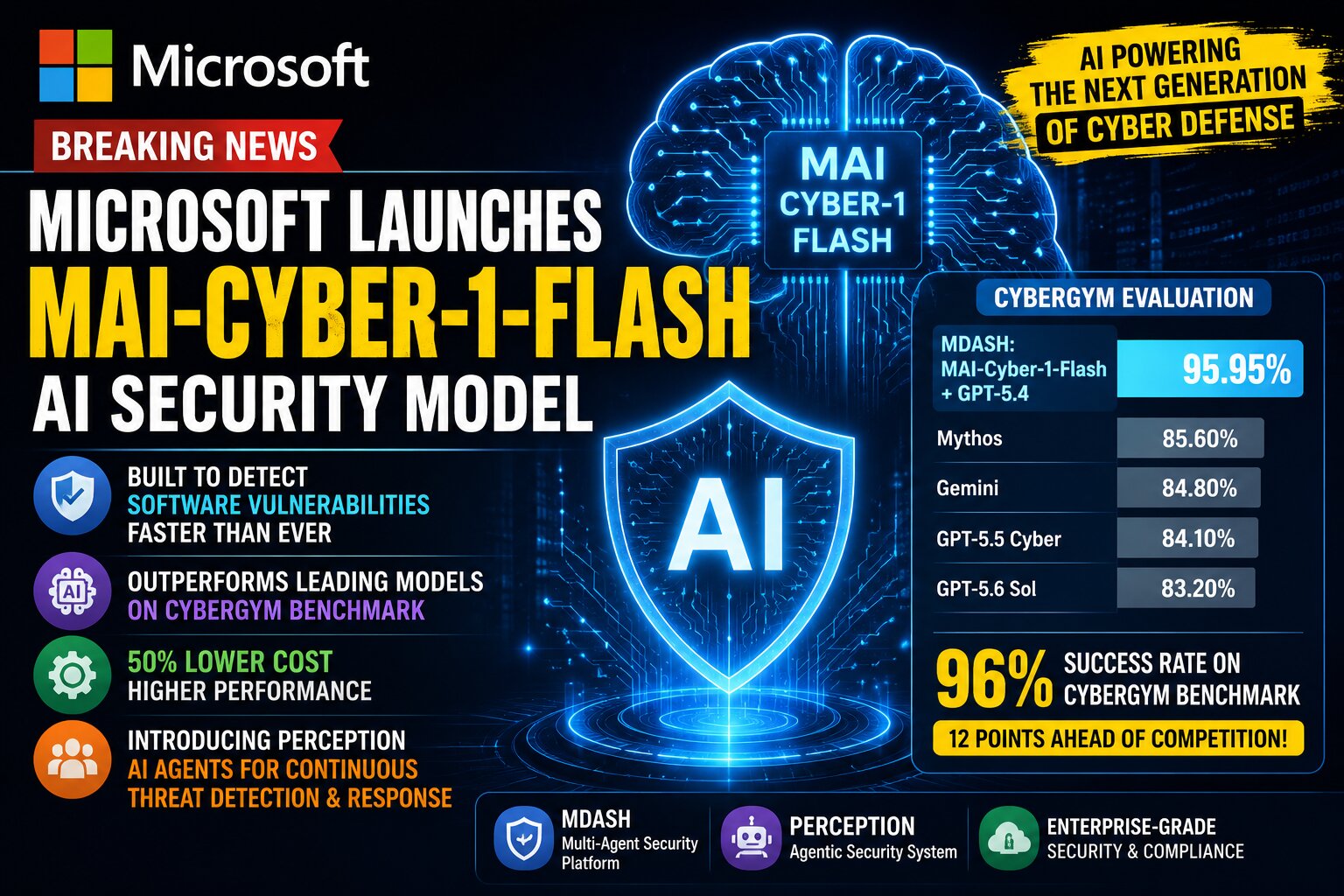
Microsoft introduces MAI-Cyber-1-Flash, an advanced AI security model that detects software vulnerabilities faster, costs 50% less than leading AI systems, and powers the company’s new MDASH cybersecurity platform.
As cyberattacks become more sophisticated, technology companies are turning to artificial intelligence to strengthen digital security. Microsoft has officially announced MAI-Cyber-1-Flash, its first in-house AI model built specifically for cybersecurity. The company says the new model can identify software vulnerabilities in complex codebases with industry-leading accuracy while significantly reducing operational costs.
The launch also introduces Perception, Microsoft’s new agent-based security system, marking a major step toward autonomous AI-powered cyber defense.
Why Microsoft Built MAI-Cyber-1-Flash
The rapid advancement of AI has changed the cybersecurity landscape. Modern attackers are increasingly using AI to scan millions of lines of code in search of exploitable weaknesses. According to Microsoft, traditional security methods—where organizations periodically scan software and patch vulnerabilities later are no longer sufficient.
MAI-Cyber-1-Flash was designed to help security teams detect vulnerabilities much faster, allowing organizations to respond before attackers can exploit them.
Integrated with MDASH for Smarter Security
Microsoft has deeply integrated MAI-Cyber-1-Flash into MDASH (Multi-Agent Vulnerability Identification and Remediation Harness), its AI-powered cybersecurity platform.
Instead of relying on one large AI model for every task, Microsoft uses a multi-model approach.
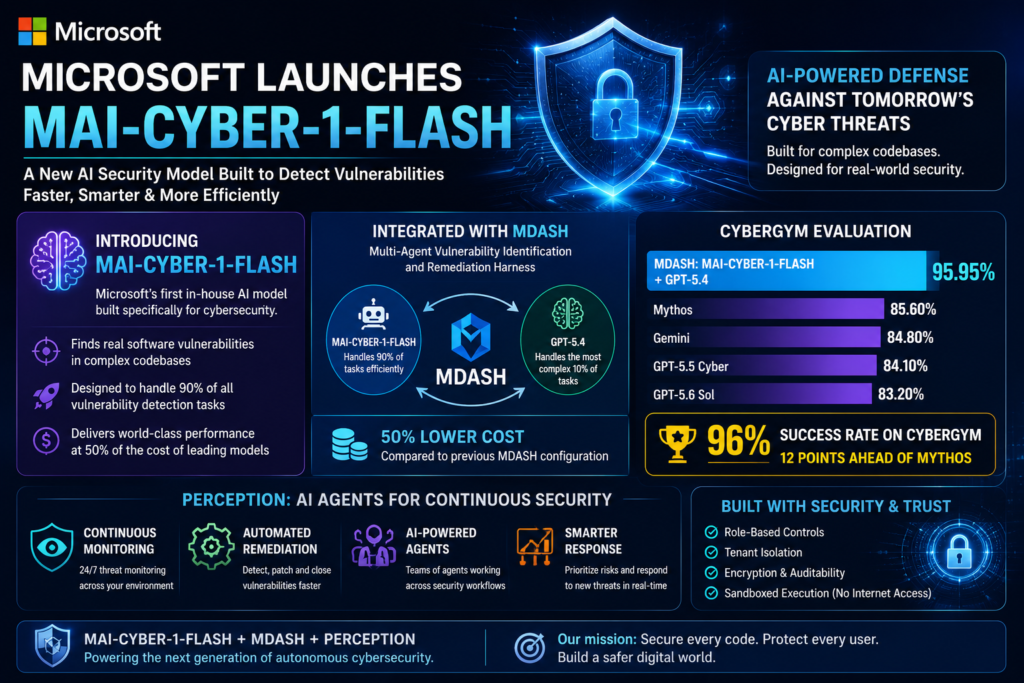
- MAI-Cyber-1-Flash handles nearly 90% of routine vulnerability detection tasks.
- More advanced models, including GPT-5.4, are reserved for the remaining 10% of highly complex security challenges.
This strategy allows Microsoft to deliver world-class cybersecurity performance while reducing AI operating costs by nearly 50% compared to its previous MDASH configuration.
Outstanding CyberGym Performance
Microsoft evaluated its new security system using CyberGym, a benchmark designed to test how effectively AI models identify real software vulnerabilities across large codebases.
According to the company:
- MDASH + MAI-Cyber-1-Flash + GPT-5.4 achieved a 96% success rate.
- The system outperformed leading AI models such as Mythos, Gemini, and GPT-based cybersecurity models.
- Microsoft says its solution scored 12 percentage points higher than Mythos on the CyberGym benchmark.
These results highlight Microsoft’s growing investment in specialized AI models rather than relying solely on general-purpose large language models.
Introducing Perception: AI Security Agents
Alongside MAI-Cyber-1-Flash, Microsoft announced Perception, an agentic security platform designed to automate cybersecurity operations.
Perception enables AI agents to:
- Continuously monitor systems for threats
- Detect newly discovered vulnerabilities
- Assist with software patching
- Help security teams remediate risks faster
Microsoft plans to expand Perception with additional MAI-Cyber-1-Flash capabilities in future releases.
Security and Trust at the Core
Microsoft emphasizes that security was built into every stage of MAI-Cyber-1-Flash’s development.
The AI model underwent the following:
- Testing by Microsoft’s AI Red Team
- Automated and expert-led adversarial security evaluations
- Independent third-party assessment
Organizations using MDASH also receive enterprise-grade security controls, including role-based access control, tenant isolation, encryption, audit logging, and sandboxed execution environments without internet access.
Final Thoughts
Microsoft’s launch of MAI-Cyber-1-Flash signals a major shift in AI-powered cybersecurity. Rather than replacing human security experts, the model is designed to act as an intelligent assistant capable of detecting vulnerabilities, reducing response times, and lowering operational costs.
As AI continues to reshape cybersecurity, specialized security models like MAI-Cyber-1-Flash could become essential tools for protecting enterprise software and critical infrastructure against increasingly sophisticated cyber threats.