Discover what AI agents are, how they work, their real-world applications, benefits, challenges, and why they are becoming the next major evolution in artificial intelligence.
Artificial intelligence has already transformed how we search for information, write content, generate images, and automate repetitive tasks. But a new wave of AI innovation is taking things much further: AI agents.
Unlike traditional AI chatbots that simply respond to prompts, AI agents can reason, plan, make decisions, use digital tools, and complete complex tasks with minimal human involvement. They represent one of the biggest shifts in AI since the launch of large language models.
From software development and customer support to scientific research and personal productivity, AI agents are beginning to reshape industries across the globe.
In this article, we’ll explore what AI agents are, how they work, where they’re being used, and why many experts believe they represent the future of artificial intelligence.
What Are AI Agents?
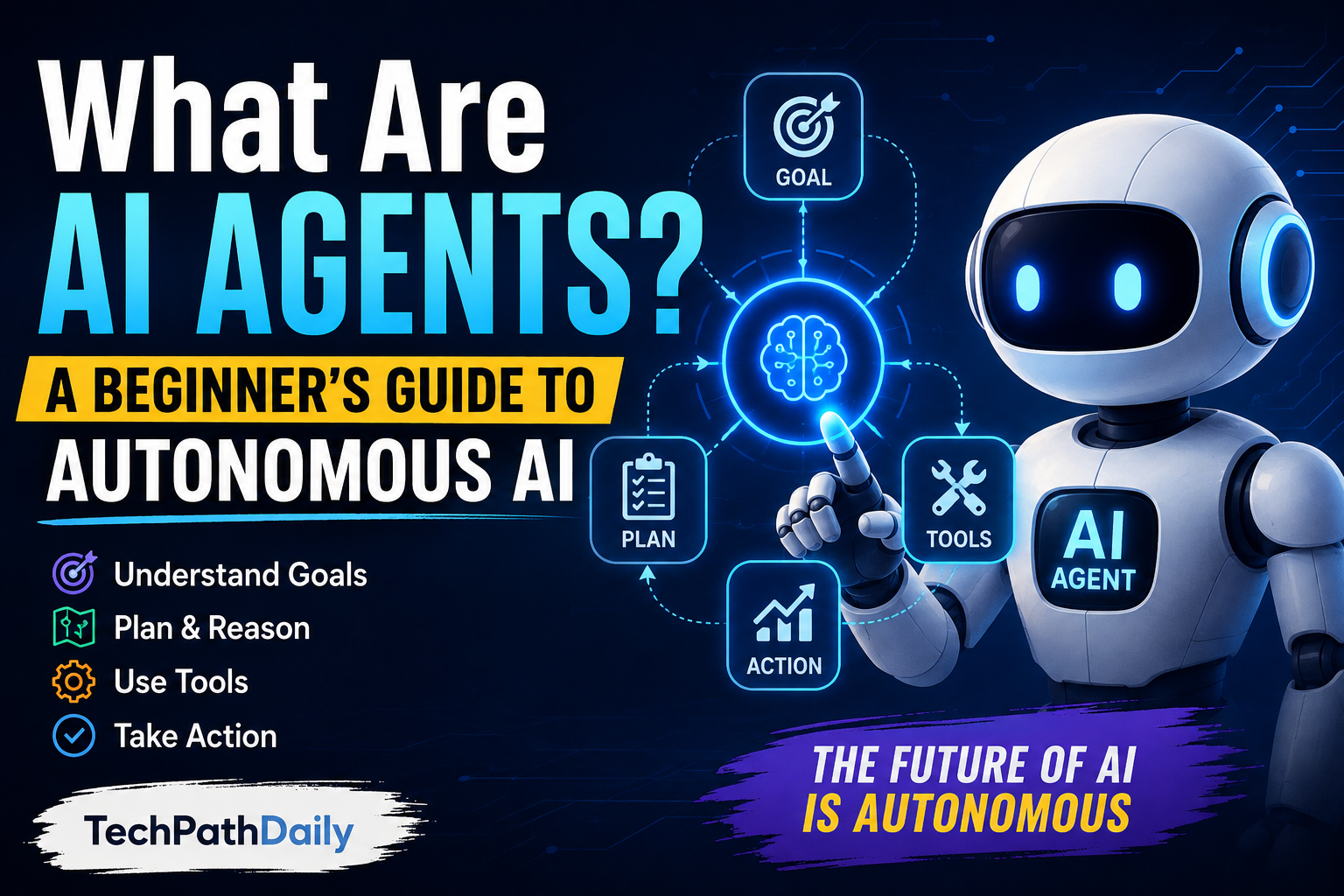
An AI agent is an intelligent software system that can:
- Understand a goal
- Break it into smaller tasks
- Plan the best approach
- Use available tools
- Learn from feedback
- Execute tasks with limited human supervision
Instead of answering a single question, AI agents are designed to complete objectives.
Example
Imagine asking an AI:
“Plan my business trip to London.”
A traditional chatbot might suggest hotels and flights.
An AI agent could:
- Search for flights
- Compare prices
- Book accommodation
- Schedule meetings
- Add events to your calendar
- Track weather forecasts
- Send confirmation emails
- Prepare an expense report
All of this could happen automatically after receiving your approval.
How AI Agents Work
Most modern AI agents follow a structured workflow.
1. Goal Understanding
The AI first analyses what the user wants.
Example:
“Increase website traffic by 30%.”
2. Planning
The agent creates a strategy.
Example:
- SEO improvements
- Content calendar
- Keyword research
- Backlink opportunities
- Social media promotion
3. Tool Usage
Unlike ordinary chatbots, AI agents can interact with external tools such as:
- Search engines
- Databases
- Email systems
- Calendars
- CRM software
- Coding environments
- APIs
- Cloud storage
4. Decision Making
The AI evaluates results and decides the next action.
If one strategy fails, it can try another.
5. Learning
Many AI agent systems improve through:
- User feedback
- Memory
- Historical actions
- Performance analysis
AI Chatbots vs AI Agents
| Feature | AI Chatbots | AI Agents |
|---|---|---|
| Answer questions | ✅ | ✅ |
| Multi-step planning | ❌ | ✅ |
| Uses external tools | Limited | Extensive |
| Works independently | No | Yes |
| Executes tasks | Rarely | Frequently |
| Long-term memory | Limited | Growing |
| Makes decisions | Minimal | Advanced |
Why AI Agents Are Rising So Quickly
Several technological breakthroughs have accelerated AI agent development.
1. Better Language Models
Modern large language models understand context better than ever.
This enables agents to reason through complicated problems instead of simply generating text.
2. More Powerful Computing
Cloud computing and AI accelerators now make large-scale AI deployment much faster and more affordable.
3. Improved Tool Integration
Today’s AI systems can connect with the following:
- Slack
- GitHub
- Databases
- Browsers
- Enterprise software
This dramatically expands what AI can accomplish.
4. Business Demand
Companies want AI that can do more than answer questions.
Businesses increasingly seek systems that can:
- Automate workflows
- Reduce operational costs
- Increase productivity
- Improve customer experiences
Real-World Applications of AI Agents
Software Development
AI coding agents can:
- Write code
- Fix bugs
- Review pull requests
- Generate documentation
- Suggest improvements
- Run automated tests
Customer Support
AI agents now:
- Resolve customer queries
- Process refunds
- Escalate complex cases
- Update support tickets
- Personalise responses
Healthcare
Medical AI agents assist with:
- Appointment scheduling
- Medical documentation
- Patient triage
- Drug interaction checks
- Clinical research support
They are designed to support healthcare professionals rather than replace them.
Education
AI agents help students by:
- Creating study plans
- Explaining concepts
- Generating quizzes
- Tracking learning progress
- Providing personalised feedback
Marketing
Marketing teams use AI agents for:
- SEO optimisation
- Content generation
- Email campaigns
- Social media scheduling
- Market research
- Competitor analysis
Finance
Banks and financial firms use AI agents to:
- Detect fraud
- Analyse spending patterns
- Generate financial reports
- Support investment research
- Monitor risks
Benefits of AI Agents
Increased Productivity
AI agents can perform repetitive work continuously without fatigue.
Faster Decision Making
They analyze large datasets much faster than humans.
Lower Operational Costs
Businesses reduce manual effort while improving efficiency.
Better Customer Service
AI agents provide instant assistance around the clock.
Personalisation
Agents learn user preferences and tailor recommendations.
Challenges and Risks
Despite their advantages, AI agents also present significant challenges.
Privacy Concerns
Agents often require access to sensitive information.
Strong security measures are essential.
Hallucinations
AI can occasionally produce inaccurate information.
Human oversight remains important.
Security Risks
Autonomous systems connected to multiple services could become targets for cyberattacks.
Ethical Questions
Important considerations include:
- Transparency
- Accountability
- Bias
- Fairness
- Responsible deployment
Job Displacement
Some routine tasks may become automated.
However, history shows that technology often changes jobs rather than eliminating work entirely, creating demand for new skills and roles.
Industries Most Likely to Be Transformed
- Software development
- Healthcare
- Banking
- Manufacturing
- Retail
- Logistics
- Education
- Customer support
- Legal services
- Human resources
- Media
- Scientific research
The Future of AI Agents
Over the next decade, AI agents are expected to become increasingly capable.
Future developments may include:
- Multi-agent collaboration on complex projects
- Continuous learning from experience
- Better reasoning and planning
- More natural voice interactions
- Wider use in robotics and automation
- Deeper integration with workplace software
As these capabilities improve, AI agents are likely to become digital collaborators that help people achieve more rather than simply replacing individual tasks.
Conclusion
The rise of AI agents marks a significant evolution in artificial intelligence. Moving beyond simple conversations, these systems can plan, reason, use tools, and carry out multi-step tasks, making them valuable across industries from healthcare to software engineering.
While challenges such as privacy, security, and governance must be addressed, AI agents have the potential to enhance productivity, improve decision-making, and unlock new ways of working. Businesses that learn how to integrate AI agents responsibly will be better positioned to benefit from the next wave of technological innovation.
As AI continues to evolve, one thing is clear: AI agents are not just another feature—they are becoming the foundation of the next generation of intelligent software.