AI Enters the Classroom… But Not Everyone Is Ready
Imagine walking into your classroom on the first day of school and finding a humanoid robot waiting to teach your lesson. It sounds like something straight out of a science fiction movie, but for one school district in New York, it was about to become reality.
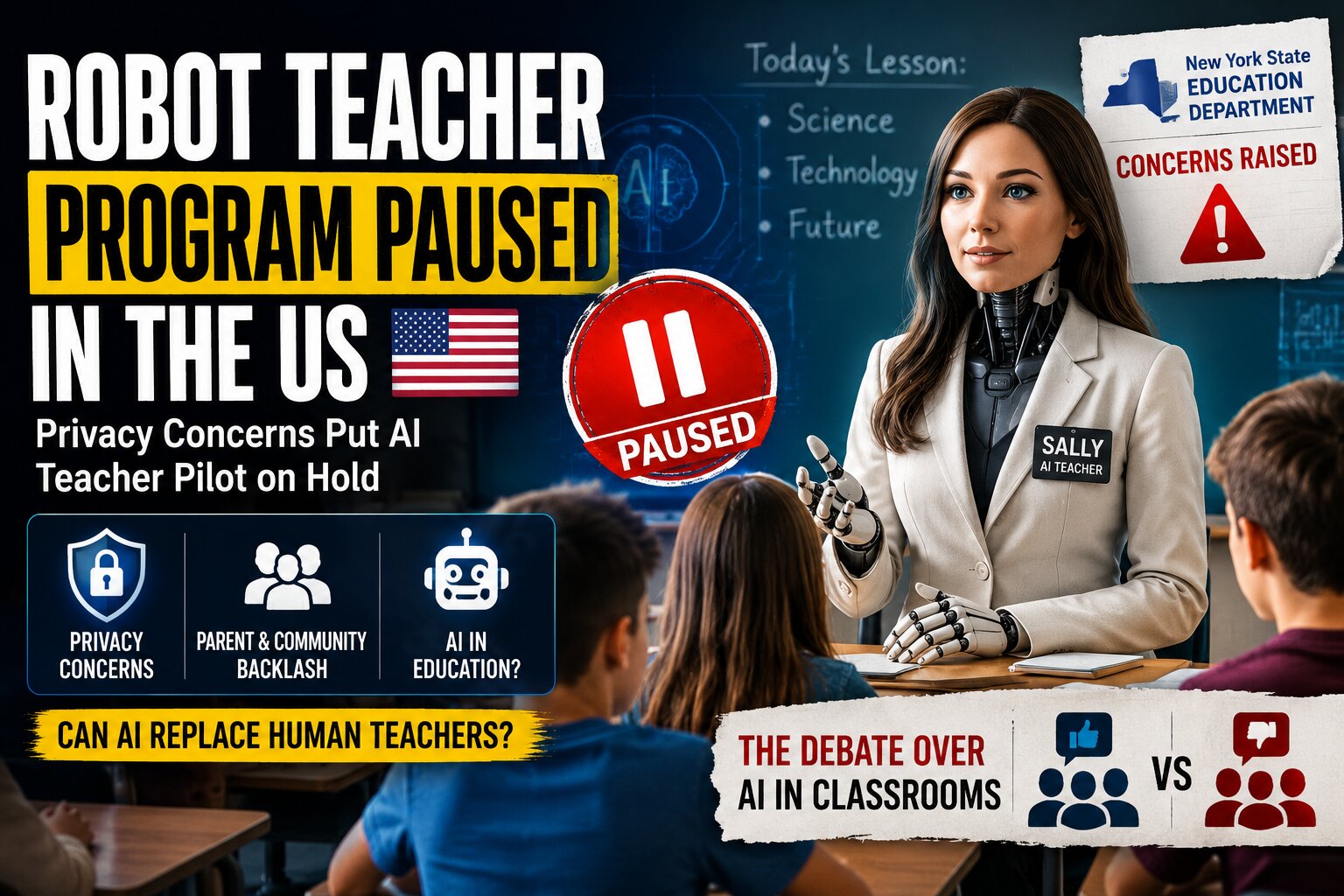
However, just hours before the pilot program moved forward, the project was put on hold after the New York State Education Department raised concerns about student privacy and the impact of humanoid robots in classrooms.
The decision has sparked a global debate: Should AI become part of education, or are we moving too fast?
Meet “Sally” The AI robot teacher.
The Salamanca City Central School District planned to introduce a humanoid robot named Sally, developed by Canadian technology company Realbotix.
Unlike a simple chatbot, Sally was designed to look and behave more like a real teacher. The robot would feature:
- A lifelike face with silicone skin
- Facial expressions and upper-body movements
- A classroom assistant avatar for laptops
- Homework support using AI
- Real-time translation in over 100 languages
Students would also be able to continue conversations with Sally outside the classroom through an AI-powered digital avatar.
At first glance, it sounded like a futuristic learning experience.
Why Was the Program Paused?
The excitement didn’t last long.
After details of the project became public, parents, teachers, and education experts began raising serious concerns.
The New York State Education Department questioned whether a humanoid robot belonged in a classroom and asked the district to strengthen its student data privacy agreements before moving ahead.
As a result, the school district temporarily suspended the project while discussions continue with state officials and the local community.
Privacy Was the Biggest Concern
Today’s AI systems rely heavily on data, and schools are naturally cautious about how student information is collected and stored.
Although the district stated that Sally would operate on a closed system and that Realbotix would not have access to personally identifiable student information, many parents still wanted stronger privacy protections before allowing students to interact with the robot.
In education, trust is just as important as technology.
The Debate Didn’t Stop There
The controversy became even bigger after critics pointed out that Realbotix entered the education sector only recently and that its parent company previously acquired RealDoll, a business known for creating highly realistic adult dolls.
The New York State United Teachers (NYSUT) strongly opposed the pilot program, arguing that children need genuine human interaction that no machine can replace.
Others worried about:
- Increased screen time
- AI providing incorrect answers
- Reduced human connection in classrooms
- Ethical questions surrounding humanoid robots
Supporters, however, saw things differently.
Many argued that AI could help teachers by answering student questions, translating lessons for multilingual classrooms, and giving students instant academic support after school.
🤖 A Little Reality Check
Let’s be honest, most students already ask ChatGPT for homework help before asking their teacher.
But imagine telling your parents:
“Sorry, I forgot my homework because the robot teacher crashed during the lesson.”
Or hearing:
“Please wait… Sally is updating to Version 3.0. Class will resume in 15 minutes.”
Funny? Maybe.
Practical? That’s still up for debate.
The truth is, AI can explain algebra, translate languages, and even help write essays, but it still can’t replace the encouragement, empathy, and real-life guidance that great teachers provide every day.
What Does This Mean for the Future of Education?
Artificial intelligence is becoming an important tool in education, but this story shows that introducing AI into classrooms requires more than impressive technology.
Schools must balance innovation with privacy, safety, transparency, and community trust.
Rather than replacing teachers, AI is more likely to become a powerful classroom assistant helping educators save time while allowing them to focus on what humans do best: inspiring, mentoring, and connecting with students.
Final Thoughts
The pause of New York’s robot teacher pilot isn’t a rejection of AI it is a reminder that technology should serve education, not rush ahead of it.
As AI continues to evolve, classrooms around the world will likely adopt smarter digital tools. But for now, the future of education still looks like a partnership between human teachers and intelligent technology, not one replacing the other.
And perhaps that’s the lesson AI needed to learn too.