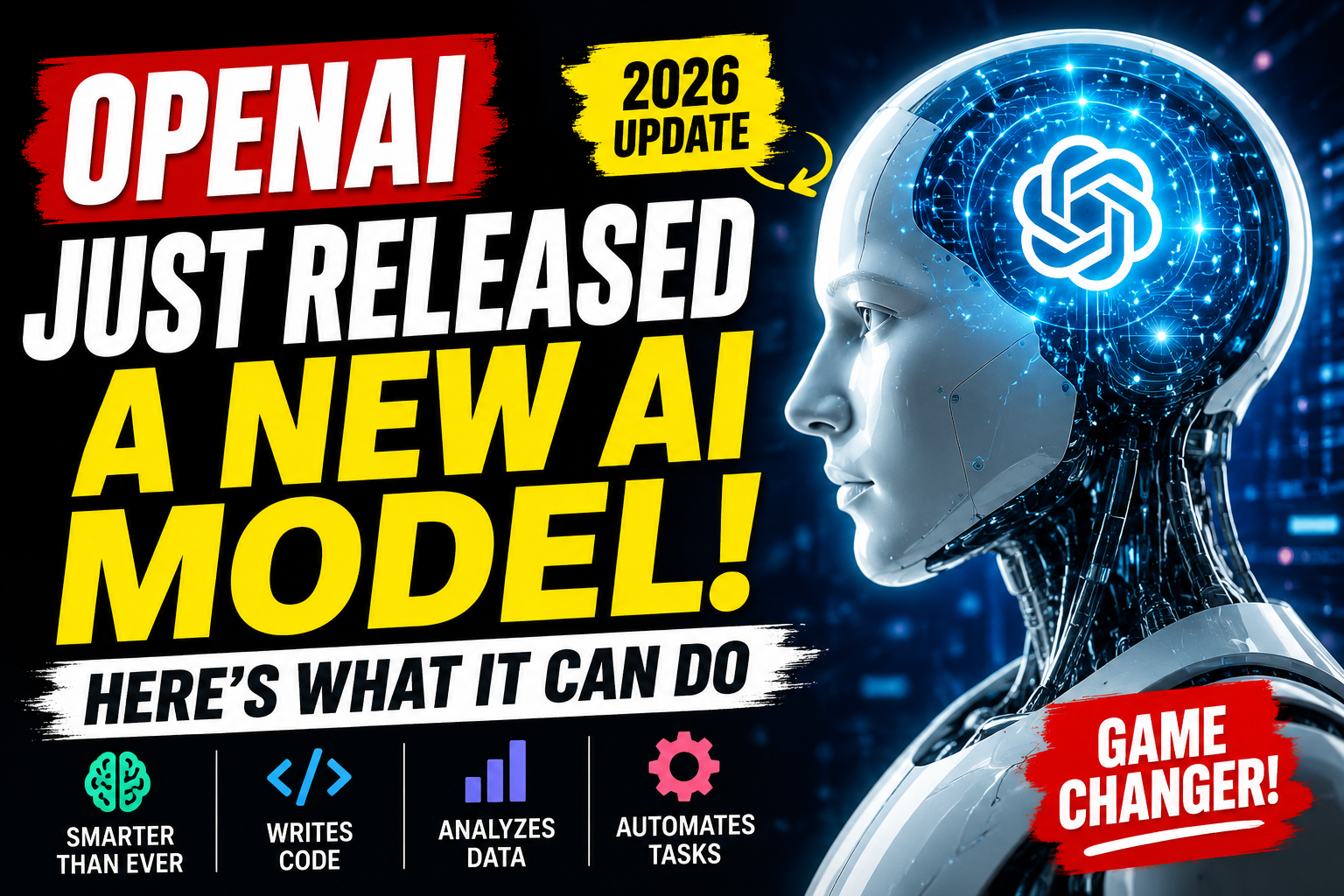
The AI race just took another major leap forward.
OpenAI has officially launched its latest flagship model, GPT-5.6, and it’s not just another upgrade it’s a powerful shift toward AI that can actually do work, not just answer questions.
From writing code to handling complex business tasks, this new model is designed to act more like a digital assistant with real capabilities.
What Is OpenAI’s New AI Model?
The latest model builds on previous versions with a strong focus on performance, efficiency, and real-world usability.
The newly released GPT-5.6 family includes three versions:
- Sol → The most powerful (flagship model)
- Terra → Balanced for everyday tasks
- Luna → Fast and cost-efficient
This structure allows users to choose between speed, cost, and intelligence, depending on their needs.
It is designed to:
- Handle complex reasoning tasks
- Generate high-quality content
- Assist in coding and debugging
- Automate multi-step workflows
Instead of being just a chatbot, it acts more like a smart system that can complete tasks from start to finish.
Key Features That Make It Different
1. AI That Can Do Real Work
This is the biggest upgrade.
The new model is capable of:
- Writing and fixing code
- Creating reports and documents
- Analyzing structured and unstructured data
- Completing multi-step instructions
2. Agent-Like Capabilities
The model introduces more agent-style behavior, meaning it can:
- Break down complex tasks
- Execute them step by step
- Use tools and logic to complete goals
This brings AI closer to acting like a virtual employee rather than just a helper.
3. Faster and More Efficient
Compared to earlier versions, the new AI model offers:
- Faster response times
- Better accuracy
- Lower computational cost
This makes it more practical for everyday use in business and development environments.
4. Advanced Reasoning
The model can now:
- Solve complex problems
- Perform deeper analysis
- Handle long-context conversations
This is especially useful for:
- Research
- Technical problem solving
- Strategic planning
5. Improved Safety Measures
With greater power comes responsibility.
The latest release includes:
- Enhanced safety filters
- Better handling of sensitive topics
- Reduced risk of harmful outputs
Real-World Use Cases
👨💼 For Professionals
- Automate reports and emails
- Generate presentations
- Analyze business data
👩💻 For Developers
- Build applications faster
- Debug and optimize code
- Generate APIs and scripts
🎓 For Students
- Learn complex topics easily
- Summarize study materials
- Get step-by-step explanations
Why This Matters
This release is more than just a technical upgrade.
It signals a major shift:
AI is becoming a core productivity tool across industries
Companies across the US and UK are already integrating AI into:
- Workflows
- Customer service
- Software development
This trend is expected to accelerate rapidly.
Challenges and Concerns
Despite the advancements, there are still some concerns:
- Potential job disruption in some industries
- Dependence on AI tools
- Ongoing need for regulation and ethical use
What Happens Next?
The future of AI is moving toward:
- Fully autonomous AI agents
- AI-powered workplaces
- Deeper integration into daily life
This latest release shows that we are entering a new phase where AI becomes a true digital partner.
Final Thoughts
OpenAI’s newest model is not just an improvement; it’s a turning point in how we use artificial intelligence. It transforms AI from a simple assistant into a powerful system capable of doing meaningful work. As adoption grows, it will reshape how we work, learn, and interact with technology.