Every time you ask ChatGPT a question, generate an image, or use an AI-powered coding assistant, thousands of powerful chips are working behind the scenes.
For years, most people believed the AI revolution was all about smarter models. Today, the real battle is happening much deeper, inside the hardware that powers those models.
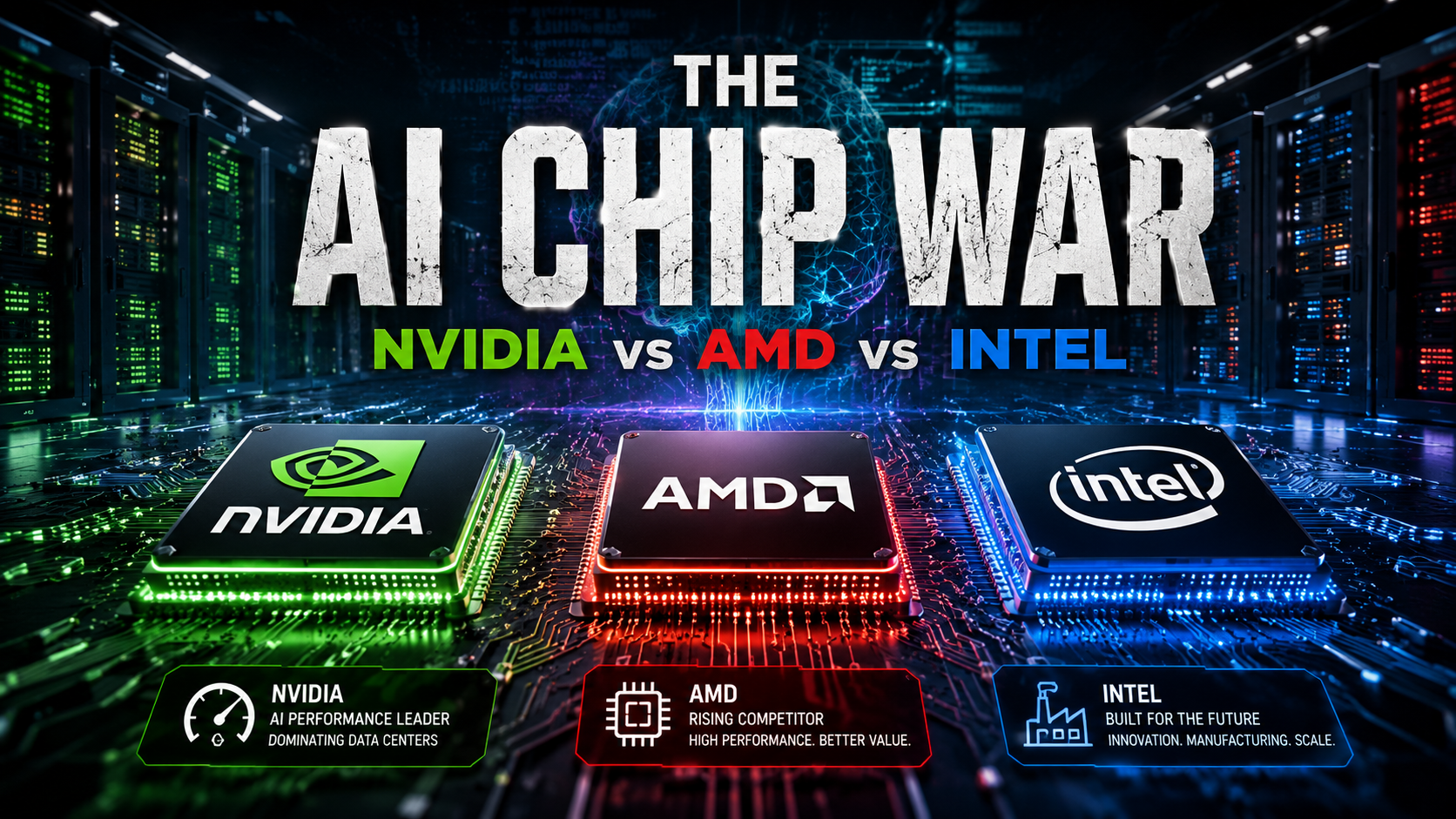
Nvidia, AMD, and Intel are now competing in what analysts call the AI Chip War, a market expected to grow rapidly as AI becomes part of almost every industry. The company that builds the fastest, most efficient AI chips could shape the future of cloud computing, robotics, autonomous vehicles, and generative AI.
Why AI Chips Have Become So Important
Artificial Intelligence requires enormous computing power.
Training a large language model involves processing trillions of calculations. Even running AI assistants like ChatGPT or Copilot requires specialized hardware capable of handling huge workloads with high speed and low latency.
Unlike traditional CPUs, AI workloads depend heavily on GPUs (Graphics Processing Units) and dedicated AI accelerators.
As AI adoption grows, companies are investing hundreds of billions of dollars into data centers filled with these processors. Analysts expect AI accelerators alone to represent one of the fastest-growing segments of the semiconductor industry over the next decade.
Nvidia: The Company Everyone Is Chasing
At the moment, Nvidia remains the undisputed leader.
Its Blackwell GPU platform powers many of the world’s largest AI systems, including infrastructure used by OpenAI, Microsoft, Meta, Oracle, and many cloud providers. The company’s strength goes beyond hardware. Nvidia has spent years building CUDA, networking technologies, and software tools that make it easier for developers to optimize AI workloads.
Nvidia is also expanding beyond GPUs. Its new Vera CPU is designed specifically for AI-native workloads, and companies such as Perplexity have already announced plans to adopt it because of its performance for AI agents. Nvidia expects its CPU business alone to generate billions of dollars in revenue.
Despite increasing competition, Nvidia continues to benefit from enormous demand for AI infrastructure.
AMD Is Closing the Gap
AMD has quietly become Nvidia’s strongest challenger.
Its latest Instinct MI350 series accelerators target AI training and inference with up to 288 GB of HBM3E memory and high memory bandwidth, making them attractive for enterprise AI deployments.
The biggest reason companies are looking at AMD is simple: diversification.
Cloud providers and enterprises do not want to depend entirely on one supplier. AMD offers competitive performance while giving customers another option in a market where AI hardware demand often exceeds supply.
Recent market performance also reflects growing investor confidence, although analysts note AMD still faces a difficult challenge in matching Nvidia’s software ecosystem.
Intel Is Playing the Long Game
Intel may not dominate AI training today, but writing it off would be a mistake.
Instead of fighting Nvidia on every front, Intel is focusing on enterprise AI, edge computing, AI PCs, and manufacturing.
Its Gaudi AI accelerators are designed to provide a cost-effective alternative for AI inference and training, while Intel’s global manufacturing network remains one of its biggest advantages.
As governments invest in domestic semiconductor production, Intel’s manufacturing expertise could become increasingly valuable in the coming years.
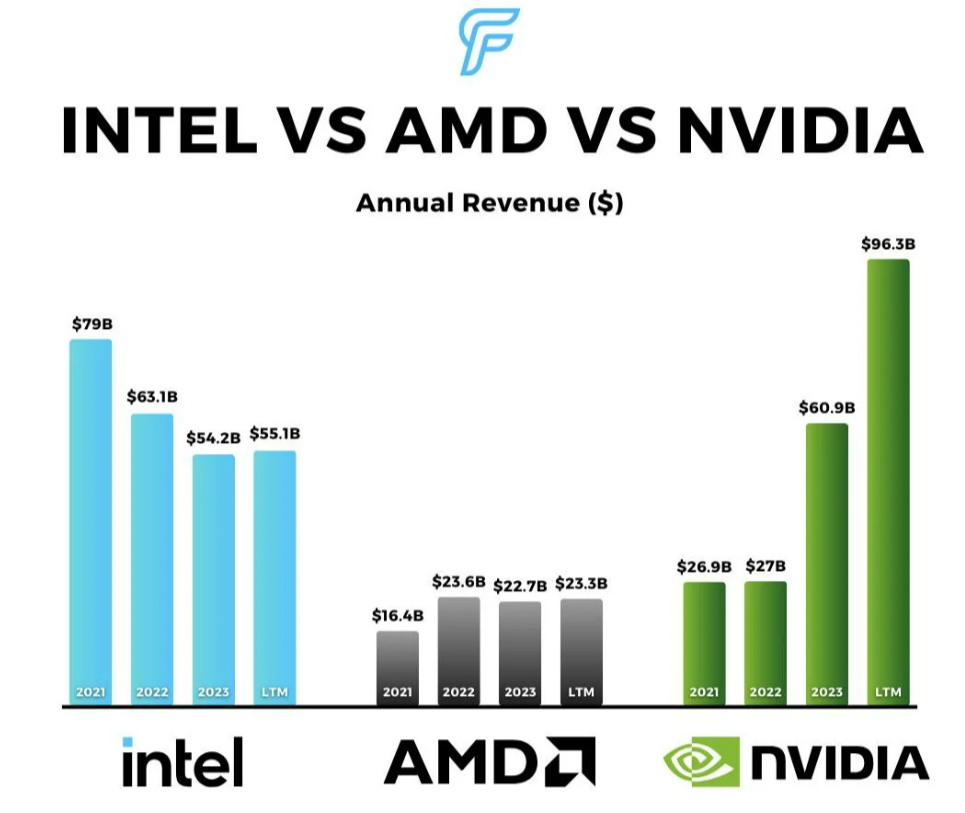
AI Chip Comparison
| Company | Flagship AI Platform | Biggest Strength | Current Challenge |
|---|---|---|---|
| Nvidia | Blackwell + Vera | Industry-leading AI ecosystem, CUDA software, dominant data center presence | Growing competition from custom AI chips and rivals |
| AMD | Instinct MI350 Series | Competitive performance, high-bandwidth memory, attractive pricing | Smaller software ecosystem than Nvidia |
| Intel | Gaudi 3 | Enterprise AI, CPU leadership, semiconductor manufacturing | Lower market share in AI accelerators |
A New Threat: Big Tech Is Building Its Own Chips
The competition is no longer limited to Nvidia, AMD, and Intel.
Meta recently revealed plans to move its next-generation Iris AI chip into production to reduce reliance on external suppliers, while companies such as Google, Amazon, and Microsoft continue investing in custom AI silicon.
This means future AI infrastructure may rely on a combination of Nvidia GPUs, AMD accelerators, Intel processors, and custom chips designed by cloud providers themselves.
What Does This Mean for Developers?
For developers, this competition is good news.
More competition generally leads to:
- Faster AI hardware
- Lower cloud computing costs
- Better AI performance
- More innovation
- Greater choice for startups and enterprises
Instead of one company controlling the future of AI hardware, the market is becoming more competitive, which benefits the entire technology ecosystem.
Final Thoughts
The AI revolution is no longer just about building smarter chatbots. It is about building the infrastructure that powers them.
Nvidia remains the company to beat, thanks to its mature ecosystem and leadership in AI computing. AMD is rapidly gaining ground with competitive AI accelerators, while Intel is betting on enterprise AI and manufacturing strength.
At the same time, companies like Meta, Google, and Amazon are developing their own AI chips, proving that the next chapter of artificial intelligence will be shaped not only by software but also by the silicon underneath it.
The AI chip war has only just begun, and its outcome will influence everything from cloud computing to robotics and the future of generative AI.