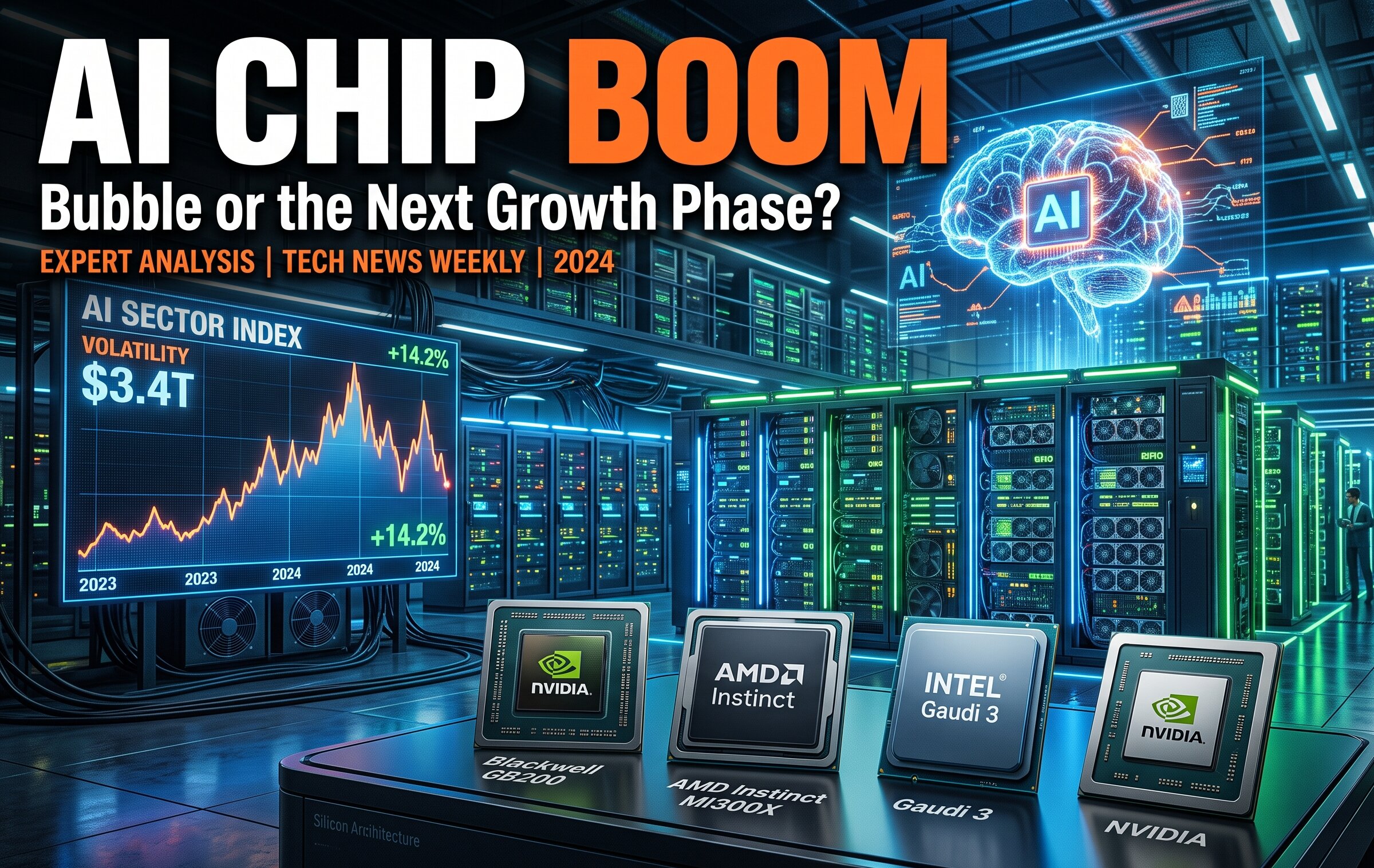
Over the past two years, Artificial Intelligence has transformed the technology industry faster than anyone expected. Companies like Nvidia, AMD, Microsoft, Amazon, Google, and Meta have invested hundreds of billions of dollars in AI infrastructure, data centres, and advanced chips to power the next generation of AI applications.
This massive investment pushed semiconductor companies to record highs. Nvidia became one of the world’s most valuable companies, Samsung reported record profits from AI memory chips, and AI-related stocks attracted huge investor interest.
But recently, the market has become more cautious. Semiconductor stocks have experienced increased volatility, and investors are beginning to ask an important question:
Can AI companies continue spending at this pace, or is the AI investment boom entering a new phase?
Why AI Chips Became the Hottest Business
Every AI model, from ChatGPT to Google’s Gemini, depends on powerful hardware.
Training large AI models requires thousands of GPUs working together inside massive data centers. Along with GPUs, companies also need advanced memory chips, networking equipment, cooling systems, and enormous amounts of electricity.
According to industry estimates, the AI accelerator market is expected to exceed $300 billion in the coming years as demand for AI continues to grow. This has created unprecedented demand for companies that manufacture AI hardware.
Why Investors Are Becoming More Careful
The AI industry is still growing rapidly, but investors are now paying closer attention to one important question:
Will these massive investments generate enough profit?
Companies such as Microsoft, Meta, Amazon, and Google continue to spend billions of dollars building AI infrastructure. While AI adoption is increasing, investors want to see stronger revenue growth from AI products rather than only higher spending.
This change in investor sentiment has caused AI-related semiconductor stocks to become more volatile in recent weeks.
However, market volatility does not necessarily mean the AI boom is ending. Instead, it reflects uncertainty about how quickly companies will recover their enormous investments.
Nvidia Still Leads the AI Race
Despite recent market fluctuations, Nvidia remains the leader in AI computing.
Its GPUs continue to power many of the world’s largest AI platforms, including OpenAI, Microsoft Azure, Meta, and leading cloud providers.
The company’s biggest advantage is not only its hardware but also its software ecosystem, which has taken years to develop.
For now, Nvidia continues to dominate AI infrastructure, although competition from AMD, Intel, and custom AI chips is steadily increasing.
Competition Is Growing
The AI chip market is no longer controlled by a single company.
AMD is expanding its AI accelerator business with the Instinct series, while Intel is focusing on enterprise AI solutions and advanced manufacturing. At the same time, major technology companies such as Google, Amazon, Meta, and Microsoft are designing their own AI chips to reduce dependence on external suppliers. This growing competition is expected to drive innovation, improve performance, and eventually lower AI computing costs.
Market Snapshot
| Company | Current AI Focus | Key Strength |
|---|---|---|
| Nvidia | AI GPUs & Data Centers | Market leader with powerful AI ecosystem |
| AMD | AI Accelerators | High performance and competitive pricing |
| Intel | Enterprise AI & Manufacturing | Strong chip manufacturing capabilities |
| TPU Chips | AI infrastructure for Google services | |
| Meta | Custom AI Chips | Reducing dependence on external suppliers |
What Does This Mean for the Future?
The recent slowdown in semiconductor stocks should not be seen as the end of the AI revolution.
Instead, the market is becoming more realistic. Companies are moving from excitement to execution. Investors now expect AI businesses to demonstrate sustainable growth, profitable products, and long-term returns.
Demand for AI chips remains extremely strong, especially as more industries adopt generative AI, robotics, autonomous vehicles, and intelligent software. The companies that deliver better performance, lower costs, and more energy-efficient chips are likely to lead the next phase of AI innovation.
Final Thoughts
The AI chip boom is entering a more mature stage.
While stock prices may fluctuate and investors become more cautious, the long-term demand for AI hardware continues to grow. Nvidia still leads the market, but AMD, Intel, and custom AI chips from Big Tech are creating stronger competition than ever before.
Rather than signaling the end of AI growth, today’s market reflects a shift toward sustainable investment and long-term innovation. The AI revolution is far from over. The next winners will not simply be the companies spending the most money, but those that can turn that investment into real products, real profits, and real value for businesses and consumers.
Key Takeaways
- AI infrastructure spending remains at record levels despite recent market volatility.
- Nvidia continues to lead the AI chip industry, but AMD and Intel are increasing competition.
- Big Tech companies are investing in custom AI chips to reduce dependence on external suppliers.
- Investors are now focusing on profitability rather than growth alone.
- The long-term outlook for AI chips remains positive as demand for AI applications continues to expand.